Ratnakar has chosen one of my favorite directors, Howard Hawks, for a blogathon May 15-31, 2013. I’ll be writing about THE BIG SLEEP. Will you join us?
Howard Hawks, a name that evokes to me memories of a group of hunters, chasing down a rhino in the wilds of Africa, one of the most epic action scenes ever in movie history. Hatari was the first Howard Hawks movie I saw on the big screen, and was fascinated by the scenes of the animal hunts, especially the rhino capture. And that made me explore some of his earlier movies.
Howard Hawks to me was one of the greats of Hollywood’s Golden era, a man who directed movies that just about covered all genres. He could switch from zany screwball comedies like His Girl Friday to Westerns like Rio Bravo to a noir classic like The Big Sleep with ease. He was not a director you could slot in a specific genre, war, noir, Westerns, big screen adventure, screwball comedies, he just about covered all bases. He was…
I am the first to admit that I have been too busy to actually see a good many of the 2013 nominees, but I still like predicting who will win and lamenting who should win but probably won’t. I haven’t read anyone else’s predictions but I do rely heavily on tweet buzz. I estimate a whopping .5% of the Academy are on Twitter, so we’ll see how that goes.
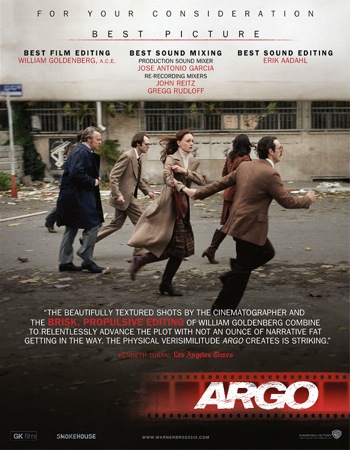
Best Picture — While I’ve seen less than half the nominees in this category, and I suspect that Moonrise Kingdom belongs in it, I’m really happy to see movies from so many different genres get the nod. We’ve got a detective story, a Western, a couple of fantasies, historical drama, a musical, and even a rom-com that shows that two dysfunctional people can have a functional relationship. Not that Silver Linings Playbook is going to win…it looks like that distinction will go to Argo, with which I’m completely happy.
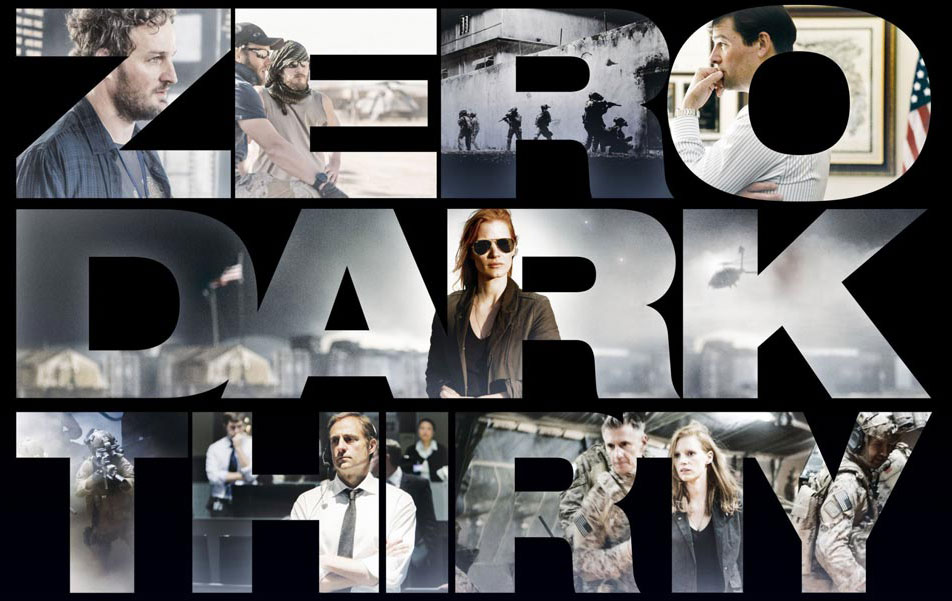
The detective story? Zero Dark Thirty. That’s how I think of it, but sometimes I wonder if I saw the same movie as everyone else. So I’ve really stopped reading anything about it. Yes, it shows torture and that really is bad f*cking news…but it also shows that, whether despite the torture or because of it, terrorist attacks continued. [[Possible spoiler —> Lead agent Maya (Jessica Chastain) gets her initial lead by tricking a suspect. Maya’s boss’s boss George (Mark Strong) sure does get ticked that his team isn’t making more progress. He advocates for more torture and more violence, to no avail. In the end, what does work (in the film anyway) was a methodology worthy of an old episode of Columbo or Agatha Christie’s Miss Marple…cross-checking rediscovered records from Moroccan intelligence. That’s right…bin Laden was found as a result of detective work.]] If this film glorifies torture, then Trainspotting and Requiem for a Dream glorify drugs.
Maybe the reason ZDT is so controversial is because a woman is the lynchpin of the ultimately successful “greatest manhunt in history.” Maybe it’s because Jason Clarke makes Dan, Maya’s colleague who does a lot of torturing, funny and likable, and that makes people uncomfortable (could just be me). Whatever the reason, the controversy surrounding this film has overshadowed its actual merit. There seems to be more outcry against a fictional piece of entertainment than there was against a real-life U.S. policy. Which is sad because it takes a ton of talent to retell a now-familiar story that is more static than dynamic in such an absorbing and visually stunning way. Yet this didn’t even get a nomination for Cinematography.
Actor — Daniel Day Lewis.
Actress — This is between Jessica Chastain and Jennifer Lawrence, with Lawrence winning it. I guess there’s a small chance they’ll cancel each other out and someone else will take home the statuette, but I doubt it. This is Chastain’s second Oscar nomination and sometimes I wonder if she’ll ever win, because her acting seems so effortless and her looks are so timeless. Hopefully those two attributes provide her with a long career.
Supporting Actor — I’d like Christoph Waltz to win but I’m thinking it’s going to be Tommy Lee Jones.
Supporting Actress — Anne Hathaway. I don’t get why there’s so much negativity about her.
Director — Even though I’d rather talk about who isn’t in this category, I have the feeling this is a really close race. Or maybe it works the other way around…the race was so close that not all the worthy could be nominated. At any rate, I predict Steven Spielberg.
Foreign Language Film — I don’t really think there’s any doute about this one...Amour.
Animated Feature — Frankenweenie or Brave. Probably Brave.
Cinematography — I’d like Django Unchained or Skyfall (Bond DP Roger Deakins is a perennial nominee who has never won), but I think Life of Pi.
The winners, the losers, the snubs, the backstories, the gossip, the players and the games… it’s all about Oscar!
The 31 Days of Oscar blogathon, hosted by myself, Aurora of Once Upon A Screen, and Kellee of Outspoken and Freckled, continues. We’ve had two great weeks of submissions covering a wide variety of films from the silent era to this year’s nominees. So if you need more Oscar, you can also check out Week 1 and Week 2.
And now…these are the brilliant Week 3 posts, listed with Twitter handles (where available) so we can all find each other and converse.
Check out my completely random, probably totally wrong 2013 Oscar predictions, including a mini-review of Zero Dark Thirty.
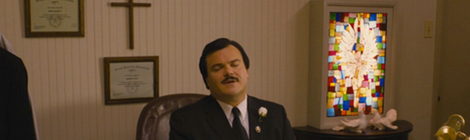
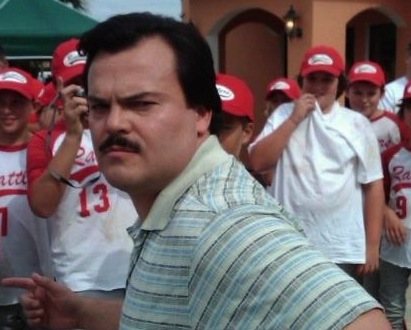
Oscar snubs are pretty much a given. When the Academy made the number of Best Picture nominees variable, it virtually guaranteed them in the Best Director category, and it’s no secret that I think both Ben Affleck and Kathryn Bigelow deserved nods this year. Still, If you haven’t seen Richard Linklater’s Bernie, you probably had to read the title of this post a couple times. But yes, I do believe Jack Black deserved a Best Actor nomination for his performance in the title role.
The film is a genre-defying mix of reality and fiction based on the true story of Bernie Tiede. It blends documentary style interviews, scenes with only actors, and scenes where actors play off real townsfolk playing themselves. Tiede befriended and eventually murdered an elderly woman, Marjorie Nugent (Shirley MacLaine), in Carthage, Texas in the mid-1990s. The character Bernie is unlike any other I’ve seen Black play. To be fair, I’d only seen him in The Holiday, Be Kind Rewind and Year One, in which his characters were all sort of similar, funny, a bit wild, sometimes manic, and seemingly based on himself.
Bernie Tiede is a complete departure. He’s a popular small-town funeral director who favors gospel music, community theater, and the company of women 20 years older than himself. Black becomes Bernie, but his performance isn’t just an imitation of mannerisms and speech. The actor invests the character with enough heart so that, murderer or not, he’s likable. We can relate to Bernie and his apparently innocent desire to help improve the lives of the town’s residents.
First this clip, Black as Bernie:
And an interview with the real Bernie
So why wasn’t Black nominated for an Oscar, despite receiving Golden Globe and Independent Spirit nominations? Part of it is that the Golden Globes have separate comedy/musical categories for Best Picture, Actor and Actress, while comedies are notoriously unpopular with Academy voters. And, because the film didn’t receive a wide release, I think it’s a safe assumption that many Academy members, like many of the moviegoing public, completely missed it. Also, the story unfolds on such a small canvas that it reminded me of Jane Austen’s work, and her description of it as “the little bit (two inches wide) of ivory on which I work with so fine a brush.” Yet, also like Austen’s work, it manages to comment on class conflict, justice, and human nature. How easy for a film like this to get lost in the shuffle of special effects showcases and global-history dramas. Which is really a shame.
When I say playing Bernie Tiede is a departure for Jack Black, I really mean it.
PS: I’ve said before, Bernie is a character study, and boy oh boy, is it ever full of characters. Make sure you watch the credits to see who is acting and who are actual members of the town. I’ve included some clips below in the hope that they’ll convince you to give the film a try:
Matthew McConaughey as Danny Buck Davidson, district attorney in Carthage:
A Carthage resident’s guide to Texas:
Plus, sing along with Bernie on “Love Lifted Me” — this scene is our first sight of Black in the film:
Greetings, all and sundry! When an opportunity arises to indulge in a favorite pasttime. Wax nostalgic about the ins and outs and nuts and bolts of a specific time in cinematic history. Its awards and rewards. You graciously accept and give it your best effort. To that end, I would like to thank Paula for chance to shine some light on…
1973: A Very Good Year in Film
A year that created a lot of controversy as the war in Vietnam was finally winding down and the palette of tastes continued to swell and expand, allowing some well-established talent to prove their mettle, while young upstarts were given the chance to make their mark for future generations.
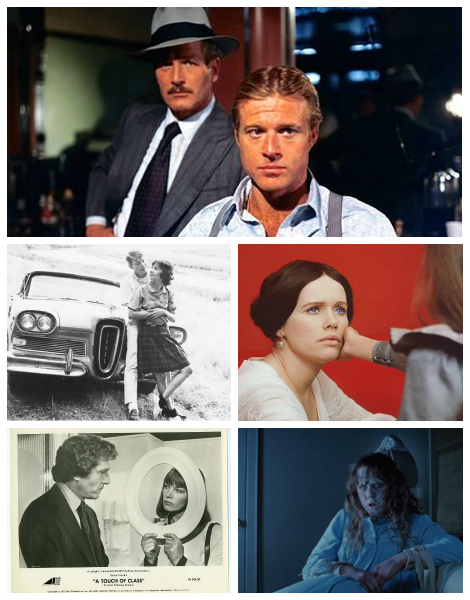
Best Picture 1974, clockwise from top: Winner THE STING; nominees CRIES AND WHISPERS, THE EXORCIST, A TOUCH OF CLASS, and AMERICAN GRAFITTI
Ingmar Bergman weighed in with a familial tome, Cries and Whispers. Which would explore the world of sisters as one is bedridden and slowly deteriorating to cancer in late 1800s Stockholm. Wondrously, sometimes rawly, told in flashbacks of earlier times and sibling rivalry, as the sisters coalesce and slowly retreat and pull apart.
While the previous year’s heavy hitter, William Friedkin, exceeded all expectations. Bought the rights to the worldwide best seller, The Exorcist, and re-wrote the limitations of American Horror. In a film that pulls the audience in and takes them on a ride not soon forgotten. And a fledgling director named George Lucas gave his personal take on rites of manhood and cruising the strip on a warm summer night before college in American Graffiti. A cut in the can, near-documentary benchmark film that would launch countless careers.
Not to be outdone, and to prove that he still had it, Melvin Frank put together a trans-continental, high-end romantic comedy, A Touch of Class. That spans Europe and mixes lush backgrounds and scenery as an affair takes root and flourishes. Placed squarely opposite what many would wrongly perceive to be a forgettable medium-length, low-budget ode to changing times and morals from John G. Avildsen, Save The Tiger. Only to have the field rounded out by George Roy Hill and his offering, The Sting. Which had the trademark look and feel of an old Warner Brothers backlot gangster film. Though highly polished and superbly executed on Universal’s backlots. Brought to life by two of the most handsome and proven actors in Hollywood.
A heady brew, indeed. Five contenders, unique in their own ways, vying for the 1974 Best Picture Academy Award. With the shot callers and odds makers outside the Academy close to tossing their arms up in the air. As quality and story cancelled each other out for the most part. Perhaps, and perhaps not, revealing the value of large ad campaigns as ballots were cast. Not exactly a coin toss, but a process of taking in the myriad details and many memorable moments as a decision is made.
I can’t disagree that The Sting deserves the top slot. Hill directs masterfully with a practiced touch around well and often meticulously detailed sets that somehow always seem smaller than they appear. Not exactly cramped, but compact. Drawing attention to the two leads as they move and share space with a stalwart cast of veterans and soon-to-be-recognized talent. In a tale that boasts no weak spots. Moves fluidly and builds to a delightful payoff. Infinitely watchable. And re-watchable, as only a few key scenes are telegraphed ahead of time. And even those have a pleasant twist.
The category of Best Actor is just as difficult. With Marlon Brando, the odds-on favorite for his role as American expatriate Paul in Last Tango in Paris. Still riding the crest of his role as Don Corleone in The Godfather and being re-introduced to a new generation of audiences. Brando plays an often unlikeable character, a bit too fascinated and fixated on sex. Under the helm of Bernardo Bertolucci. In a film more memorable for its intimate scenes than stunning dialogue.
Followed closely by Jack Nicholson. A soon-to-be household name after his roles in Easy Rider, Five Easy Pieces and Carnal Knowledge. It is in The Last Detail that Nicholson is allowed to push already legendary boundaries. Chew occasional scenery in scenes where he loses it. Keeping the faith as a believable career Navy NCO on a job few want, but needs to be done.Up-and-coming Al Pacino delivered a more than solid performance in Serpico. As New York policeman, Frank Serpico. A career-long honest cop who resisted the temptations of payoffs and worse. Becoming a pariah and shifted from precinct to precinct. Making notable cases, busts and arrests across the boroughs. While gathering information on bad cops and being denied a detective’s gold shield.
Staunch and stoic Jack Lemmon’s name on the ballot may have raised cursory eyebrows. An everyman’s actor just coming into his own. And his Harry Stoner in Save the Tiger has those quiet inner qualities writ large. As the head of a company which mass produces fashions seen on the catwalks of Paris, Milan and London. Suddenly stricken with hard times. In a film that would reveal Mr. Lemmon to be one of America’s great untapped dramatic talents. I’ve no doubt those cursory eyebrows were lifted a bit more with the addition of Robert Redford in The Sting. His often too-cautious Johnny Hooker is one of Redford’s best roles opposite Paul Newman. Though not what I would consider to be Oscar quality.
Many might have been surprised with Mr. Lemmon’s Oscar win for Best Actor, though I wasn’t. I knew his performance as mid-life crisis material Harry Stoner was special after just fifteen minutes of sitting in a near-empty matinee. And that the fix would be in as the final credits rolled. Few actors have been able to open up and reveal the heights and depths of their characters as Mr. Lemmon had. And would again in later films.
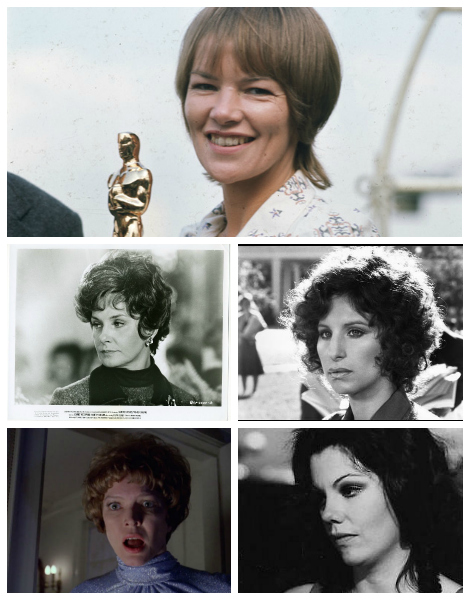
Best Actress 1974, clockwise from top: Winner Glenda Jackson; nominees Barbara Streisand, Marsha Mason, Ellen Burstyn, and Joanne Woodward
Which made the selection of Best Actress only slightly less difficult. With fresh, aspiring faces mixed amongst veterans who always delivered more than was asked or required. With Joanne Woodward exploring and making her mark in fertile fields usually left for Gena Rowlands in Summer Wishes, Winter Dreams. As Rita, a wife on the verge of a nervous breakdown due to empty nest syndrome and wishes that she had married the young man she had a crush on ages ago. One of the first and better “What if?” films of the 1970s. Followed closely by Barbra Streisand’s post-WWII radical chic Katie in The Way We Were tangled up with Navy officer Redford in an “on-again, off-again” relationship under the deft touch of Sydney Pollack.
Offset by Marsha Mason’s hard luck Maggie Paul in Mark Rydell’s Cinderella Liberty. Doing whatever is necessary to her and her ten-year-old mulatto son’s heads above water in the Navy liberty port of Seattle, Washington. While a single mom in Georgetown (Washington DC), Chris MacNeil, played by nearly unknown Ellen Burstyn, copes with her daughter being possessed by Satan in The Exorcist.
Leaving Glenda Jackson several obstacles and egos to clear in her role as George Segal’s “other woman” in A Touch of Class. A nicely detailed return to the earlier sophisticated romantic comedies of 1950s and ’60s. Where wit, adult dialogue and lush sets and backdrops have equal weight with the leads’ chemistry. An odd, almost safe choice for Best Actress at first glance and by today’s standards, though Ms. Jackson and Mr. Segal make the idea of “love at first sight” appear elegant, if not effortless. Even between a divorcée and a married man.
Which brings us to Best Supporting Actors. With Jason Miller and his role as Father Damien in The Exorcist out in front. Mostly, I believe for his ability to respond so well to shock and fear amongst then cutting edge special effects technology and a child’s bedroom kept at below freezing temperatures. Followed close by John Houseman’s Professor Kingsfield in James Bridges’ The Paper Chase. Mr. Houseman made the most of his voice that could easily bounce off the back walls of any enclosed space. Along with enunciation, a near void of contractions to project and surround himself with the aura of omniscient invincibility to a classroom full of aspiring college students.
Leaving plenty of room for Vincent Gardenia to play with his role of old and wizened coach, “Dutch” Schnell, in Bang the Drum Slowly. Though tinged with tragedy, still one of the better baseball films around. And Mr. Gardenia makes the most of his role as the team’s Father Confessor, manager, and mother hen. With veteran Jack Gilford and young upstart Randy Quaid filling whatever space is left with their quiet brilliance. In Mr. Gilford’s case, it’s playing Jack Lemmon’s wise old sage and business partner Phil Green in Save the Tiger.Who, like Mr. Lemmon’s Harry Stoner, just wants another season, but won’t condone arson and insurance money to do it. And Randy Quaid’s oversized, introspective, something of a dullard young sailor, Meadows, makes more than the most of each scene opposite Jack Nicholson. While on their way to Norfolk and its brig for petty theft from a Base Exchange.
A very contentious field. A grand master of projection with Mr. Houseman. Opposite a grounded character actor in Mr. Gardenia and two students of the “Less is more” contingent. A tough choice for Best Supporting Actor, but a proper one, as Mr. Houseman’s haughty, eloquent Professor Kingsfileld in The Paper Chase is awarded the prize.
With ladies demanding equal time. The nominees for Best Supporting Actress are more diverse and eclectic. Peter Bogdanovich’s Paper Moon is double-tapped, with Madeline Kahn’s Trixie Delight and Tatum O’Neal’s Addie Loggins, who may or may not be con man Ryan O’Neal’s Moses Pray’s daughter. Busily wrapping any and all in her way around her little finger. While Trixie offers fresh and often insightful comic relief.
While near complete unknown Linda Blair delivers above and beyond as an adolescent girl with familial problems experiencing a close encounter of the inexplicable kind in The Exorcist. While Sylvia Sidney excels as Woodward’s aged and infirm mother Mrs. Pritchett in Summer Wishes, Winter Dreams. Leaving Candy Clark’s bombshell blonde turn as a tempting Marilyn Monroe beauty behind the wheel of a classic white T-Bird in Lucas’ American Graffiti.
The award of Best Supporting Actress to Tatum O’Neal in Paper Moon came as no real surprise. Though her voice may have grated a time or two. Ms. O’Neal showed great potential and ease of execution in a familial, very family-friendly film. The sum of which reflected Mr. Bogdanovich’s “sit back and let it happen” school of direction.
Overall Consensus:
I’ve long believed that the 1970s were the last great era for films. With many directors taking a path away from the slowly stagnating Hollywood “system” and indulging in ventures that would make or break them and their reputations. And 1973 is a banner year for those pioneers. Who were able to find the talent and money and put it all on the line. As with John Alvidson and Jack Lemmon collaborating in what could and should have been a just under two hour personal ode to changing times and morals that reaped enormous rewards. Especially for screenwriter, Steve Shagan. And just being recognized Marvin Hamlisch and his minimalist score for Save the Tiger.
Add to the mix a young unknown named George Lucas given a fistful of money to start a project, choose his own cast of unknowns who would find fame in later films, shoot through the nights, and cut the film in the can. And start all over again for consecutive nights. While proven directors like William Friedkin and George Roy Hill are given wherewithal to run their films their way. Even if the former’s project, The Exorcist, rubbed many the wrong way at first viewing, and the latter’s The Sting, the second collaboration of Messieurs Newman and Redford, is a superior, cast-driven long con and period piece.
Taken altogether, 1973 was a watershed for directors taking the less-used path. And actors, cinematographers, arrangers, musicians, set designers, and wardrobe technicians applying new ideas and swinging for the fences.
Time for an update on the 31 Days of Oscar blogathon (full rundown at the original post). We’re a little more than a couple of weeks out from the first deadline. Publish your post and email me the link by any one of the following dates: January 31, February 7, February 14, February 21 and February 28.
The nominations were announced on Jan. 10, providing as much fodder for blog posts as any other’s, maybe more. Right away, I was aware of what I consider to be one major snub: Ben Affleck for Argo, and now that I’ve seen Zero Dark Thirty, I think Kathryn Bigelow was snubbed as well. Of course, the format of the Best Picture nominations, where 5-10 movies are tapped, virtually guarantees that there will be snubs. Is the Academy crazy, or crazy like a fox? Sounds like an idea for a blog post, speaking of which here’s some topic prompts (new ones at the end of the list):
Is there a film, performance or art or technical work the non-nomination of which you feel is a crime? Tell us about it.
Sometimes the Oscar seems to hinder, not help, someone’s career, including but not limited to the “Best Supporting Actress Curse.” Discuss.
Spotlight on sound editing and sound mixing, or any other unfairly neglected award.
Your favorite/the most influential Best Costume winners/nominees/should-have-beens through the years, or just focus on one.
Short films are often given short shrift…throw some love on your favorite.
Cinematography and editing vs.directing…the auteur theory, etc. Discuss, using Oscar-winning examples.
The Oscars still create the most hoopla, but should we be paying more attention to other awards, such as the Golden Globes or (fill in the blank)?
NEW:
The Academy’s rules for selection of the Best Picture dictate that any film receiving 5 percent or more of first place votes is nominated, so that a minimum of 5 and a maximum of 10 are in the running each year. This year there are 9 nominees, but there are still only 5 Best Director nods. Discuss the implications and ramifications of this set-up.
Judi Dench famously won a Oscar for her 6 flawless minutes in Shakespeare in Love. If there was an Oscar for cameos, who would be nominated, and who would win?
It’s generally accepted that actors and directors, and possibly other filmmakers, may receive an Oscar for a previous year’s, or an entire career’s, work, sometimes referred to as a “cumulative Oscar.” Do you think this is legit or totally unfair? Discuss.
Academy…why so serious? Certain genres are overlooked every year, generally speaking comedy, adventure, and science fiction are rarely given nods. Is this due to the overall age of the Academy, or other factor(s)?
Final Oscar ballots aren’t due until the Tuesday before Oscar Sunday; this year that is Feb. 19. Any answer to this question is likely to be pure speculation but: Do the other awards influence voting?
The winners, the losers, the snubs, the back stories, the gossip, the players, the games…this time it’s all about Oscar!
We’re back! Myself, Kellee (@IrishJayhawk66) of Outspoken and Freckled, and Aurora (@CitizenScreen) of Once Upon a Screen are hosting a new, mammoth blogathon event that coincides with Turner Classic Movies’ 31 Days of Oscar, February 1 to March 3, 2013. It’ll be a month filled with fabulous tales and screen wonders.
But this one is not just for classic film fare; we want to see and hear it all from the golden man’s more than eighty-year history, up to and including this year’s nominees. And you don’t have to stick to just Best Picture or acting winners. Posts about nominees or winners in all the other categories…Original Screenplay, Costume Design, Cinematography, etc….are more than welcome.
The details:
Let us know what you’ll be writing about by email [paula.guthat[at]gmail.com] or leave us a comment.
Submit links to as many posts as you would like by email or by comments in time for any of the following due dates throughout the month. Submissions should include as much information about you as possible: First name, Twitter username, link(s) to your site(s) and email address.
January 31
February 7
February 14
February 21
February 28
We’ll promote entries for an entire week after each due date. If you have a preferred promotion date, please make a note of that as well. However, we welcome all submissions by any of the dates specified. Don’t forget to include your Twitter handle if you have one.
This is the banner I created for the blogathon. We encourage you display it on your site to help promote this event and cannot wait to hear from you. Happy blogging!
UPDATE: I have so many ideas for this blogathon, far more than I could ever tackle myself, so I offer these as topics for posts or inspiration thereof:
Is there a film, performance or art or technical work the non-nomination of which you feel is a crime? Tell us about it.
Sometimes the Oscar seems to hinder, not help, someone’s career, including but not limited to the “Best Supporting Actress Curse.” Discuss.
Greetings, all and sundry! Being more than a fan and somewhat short of a student of cinema, it is not often that I have been granted the opportunity to wax poetic and in detail about the many building blocks and structures of the fine art of visual storytelling. Directors ride herd and guide projects. Writers, of course. supply the words and the mood. Lead actors are often the heroes and the focus of attention. But what about the myriad other familiar faces in the background?
The faces we recognize either right away, or within a few minutes, after one of their limited number of lines. Not necessarily the fresh-faced, too-young-to-shave kid who gets killed in the last reels of a war film, but the other guy.
The guy who nods sagely to the Sergeant’s or Lieutenant’s words of advice. The kid brother who tries to stop his hot-headed older sibling from seeking revenge on a cattle rustler. The always-smiling Army GI who’s young enough and smart enough to jump at the offer to spend some time off the front lines of the frozen Ardennes forest during the Battle of the Bulge. The quiet blacksmith in a dusty, middle-of-nowhere Texas town. Or one of two twin brothers who sign up for the Marine Corps after Pearl Harbor to fight the “heathen Japanese” in the Pacific islands theater of WWII.
Yeah. That guy! Stocky, Not too tall. Blonde hair. Blue eyes. Sometimes a quick wit, though more often not. A little headstrong. With good hands that can also be fast and righteous. Made for any number of uniforms. Or jeans, a flannel shirt, and a sweat-stained Stetson or baseball cap. You’ve seen him in many films. And remember him fondly in one or two, but can’t place his name. Well, let me tighten up your memory receptors and critique one of his best and most memorable roles.
Richard Jaeckel: Sgt. Bowren. Top Kick of ‘The Dirty Dozen’.
First seen in full Garrison uniform, pistol belt, sidearm and white MP helmet liner. Jaeckel’s Sgt. Bowren brooks little nonsense when lining up twelve diverse convicts for his new boss, Major Reisman (Lee Marvin). Then introducing the good Major to each after the twelve have dressed and covered according to height. Reading names and sentences that range from decades of hard labor to death by hanging. After a failed attempt at close order drill, caused by upstart Victor Franko (John Cassavetes) and an appropriate thumping by the Major. The remainder show a renewed attention to commands. Giving the first glimmers of light to the possibility that the Major may just be able to pull this cockamamie idea off.
Reinforced a bit more as the Major conducts face to face interviews and asks what Bowren thinks. Sgt. Bowren answers the way he thinks the Major wants, And the Major tells him to try again. Bowren replies, ” I think the first chance one of those lovers gets, he’s going to shoot the Major right in the head… sir.”
The two understand each other a bit more. As Bowren later chastises one of his own MPs for an off color remark made to R.T.Jefferson (Jim Brown). An African-American awaiting the gallows for killing a white man who had tried to lynch him. Then responding to a ruckus between the convicts in the prison gym. Brought on by Maggot’s (Telly Savalas) use of the ‘N word’ regarding Jefferson. Only to be delayed by Major Reisman, who explains that those involved are discussing seating arrangements and place settings. Sgt. Bowren picks up on the implied message and starts an impromptu discussion about baseball as the convicts noisily work their aggressions out.
And Sgt. Bowren begins to slowly evolve into the Major’s bodyguard. Official watcher of the convicts during training and off site compound’s layout and construction. As well as taking on the role of Major Reisman’s unofficial enforcer and Executive Officer. Always close by with his hand covering his flap holstered .45 should things get a little tense between the Major and his convicts. Or to add strength to his boss’s directive that the convicts will no longer shave, bathe or have hot food or hot water, courtesy of Victor Franko. Pointing out that the saved time will be devoted to training and sarcastically coming up with the colloquial, ‘Dirty Dozen’.
About the only time Sgt. Bowren falters is when the convicts are sent to another base for parachute training and Pinkley (Donald Sutherland) embarrasses Colonel Everett Dasher Breed (Robert Ryan). West Point graduate and ring knocker during an inspection of his troops. The Colonel wants to know more after three of his biggest and baddest fail to get answers from Wladislaw (Charles Bronson) alone in a latrine. Jefferson and Posey (Clint Walker) intercede. Jefferson breaks one of the goon’s hand and jaw with his helmet. While Wladislaw and Posey
leave the other two unconscious. The explanation for Wladislaw’s bruises? “He slipped on a bar of soap”.
Infuriated, Colonel Breed and a squad of armed paratroopers storm the convicts’ compound and disarm Sgt Bowren at its drop gate, Though he does get some satisfaction after Major Reisman infiltrates the compound. And stops Breed and his men in their tracks with aimed bursts of fire from an M-3 Grease Gun. Bowren unleashes his convicts to get some payback. Admiring their measured use of force and working as a team as paratroop are left muddied, hurt and their weapons piled neatly out of reach. All prelude to a ‘Graduation Party’ for the convicts, a live fire exercise, attached as an independent unit. Whose objective is capturing Colonel Breed and his staff. And their final mission…
What does Jaeckel’s Sgt. Bowren bring to the film?
A much-needed and well-executed dash of maturity and adherence to rules. As displayed in his well-turned-out Garrison uniform, tie, Ike jacket and bloused, and polished boots. Someone who is proud of his profession and rank. And shows it. Not exactly a ‘Lifer’, but one who adapts to changing situations and keeps ahead of the curve. Until Major Reisman shows up and the twelve convicts are led out to the prison’s small exercise yard.
Sgt. Bowren does what he can to maintain order among the lackadaisical convicts. Who think they have the upper hand until Franko makes a jail house lawyer fool of himself before the unamused OSS (Office of Strategic Services. Forerunner of the CIA) Major Reisman. And every thing changes. Unit cohesion starts to make itself known and Bowren can use that and build on it as he is given more autonomy. Progress is slow and Bowren remains aloof until at least an effort is made to rise close to his and the Army’s standards. Which begins with Franko’s
revolt and its resulting lack of hot food and water. And ends with the take down of Colonel Breed and his troopers.
A small role, but an essential one, to be sure. With time well divided out amongst a grounded, diverse and memorable ensemble cast. In one of the better character driven WWII films of the 1970s. That added another notch on the resume and body of work of one of the late, great, grand masters in the firmament of character actors!
Happy Monday! It’s difficult to believe it’s already Day 3 of the WHAT A CHARACTER! blogathon.
The WAC blogathon, hosted by myself, Kellee of Outspoken and Freckled, and Aurora of Once Upon A Screen, is our tribute to those supporting players who manage to steal nearly every scene of the classic movie they’re in, but didn’t always get their due in terms of fame, money, or awards.
Although most never played leading roles, we look forward to their appearances — as the butler, the maid, the hotel manager, or the ever-loyal best friend — almost as much as those of the major stars, or in some cases, even more. Today’s posts honor the following lesser-known, but well-loved, thespians:







 Paula's Cinema Club