Joel McCrea is TCM”s Star of the Month for May 2012 and I admit I hadn’t really given him much thought. But sometimes all it takes to appreciate someone’s work is further exposure to it, and so it is with McCrea. He has a mellow, old-fashioned all-American quality that is really growing on me. He is really good in Espionage Agent (1939) as the diplomat whose wife (Brenda Marshall) has been forced into spying for the Nazis in the early part of WWII, before the US entered the war.
The film has the same producer as Casablanca, Hal Wallis, and it shares an anti-isolationist perspective with that picture and with Foreign Correspondent, which also starred McCrea. Agent is like a cross between Correspondent, Night Train to Munich and Confessions of a Nazi Spy. No wonder I really liked it.
What I also really dig about this film is the typography. It’s just really lovely. Espionage Agent isn’t available on video in any format…maybe Warner Archive will release it someday…for now we’ll have to rely on photos of my TV that I took with my phone.
Dreams Within Dreams Within Dreams…Fights in a Spinning Hotel Lobby…LEONARDO DICAPRIO!!
These are some of the many reasons why I believe that Inception will end up being a Future Classic Movie. When the movie first came out a couple of summers ago, everyone flocked to the theaters to catch it due to the super-mysterious plot at the time and mainly because of this being the first follow-up of director Chrstopher Nolan’s since this little old flick called The Dark Knight came. But once the dust settled at this film’s exciting conclusion (oh…darn you spinning top!), the conversations and endless debates on its plot details never seemed to stop.
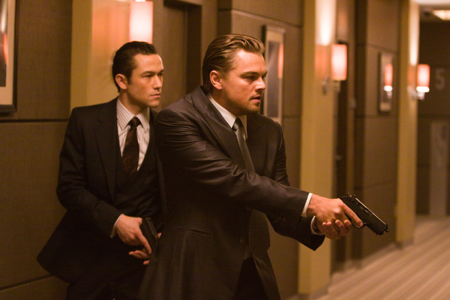
Joseph Gordon-Levitt and Leonardo diCaprio in INCEPTION
Instead of being a one-note, too gimmick-ridden film, Inception proved to be a multi-layered film that still drives multiple repeat viewings (with no pun about its main dream plot intended). On top of this, its clever odes to the action, sci-fi, and psychological thriller genres help this go a long way in being a good long-term future classic movie that never seems to get old. Inception to me will definitely be one of those awesome flicks to turn on 10, 20 years from now and be a good way to spend a Sunday afternoon.
Along with Inception playing on a future classic movie channel, the one person who I strangely see taking on hosting duties on movie marathons in the future is actor/comedian Joel McHale of The Soup and Community fame. The man may not a super well-known respected actor and is currently just really known for drawing up goofy laughs, but I see that his years of being a good steady host on Soup could one day translate to a neat little side soundtrack for a nice afternoon movie marathon.
Given the premise of what film and cinema may look like 40 years hence, I’ll opt for the convenience of handheld devices, flatscreen home entertainment centers and personal 3-D glasses, now that the very first, infant steps of the future Blue Sun Consortium so well-loved in Firefly has put out a bid for the AMC chain of theaters here in the U.S.
Now, as to what cinephiles, movie buffs and assorted hormonally-driven teens will want to view. The sky and its opposite end of the spectrum are the limit. Though Classics will always be present to fall back on. Be it for nostalgia sake. Or just to sit back and experience what good really is and can be. There will always be a healthy clutch of films in dust laden cans ready to be spun up on a projector. Or taken to a lab to be cleaned up, re-mastered and brought back to life in whatever form of medium is in use at the time.
To that end, allow me to prognosticate and put forth three choices for what may be viewed and enjoyed by those of all ages in the future.
Bringing Up Baby (1938)
The definition of screwball comedies of the 20th century stars Cary Grant as David Huxley, a clumsy, mild-mannered paleontologist with Harold Lloyd glasses. Deep in the Sisyphian task of assembling the skeleton of an ancient Brontosaurus, David only needs one bone to complete the task. To add to his stress, David is engaged and soon to be wed to a woman of means whose family can supply extra funding for David’s museum.
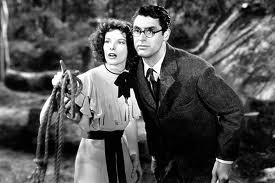
Cary Grant gets mixed up with Katharine Hepburn and her zipper in BRINGING UP BABY
Seeking surcease, David decides to play some golf the next day and meets a striking, fast-talking Katherine Hepburn as Susan Vance, madcap extraordinaire and niece of his future mother-in-law. Susan plays by her own rules and speaks her mind. The repartee between David and Susan is as over-layered, stepped-on, and Hawksian as it is flat-out hilarious! With David constantly trying to catch up when to two meet again at a resplendent, elegant restaurant and night club.
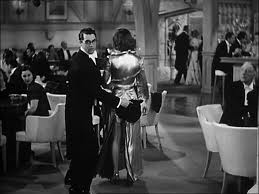
Rapid-fire banter turns into a whispered argument that segues into an accidentally ripped and torn skirt of Susan’s evening gown. Which David tries to cover as best he can with his top hat and quick turns as they seek club’s front door. For a quick trip to Susan’s family’s palatial manse and manicured grounds. Where David is introduced to kith and kin, including a leopard from Brazil named ‘Baby’ and a terrier named ‘George,’ who slyly buried the essential Brontosaurus bone the ‘intercostal clavicle’ somewhere beyond the house while ‘Baby’ ambles away into the night.
Desperately seeking George
What follows is a primer on comedic timing, quips, pratfalls and stalking through foggy woods and narrow streams. Interspersed with choruses of “I Can’t Give You Anything But Love” which Baby likes, as David and Susan search high and low. Accidentally break windows while seeking assistance. Run afoul of the law and are locked up in the Constabulary’s jail. Where Susan takes on the voice, slang and body language of a gangster’s moll. An incredibly funny few moments that involve a second leopard and mistaken identities. Until a friend of the family arrives and straightens things out.
David goes his way. Susan and Baby go theirs. The intercostal clavicle is recovered and Susan takes it to a now busy David high atop the incomplete Brontosaurus on tall scaffolding to make amends. When Susan sees a nearby flimsy ladder…
Casablanca (1942)
The film that solidified Humphrey Bogart as a romantic leading man still manages to pack a heck of a lot of story and tell it well within its 102 minutes. Wondrously crowded, well designed and executed sets transport to a stylized Morocco, Casablanca, its shadowy casbahs and Rick’s Cafe Americain. The hub of all things curious and worth noting by the Vichy constabulary and its German occupiers.
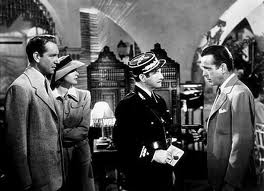
Paul Henreid, Ingrid Bergman, Claude Rains and Humphrey Bogart in CASABLANCA
Bogart plays Rick Blaine, expatriate American cafe and casino owner with a fixed roulette wheel that pays on 22. Who drinks alone, plays chess against himself. Has few friends. Is rarely impressed. While exuding an air of supreme clever confidence. Master of his own fate in a corner of the world where suspicion runs rampant and others beg, borrow and steal for exit visas and a way out.
Enter into this world skullduggery, Ilsa Lund. Spectacularly gorgeous Ingrid Bergman. Rick’s old flame from happier times in Paris, just before the Germans rolled in. Unfortunately, Ilsa has brought her husband along. Suave and elegant Victor Laszlo. Leader of the Free French movement and Public Enemy #1 of Conrad Veidt’s Major Heinrich Strasser and his minions. Who would be quite content to keep Ilsa and Victor right where they are.
Who, but director Michael Curtiz and writers Philip and Julian Epstein could wrap a deliciously moody love story around this foundation? As Rick politely reintroduces himself to Ilsa. Sparks flare to life. Aware that she and Victor are in need of a pair of exit visas that Rick possesses. The possibilities are endless as emotions sway. I’ll leave it right there for you to draw your own conclusions.
Goodfellas (1990)
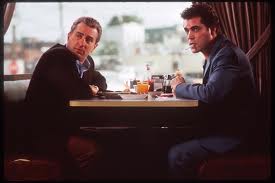
The life of Henry Hill. A Brooklyn kid who says, “As far back as I can remember. I always wanted to be a gangster,” is given the full blown Martin Scorsese treatment. In full blown, lush color. From Henry’s early years hanging out on street corners and parking cars for the meetings of made men he idolized. To huge tips being taken under the wing of slow moving, always cautious ‘Paulie’ Cicero. Henry climbs up the lower tiers of organized crime. Befriending a young young Joe Pesci giving wondrous psychotic life to Tommy DeVito and his friend, Jimmy ‘The Gent’ Conway, played with low-key deliberation by Robert De Niro.
Robert De Niro and Ray Liotta in GOODFELLAS
Life is good as Henry dumps school in favor of selling hijacked cigarettes to any and all. Until he is arrested for the first of several times. Surprisingly, the pinch helps rather than hinders Henry’s slow, yet steady climb up the criminal corporate ladder. Henry, now played by a smooth faced, lean Ray Liotta is all style and flash, but not a lot of substance. Part of Jimmy’s crew, Henry learns the ins and outs of the finer points of hijacking semi tractor trailers along the New Jersey Turnpike. When not robbing Idlewild Airport of its employees’ payroll. or burning down restaurants or clubs slowly taken over by Paulie and his friends.
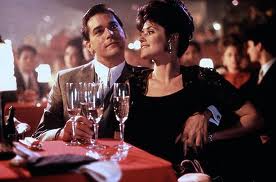
Henry falls in loves with, pursues and courts Karen. A stunning Lorraine Bracco with visits to famed New York nightclubs. Filmed in Steady Cam from the rear entrance. Through the kitchens and to a quickly laid out ringside table in time for Henny Youngman and complimentary champagne. Then taking the time to brutally beat a competitor close to death with a pistol who. Making Karen an accessory after the fact, by giving her the pistol to hide.
Ray Liotta and Lorraine Bracco enjoy the good times in GOODFELLAS
The good life continues. Henry marries Karen. The money rolls in and heists get bigger and bigger. Until one night when a made man runs afoul of Tommy. Is killed messily and buried somewhere Upstate. Then exhumed six months later when Jimmy finds out the land is going to be developed. The wheels start to come off. As Henry takes a mistress and Karen finds out. Threats are made and Paulie tells Henry to get back with Karen. Henry does. Then he and Jimmy go down to Florida to collect some betting markers and draw a delayed bust from the FBI.
Henry discovers drugs behind bars, though life there is better than for most. Against Paulie’s wishes, he continues in the trade as a major heist goes bad. And those involved get very sloppy and spend very conspicuously. Then pay for it rather sloppily to the strains of ‘Layla’ by Derek and the Dominoes. I’ll end it here, lest I get into Spoiler Territory.
Overall consensus
I’ve chosen three films which have stood the test of time. Masterpieces assembled by directors with the clout and ability to get superior writers, cinematographers, set designers. Then turn it all over to superior casts anxious to make their marks. Creating benchmarks that have aged well and improved with time. And will be amongst the first chosen decades from now.
What do you think of Jack’s picks? Are there other films that are already considered classics now and will remain so?
To recap really quickly, the Future Classic Movies (FCM) Blogathon involves predicting films that will still be drawing audiences on TV, or a chip in our brains, or whatever form of communication exists, 30 or 40 years from now. The vast majority of the posts involve films made during or after 2000; these will be as old then as the ones we watch on TCM now.
My FCM pick is The Artist (2011). Regular readers of this blog know that I adore this film. It is a little miracle — a silent film premiering in the 21st century. It was made by people who really love movies and stocked their film with tons of homages, tributes and shoutouts to the classics. It has romance, humor, suspense and melancholy. The acting in it is superb. It was beautifully written, art-directed, and shot. There is something about it that makes me cry every time I see it. (I’ve actually plunked money down to see this three times. Once I was actually on vacation.) It was nominated for 10 Academy Awards, and it won five: Best Director, Best Picture, Best Costume Design, Best Score and Best Actor. But none of these reasons are why I chose this film to endure into the middle of this unpredictable 21st century and beyond.
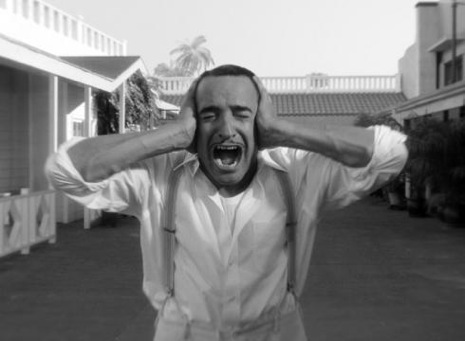
Sometimes it’s all a little too much…Jean du Jardin as George Valentin
Every day our lives get a little more complicated and a little more technological. As recently as 2006, the vast majority people had only a vague idea of what Facebook was. No one had heard the term “social media.” Phones were decidedly dumb; they made calls, and that was about it, at least in the US, where SMS hadn’t yet caught on. Now billions of people are using social media every day. Approximately 20,000 tweets go out every 10 seconds. You can watch a movie, video-chat with someone on the other side of the world, or run a business, all from a smartphone. And the pace of new technology only seems to accelerate rapidly. Economically, the upheaval of 2008 seems to have stabilized somewhat but lots of people lost their jobs and homes, and technology is ending some jobs and creating others. Everything in life is changing so quickly that the term “radical transformation” comes to mind, although nothing is happening quite that fast. I love all the technology, but sometimes even I feel a little overwhelmed, a little bit blindsided…a little bit like George Valentin. He would understand if he was here, because this is what The Artist is at least in part about: coping with change. (It’s about love, loyalty, friendship, the creative process, paying it forward, and really great shoes as well. But I digress.)
The world the characters inhabit is completely shaken with the advent of sound, and they each provide an example of a different coping strategy, from stubborn disregard (George) to grudging acceptance and pragmatism (Al Zimmer, the director played by John Goodman) to leveraging new opportunities that open up and helping others to reconcile themselves with a new reality (Peppy). We’ll all have to adapt, and since we’ll be adapting well into the foreseeable future, this film is always going to be relatable and relevant. There’s a few people out there who didn’t like this film. To those people I say, get used to it…The Artist isn’t going anywhere, and neither are the rest of these picks, all films that I believe will persevere:
Many thanks to everyone who participated in the very first blogathon I’ve ever run. I hope you had as much fun writing these as I did reading them. To paraphrase a title…there will be more 🙂
Ruth over at Flix Chatter has had another great blogathon idea, this time in honor of Gregory Peck, who would have been 96 (if my math is right) today, April 5. Her birthday tribute post: Beauty is Forever: Happy Birthday, Gregory Peck.
As my tribute, I’ve chosen to review one of my favorite WWII movies, The Guns of Navarone (1961). A lot of my love is due to Peck’s presence. He won his acting Oscar in 1963 playing the world’s greatest fictional Dad, Atticus Finch in To Kill A Mockingbird, and I believe that his character in Navarone, Mallory, may just be the world’s greatest commanding officer.
The basic idea of the film is that an Allied special forces team is sent to destroy two gigantic Nazi guns high up on a mountainous island in Greece. They must complete their mission in 6 days, before a British navy convoy is due to go through the nearby straits. If the guns are still operational, the ships will certainly be destroyed, and all the men on them killed. The odds, of course, are stacked against the team, and to a certain extent, they were stacked against the film. There were several screenwriters and a few directors working on it, so that the script changed from day to day, until J. Lee Thompson took over direction and Carl Foreman the script. David Niven cut his lip filming the boat scene in the studio water tank and developed a life-threatening infection. (PS: You’d never know the scene was filmed in a tank. Not for nothing did Navarone win the Oscar for Best Special Effects.)
There is a still center in all this chaos, and that is Gregory Peck. His character, Keith Mallory, known as “The Human Fly” for his extraordinary climbing abilities, is hoodwinked into leading the mission by the promise of leave and promotion. That, and the knowledge that if he doesn’t, 2,000 British soldiers will die. Although he states quite plainly, “I think the operation is insane,” he goes ahead with it. I don’t think it’s much of a stretch to say Corporal Miller the explosives expert (David Niven) is a bit of a malcontent. Greek assassin Andreas (Anthony Quinn) has sworn to kill Mallory after the war, and there’s spies and traitors along the way. Mallory puts up with quite a bit from his team, and the enemy, and only really loses his temper once.
Gregory Peck in disguise in The Guns of Navarone
The decency and authority that Peck brings so believably to the role, two years before Mockingbird, helps to focus attention on the film’s meditations on the nature of war. It isn’t that Mallory won’t kill anyone. It’s just that he won’t do it indiscriminately. His presence throws many questions into sharper relief. Questions like, When is it acceptable to kill someone? Is torture OK? Is revenge? How about executing a female traitor? Is it OK to send men on a suicidal mission? Not that Navarone devotes a lot of time to agonizing over this stuff…it’s an action picture, and Peck handles all of that well too.
Another fun fact I learned while watching this film on TCM…host with the most Robert Osborne recounted Niven’s claim that Peck could drink brandy all day (to stay warm) and “never drop a line.” Niven referred to this talent as “disgusting,” but I think it’s only remarkably appropriate for Gregory Peck.
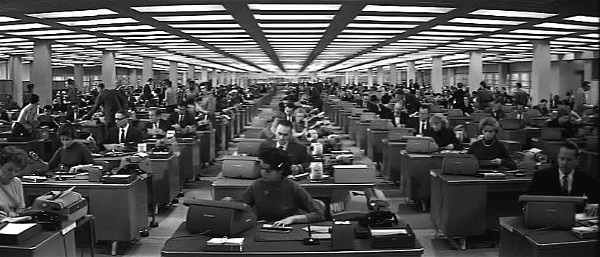
With the 2012 Oscars less than a week away, Ruth at Flix Chatter came up with an amazing idea: A bunch of bloggers each pick a past year’s Best Picture winner and defend (or not) its merits and win-worthiness. I chose the year 1961. There’s no question that the Best Picture Oscar race that year was an interesting one. All the films in the contest had mighty talent behind and in front of the camera; some had sweeping scope, literary sources, and/or exotic locations. The eventual winner, The Apartment, relied on a deceptively simple concept and a very focused, contemporary setting to work its magic. The apartment of the title is that owned by C.C. “Bud” Baxter (Jack Lemmon), one of thousands of workers at the bottom of the pecking order at a giant insurance company in New York City. So many people work in the company’s offices that the start and stop times of the business day are staggered, so that there isn’t too massive of a crowd trying to catch the elevators at the same time.
At some point before the movie begins, Bud had lent the key to his conveniently located residence to one of the office higher-ups. Soon the key was in high demand by married execs who needed a place to entertain their mistresses. Bud doesn’t want to rock the boat, and he does want to get ahead, so he’s agreed to every request. Not that it’s easy on him. Bud has to find something else to do between the end of the business day and 8 p.m., when his “tenants” are supposed to be out. They eat all his food, drink all his booze, and leave their dirty dishes around. It seems he’s got it made, though, when he gets promoted after the execs give him rave reviews. Called upstairs to see the sleazy vice president of personnel, Jeff Sheldrake (Fred MacMurray), Bud receives a promotion, complete with an office that has a window. There is only one condition…Bud must now loan his key exclusively to Sheldrake, which Bud agrees to do. Soon after, Bud discovers that the lovely company elevator operator Fran Kubelik (Shirley MacLaine) is Sheldrake’s mistress. Although Bud hasn’t quite figured it out yet, he is in love with Fran. When circumstances throw them together, his life really gets complicated.
Anonymous corporate office life, c. 1959
Billy Wilder directed and co-wrote the film and much of the time it has the trademark seriocomic vibe of another Best Picture nominee he wrote and directed, Sunset Blvd. (1950). The Apartment is both a satire of American corporate society, which seems not to have changed much since the late ’50s/early ’60s, and a charming, bittersweet romantic comedy. Wilder uses stunning wide shots of hundreds of desks or a seemingly endless park bench to emphasize the anonymity and facelessness of modern life, while using tight shots to signal the growing intimacy between Bud and Fran. His script laid the groundwork for really memorable, three-dimensional characters. The acting is uniformly great; Lemmon and MacLaine, who have some of the best chemistry ever, are perfect as two neurotics who take a while to realize they’re meant for each other. Fred MacMurray is astonishingly effective as one of the worst cads in a movie ever.
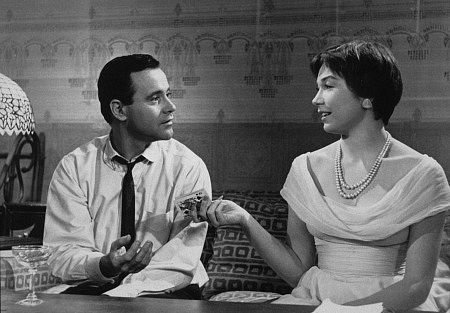
Shut up and deal: Jack Lemmon as Bud, Shirley MacLaine as Fran
The Academy recognized The Apartment with 10 Oscar nominations, of which it won Best Picture, Director, Screenplay (Written for the Screen), Art Direction, and Editing. Lemmon and MacLaine were both nominated as well, but competition was tough that year. Burt Lancaster, Trevor Howard, Laurence Olivier, and Spencer Tracy received nods for Best Actor, while MacLaine contended with Elizabeth Taylor, Greer Garson, Deborah Kerr, and Melina Mercouri. (Lancaster and Taylor were the winners. MacMurray wasn’t nominated at all, which I find inexplicable.)
In the Best Picture category, The Apartment faced formidable competition from four other excellent films, all of which were set in the past: The Alamo in 1836 Texas, Elmer Gantry in small-town America in 1927, Sons and Lovers in London and Welsh coal mines in the early 20th century, and The Sundowners in 1920s Australia. And I would argue that, The Apartment, set in contemporary New York City, deserved to win, because it has retained its relevance and has the most to say about modern American life.
The questions dealt with in The Apartment — What are you willing to give up to get ahead? Which is more important, love or money? — resonate in everyday life possibly even more today. It’s easy to see oneself in Bud, Fran or possibly even Sheldrake (though I hope not the latter). Even more people are working in offices than in 1960 and can readily relate to its situations and dilemmas. If anything, corporations are even larger and more faceless, and even more depends on a person’s ability to survive workplace politics, doublespeak and backstabbing. If, God forbid, anyone wanted to do a remake set in the 21st century, a different location, a few mobile phones, and some laptops would be all that is necessary to update it.* Yes, elevator operators and giant metal adding machines are a rare sight in 2012. But greed, manipulation, deception, and infidelity, as well as love, friendship, and generosity are all still alive and well. And the small scale and everyday setting of The Apartment makes its comedy and wisdom universal. Oscar-wise, The Apartment was a great choice.
*The location change is absolutely necessary because I don’t believe there is any way an entry-level employee could afford a place in the west Sixties, just half a block from Central Park, but I am told that wild Christmas parties still occur, though I’ve never been to one.
In my 2011 Year-End List, I chose The Artist as one of the 2011 movies I was dying to see but couldn’t until 2012. Well, I did get to see it — twice! — and I have to say it’s one of my favorite movies of last year…this year…any year. I even modified my banner…yeah, it’s that good.
The film offers a special thrill for fans of classic movies, because it pays tribute to them, yet it’s thoroughly modern. Without giving too much away, I noted homages to classics like Sunset Boulevard, A Star Is Born, and Singing in the Rain (see below). Director Michel Hazanavicius shot at 22 frames per second, instead of the standard 24, to give the film a little of the jumpiness so characteristic of silent movies. Music is used more centrally than in a sound film, to emphasize moods or events. But the way sound is used and the way shots are framed are thoroughly 21st century. Also, it is a rare silent that has the high contrast of the deep blacks and crisp whites that Hazanavicius and his DP, Guilllaume Schiffman, were able to produce. I don’t want to say too much because I want everyone to see this movie on the big screen if possible…but even at home, it’ll still be stunning.
I so love seeing a movie made by people who love classic movies that I decided to try to put all the references I could think of together. NB: I have a complex about spoiling things for people…I hate to do it! So: There may be spoilers below…if you haven’t seen The Artist you might want to wait until you see it…and then come back and add the movie references you find! I know I’ve missed some.
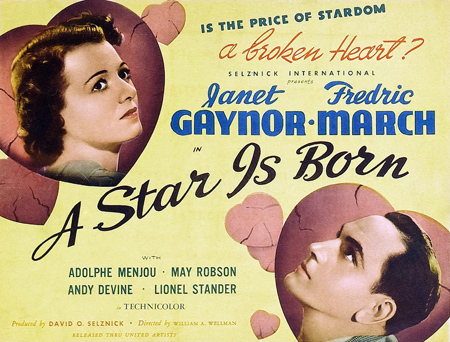
Poster - A Star Is Born (1937)
The basic idea that propels the film is familiar to viewers of all three versions of A Star Is Born: a young woman who wants to be an actress (Peppy Miller, played by Bérénice Bejo) works her way up from extra to top-billed talent, aided greatly by an established actor (George Valentin, played by Jean Dujardin), whom she meets in a chance encounter. Her career skyrockets while his is fading. TCM is running the 1937 and 1954 versions of Star on Feb. 26, so if there are any more specific points in common I’ve missed, I might be able to pick them up then.
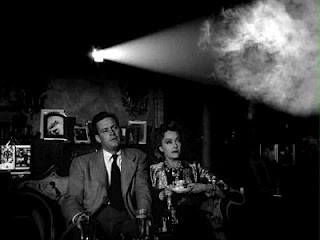
Joe Gillis (William Holden) and Norma Desmond (Gloria Swanson) in the screening room
The Artist shares a thread with Sunset Boulevard: The proud (though faded) star who is disdainful of change and has a kind chauffeur. Like Norma Desmond (silent star Gloria Swanson), George Valentin has no use for talkies. Both like to relive their pre-talkie glory days by watching their old movies. I can see him nodding vigorously in agreement as she declaims, “I am big. It’s the pictures that got small” or “We didn’t need dialogue. We had faces!” Unlike the protagonists in the above-named films, thank goodness George is ultimately a more sane and hopeful figure.
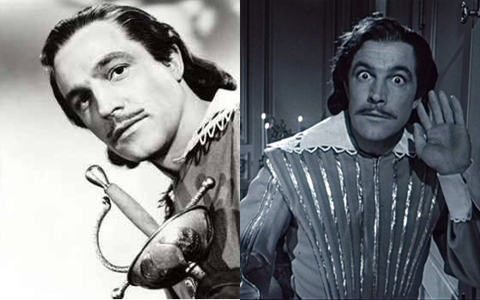
The Artist takes place at around the same time Singin’ in the Rain is set, and in the same context, and there are quite a few similarities between the two films. Like Don Lockwood (Gene Kelly), George has an acting partner, Constance (Missi Pyle), whose transition to talkies was rough. Her sound test reminded me a lot of the work done by Lina Lamont (Jean Hagen) in Singin’ (above). Kelly as an actor seems to have been a major influence. Dujardin gives George the same athletic style of movement as Kelly. I wish I could have found a still of Dujardin in the swordfight scene; with the thin moustache. he really resembles Kelly as D’Artagnan in The Three Musketeers (1948) or in The Dueling Cavalier (the movie within a movie in Singin’).
Early in The Artist, the scene where George is having breakfast with his disapproving soon-to-be ex-wife Doris (Penelope Ann Miller) references the breakfast montage in Citizen Kane. Hazanavicius’ use of mirrors reminds me a lot of Kane. Also, when George finds a room full of belongings that he had to sell (that’s all I’m going to say), it reminded me of the shot at the end of Kane, depicting the dead man’s vast and largely meaningless collection of stuff.
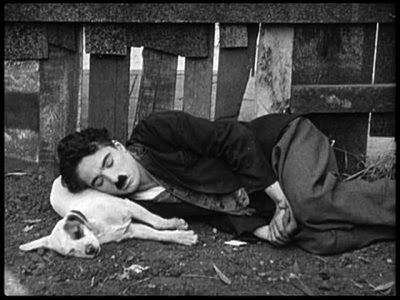
In Charlie Chaplin’s A Dog’s Life, The Little Tramp’s dog is always getting his human out of a jam, as is George’s dog (played by Uggie). I know there are probably references to other silent films, especially the staircase scene where George, on his way down, meets Peppy, on her way up. I have a lot to learn about silents though, so I will have to discover them as I work through them. Many thanks to @tpjost, for his help with this post. If you want to learn or talk about silents, definitely follow him on Twitter.
UPDATE: From sharp-eyed and knowledgeable film fans @caralluch and @Kinetograph (you really should follow them :)): The dance number at the end of The Artist is a lot like Fred Astaire and Eleanor Powell’s tapdance to “Begin the Beguine” in The Broadway Melody of 1940. Also, @caralluch alerted me to Hazanvicius’ use of mirrors, which recalls Ernst Lubitsch’s Trouble in Paradise. And, though @Kinetograph wasn’t the first to notice the use of part of Bernard Hermann’s Vertigo score in the scene where Peppy drives frantically across town to save George, he did give me the heads-up on that and also similarities with 7th Heaven, which I haven’t seen. So there are more specifics in the works.
UPDATE: Vincent from Carole & Co (dedicated to the fabulous Lombard) has written a great review of The Artist that includes some similarities that I missed.
What do you all think? What did movie references in The Artist I miss? Let me know below 🙂
Due to the SOPA blackout, I am a day late with my Cary Grant birthday post, but I am no less sincere. Writer’s block is troubling me for the second time in two weeks as I try to be original about how handsome, charming, and debonair he was, both in his movies and apparently in real life. As Audrey Hepburn said to him in Charade: “Do you know what’s wrong with you? NOTHING.” OK, that was dialogue between their characters…but still. And though at least some of the time American acting is about playing oneself, I also think Grant was a great actor. I’m thinking of Roger O. Thornhill’s disorientation and distress in North by Northwest, Johnny Aysgarth’s furtive shadiness in Suspicion, and John Robie’s desperation in To Catch A Thief.
My favorite Cary Grant moment, right at this moment, is his entrance in Indiscreet. He’s just there suddenly when Anna (Ingrid Bergman) turns around and she reacts pretty much as I would expect. The clip is here, he apparates in (yes, I do mean apparate) around the 7:55 mark.
I think probably the best tribute ever to Cary Grant has been done, by Michael Caine, courtesy of TCM:
So what’s your favorite Cary Grant movie, scene, or line? Leave a comment!





 Paula's Cinema Club