The winners, the losers, the snubs, the back stories, the gossip, the players, the games…this time it’s all about Oscar!
We’re back! Myself, Kellee (@IrishJayhawk66) of Outspoken and Freckled, and Aurora (@CitizenScreen) of Once Upon a Screen are hosting a new, mammoth blogathon event that coincides with Turner Classic Movies’ 31 Days of Oscar, February 1 to March 3, 2013. It’ll be a month filled with fabulous tales and screen wonders.
But this one is not just for classic film fare; we want to see and hear it all from the golden man’s more than eighty-year history, up to and including this year’s nominees. And you don’t have to stick to just Best Picture or acting winners. Posts about nominees or winners in all the other categories…Original Screenplay, Costume Design, Cinematography, etc….are more than welcome.
The details:
Let us know what you’ll be writing about by email [paula.guthat[at]gmail.com] or leave us a comment.
Submit links to as many posts as you would like by email or by comments in time for any of the following due dates throughout the month. Submissions should include as much information about you as possible: First name, Twitter username, link(s) to your site(s) and email address.
January 31
February 7
February 14
February 21
February 28
We’ll promote entries for an entire week after each due date. If you have a preferred promotion date, please make a note of that as well. However, we welcome all submissions by any of the dates specified. Don’t forget to include your Twitter handle if you have one.
This is the banner I created for the blogathon. We encourage you display it on your site to help promote this event and cannot wait to hear from you. Happy blogging!
UPDATE: I have so many ideas for this blogathon, far more than I could ever tackle myself, so I offer these as topics for posts or inspiration thereof:
Is there a film, performance or art or technical work the non-nomination of which you feel is a crime? Tell us about it.
Sometimes the Oscar seems to hinder, not help, someone’s career, including but not limited to the “Best Supporting Actress Curse.” Discuss.
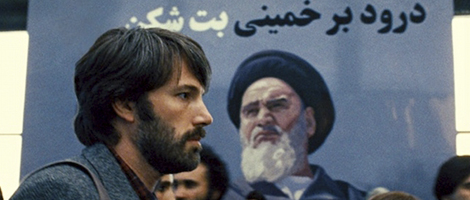
The thing about Argo is that we already know how it ends. In 1980, CIA operative Tony Mendez (played by Ben Affleck) managed to “ex-filtrate” the six Americans who escaped to the Canadian ambassador’s house when Iranian revolutionaries took over the US embassy in Tehran. But I forgot all about that, and judging from the reactions of others in the audience, so did everyone else. This film immerses you in suspense.
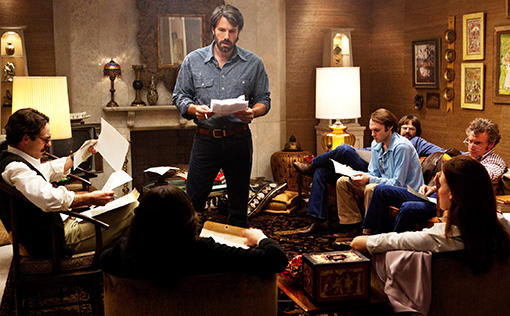
Table read…or briefing session? Mendez/Affleck coaches his “cast” in a scene reminiscent of the film’s earlier table read of the fake film they’re supposed to be making, also named ARGO. It’ll make sense when you see it.
As I noted in one of my past posts, I liked the trailer for Argo, maybe because it reminded a bit of The Town, one of my favorite heist pictures ever, also directed by Affleck. The director doesn’t disappoint, ratcheting the tension up exponentially. It could have been a bit too tense, but Affleck and screenwriter Chris Terrio break the mood with some very funny moments at Hollywood’s expense. The lighter, satirical scenes with John Goodman and Alan Arkin in the movie capital do more than just relieve almost unbearable stress. These scenes – actually the whole movie – are a meditation on the nature of espionage, movies, and storytelling. It begins with a brief history of Iran and the causes of the 1980 revolution. Instead of the usual text on a blank background, or a newsreel-style montage, Argo‘s introduction is a series of animated story boards. Then, of course, there are the fake identities and backstories the diplomats take on to pull off their own rescue. If they can act convincingly enough, they’ll live. At the risk of saying too much, this film shows that the key to being a good spy and the key to making a good movie are one and the same — having the ability to tell to a good story.
PS: I highly recommend reading this excellent Entertainment Weekly interview with Affleck and Mendez if you haven’t already. Among other things, I found out that the Argo story is just one chapter in the CIA agent’s fascinating life. Hoping Hollywood will call on him again.
A few days ago I was honored to receive the Liebster Award from Iba at I Luv Cinema and from Ruth at Flix Chatter and I couldn’t be more surprised and grateful. It’s a really cool idea for a blog event.
The rules:
Each person must post 11 things about themselves.
Answer the 11 questions the person giving the award has set for you.
Create 11 questions for the people you will be giving the award to.
Choose 11 people to award and send them a link to your post.
Go to their page and tell them. I think letting people know on Twitter is cool.
NO TAG BACKS. Although I will answer my own questions.
A movie is a couple hours, but a TV show is a much lengthier commitment. I only watch two shows, Mad Men and The Vampire Diaries. Don’t knock TVD unless and until you’ve actually watched a couple episodes of it 🙂
I love anything French, and any book/film about or taking place in France. The 2011 Three Musketeers? Yep, I saw it, it was actually pretty good.
Related to that, I want to write about French film and film noir more often.
My dad and my husband’s dad went to the same high school.
I have three tattoos and am working on a fourth.
One of the people I most admire is the inventor James Dyson for his creativity and resilience. Plus, if you have furry pets, the Dyson vacuum cleaner will change your life.
I believe in that astrology stuff (I’m a Taurus). It isn’t just your sun sign, it’s where all the planets are in your whole chart. I’ve been a lot happier since I started to rely more on astrology and my intuition.
Over the past few years, I’ve lost around 100 lbs. and am still dropping.
Now, my answers to Iba’s questions:
1. Lord of the Rings or Harry Potter?
What a question! Wow. While I read The Hobbit and The Lord of the Rings first, Harry Potter has the slightest edge. Don’t tell my husband.
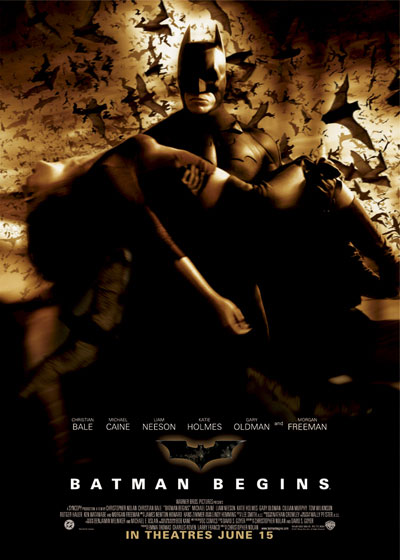
I waited 2 or 3 hours for Christian Bale in BATMAN BEGINS back in 2005
2. What’s the longest you have waited in line for a movie?
Two or three hours. Not long, compared to other people.
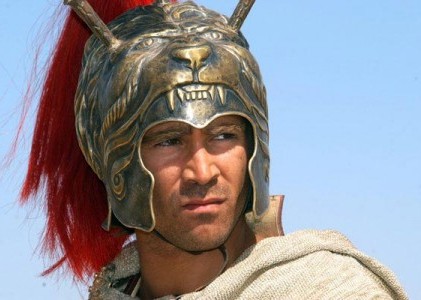
No disrespect meant, but ALEXANDER (2004) just wasn’t my thing
3. Have you ever fallen asleep in a film? If so, which one?
Never, though I got pretty drowsy during Alexander(2004).
Pretty weird, huh?
4. What was your first concert experience?
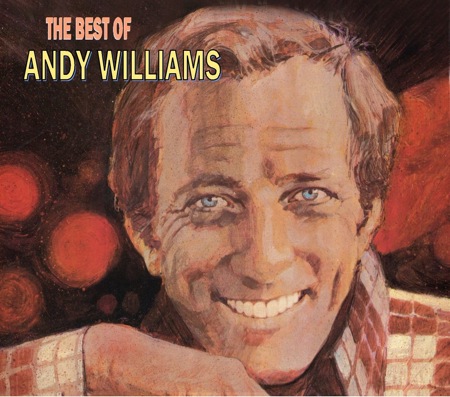
Andy Williams. I was eight or nine, I think. So hip!
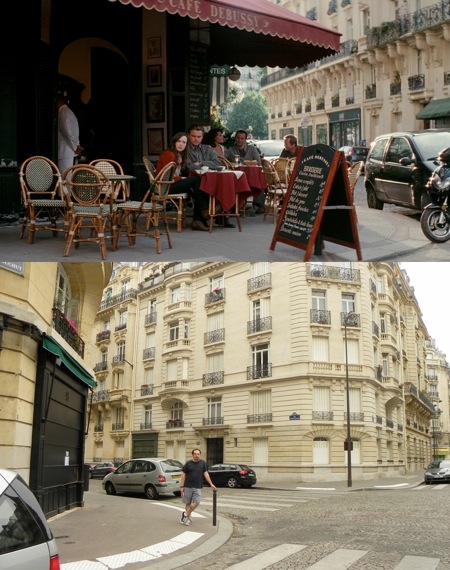
Paris 2010. Tim in front of the café Da Stuzzi, aka Café Debussy in INCEPTION
5. If you could go anywhere in the world, where would it be?
Back to Paris, and I wouldn’t ever leave.
6. Any hidden talent(s)?
Black belt designer/art director and Adobe Creative Suite ninja. I have other talents, but they will remain hidden.
7. Subtitles: Yea or Nay?
That’s a definite yea! Dubbing is horrible to watch, the voices never match the actors, and you can pick up and/or practice another language by watching subtitled movies.
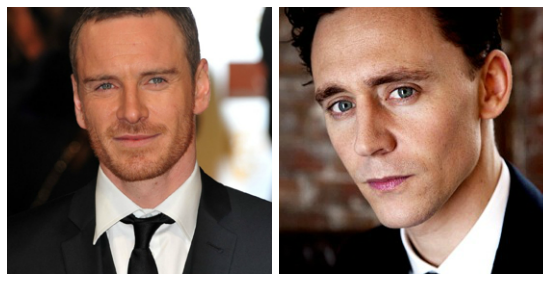
With Michael Fassbender and Tom Hiddleston on board, THE ENGLISHMAN’S DAUGHTER is sure to be awesome.
8. What book would you like to be seen made into a movie? The Englishman’s Daughter by Ben McIntyre. It’s one of those non-fiction novels, about English soldiers who get caught in a French village behind the enemy lines during World War I. That’s all I’m going to say, you should read it! But it’s short and McIntyre’s style is fairly cinematic; it would make an excellent film. I think Joe Wright, François Ozon, or Guillaume Canet (Ne le dis à personne) should direct it, Michael Fassbender and Tom Hiddleston should be two of the soldiers, and all my favorite French actors should be in it — Marion Cotillard, Mèlanie Laurent, Audrey Tautou, Catherine Deneuve, Alain Delon, Jean Rochefort, Daniel Auteuil, Gilles Lelouche, and Gaspard Ulliel.
9. What is the first thing you would do if you won the lottery?
After I took care of all my entire family’s financial obligations, I’d buy a movie theater.
10. Have you ever snuck into a film without paying for it?
Yes, I have. I did actually pay, but I saw another film after the one I paid for. I guess that’s half price.
11. What is your favorite silent film?
I haven’t seen that many, although I’ve seen more in the last six months than I have my whole life. I’ve got a soft spot in my heart for The Artist, the “silent film gateway drug,” but I also love Sunrise (1927) and Das Cabinet des Dr. Caligari (1919).
And, my answers to Ruth’s questions:
1. Who’s your favorite movie actor who’s currently starring in a TV show?
I guess Jon Hamm or Ian Somerhalder. They have both been in a couple movies. Or maybe Kristen Wiig, although she’s not on TV anymore.
2. Could you date someone who does not love movies?
No.
3. What makes you want to have a movie blog?
I write a column for Examiner about classic movies in Detroit and I wanted to branch out and write about current movies and other classics. Also, it gives me somewhere to put all my movie babble instead of driving everyone around me crazy with it. I have to say, this blog wouldn’t exist without the encouragement of Ruth (Flix Chatter).
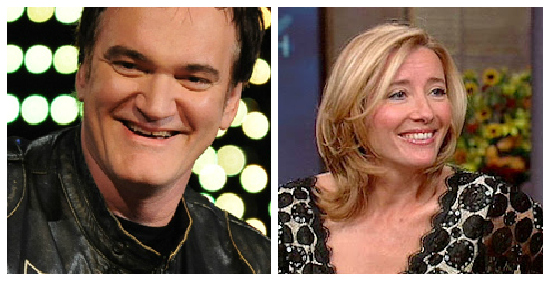
Science fiction film, Emma Thompson plays the lead. Call me, QT!
4. Which director/actor collaboration you’d like to see [it has to be people who have never worked together before]?
Quentin Tarantino and Emma Thompson.
5. What dish are you good at making?
Any kind of Italian or Mexican food. I also make a mean potato salad and the best pancakes.
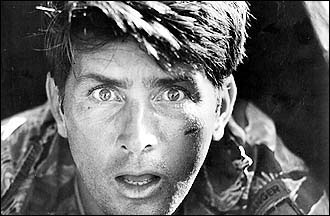
I met Martin Sheen considerably after this picture was taken
6. Any encounter with a celebrity you care to share?
I met Martin Sheen once. He’s about my height and seemed like one of the nicest people you’d ever want to meet.
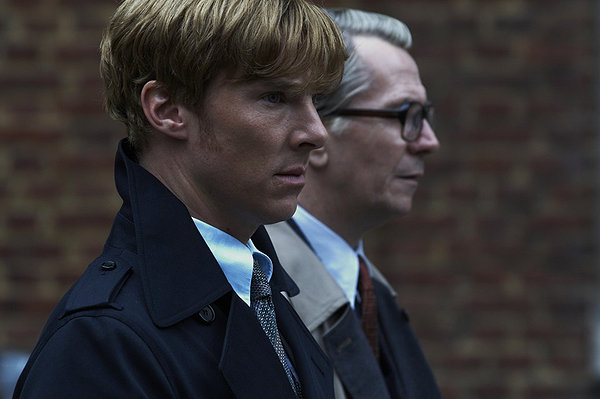
TINKER TAILOR SOLDIER SPY is set mostly in London
7. Since the Olympics is still going on, what’s your favorite movie set in London?
There’s so many…I’ll stick to the most recent one I really liked, Tinker Tailor Soldier Spy.
8. Which is your favorite movie writer [could be a journalist, novelist, etc.]?
Hildy Johnson (Rosalind Russell) in His Girl Friday (1940-above) or Jo March (Winona Ryder) in Little Women (1994).
9. Which do you prefer: sweltering heat vs. cool, rainy days?
You need some of both, and I really like sweltering heat, but I like cool rainy days just that little bit more.
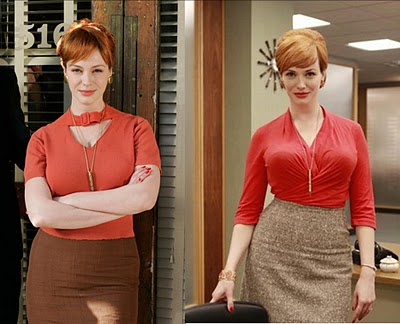
I broke the rules on this one…MAD MEN is not a movie. [Image from Down The Retro Rabbit Hole]10. Favorite outfit/costume from a movie?
The costumes in Marie Antoinette (2006). Myrna Loy’s dresses in Libeled Lady. Peppy Miller’s outfits in The Artist, especially the shoes. And Joan Holloway Harris’ entire wardrobe on Mad Men. I know it’s not a movie, but it’s not often that a fictional character has my body type 🙂
11. Which actor/actress you initially detest but then slowly warming up to? [Feel free to reverse the question, that is an actor you initially love but now can’t stand.]
I never detested Channing Tatum, I just didn’t understand why he kept getting movies…he works a lot. But he was pretty good in The Eagle and hilarious in 21 Jump Street, which is getting its own sequel.
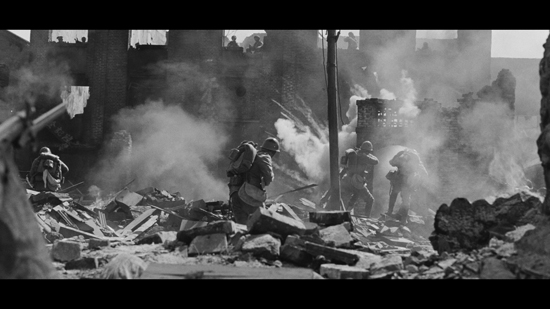
One of the major problems with war movies is they can tend to be a little revisionist – or blatently laced with nationalistic propaganda – to the point that they shouldn’t be taken too seriously by any discerning future filmgoer. Strangely enough, an exception to this rule is an epic Chinese film made in 2009 about a seminal event which took place in the lead up to the Second World War. A masterpiece in every sense of the term, Lu Chuan’s poignant City of Life and Death is a worthy entry in Paula’s Cinema Club’s Future Classic Movies blogathon.
When it comes to military atrocities of the 20th century, not too many can top the brutality of Japan’s invasion of the Chinese city of Nanking during the late 1930s. In the six weeks following Nanking’s capture in mid December 1937, the Imperial Japanese Army systematically killed somewhere between 250,000 and 300,000 people – including an estimated 57,000 prisoners of war on the banks of the Yangtze River in what has since been coined the Shaw String Massacre.
While this infamous mass murder of unarmed POWs does not occur until a third of the way through City of Life and Death, it more or less serves as a starting point for the remainder of the film’s grim narrative, which concerns itself not only with the plight of Nanking’s remaining citizens as they are forced to endure the barbarous and cruel occupation, but also the reaction of the invaders to their own behaviour while they execute their savage agenda.
As it works its way towards the Yangtze River slaughter, the movie follows the fortunes of two brave soldiers – Chinese lieutenant Lu Jianxiong (Liu Ye) and Japanese super private Kadokawa Masao (Nakaizumi Hideo), both of whom are key figures in a final, but somewhat futile, skirmish before the city’s inevitable capitulation.
The story then focuses on the dismantling of the Nanking Safety Zone – a 3.85 square kilometre refuge that had been set up by a group of foreign interests led by German (and Nazi) businessman John Rabe (John Paisley) just before the invaders arrived – after its inhabitants are betrayed by Rabe’s Chinese business assistant Tang “Mr Tang” Tianxiang (Fan Wei) as he attempts to negotiate his family’s passage to safety. (Interestingly the real life Rabe has been credited with saving 100,000 Chinese lives, putting him in the same league as fellow countryman Oskar Schindler, although the film does not really dwell on this point.)
By dividing the film into these two parts, writer/director Chuan convincingly paints a comprehensive picture of war at its very worst – firstly via one of the grittiest combat scenes seen in the cinema since the fight for Ramelle in Steven Spielberg’s Saving Private Ryan, and then through the painful depiction of the Japanese occupation in which women are procured as sex slaves and repeatedly raped, prisoners are hung and/or beheaded (or, in one painful sequence, buried alive), a small child is ruthlessly thrown from an attic window, and injured soldiers are summarily executed in cold blood by makeshift firing squads.
Had City been in the hands of a lesser filmmaker, it’s possible that it might not have fully recovered after Jianxiong’s execution, such is the strength of Liu’s opening performance as the battle hardened Chinese soldier who, along with a few others, initially tries to stop most of his comrades from fleeing the city before making a desperate final stand against the Japanese invaders.
There are, however, too many other good things working for the film which keeps it in masterpiece territory for its two hour-plus running time. These include its stunning black-and-white cinematography (by Cao Yu and He Lei), its set design of mass destruction, as well as the strong performances of the supporting cast – perhaps the most noteworthy being Fan (as the hapless collaborator who ultimately redeems himself), Qin Lan (his wife “Mrs Tang”), Gao Yuanyuan (as Jian Shuyun, one of the zone’s Chinese administrators who defiantly stands up to the occupiers) and Japanese actor Kohata Ryu (playing the brutally pragmatic Second Lieutenant Osamu).
If anything, sitting through City of Life and Death is sort of akin to watching an extended version of the sacking of Vladimir by the Tartars in Andrei Tarkovsky’s 1966 classic Andrei Rublev. At the end of the day it’s not so much the human spirit that triumphs, but rather the horror.
To recap really quickly, the Future Classic Movies (FCM) Blogathon involves predicting films that will still be drawing audiences on TV, or a chip in our brains, or whatever form of communication exists, 30 or 40 years from now. All of the films were made during or after 2000; these will be as old then as the ones we watch on TCM now.
My FCM Round 2 pick is Moneyball (2011). It begins with a playoff disaster. In the 2001 post-season, the Oakland A’s squander their two-game lead over the New York Yankees, who win three games in a row. Their general manager, Billy Beane (Brad Pitt), sits in the home stadium, flicking a transistor radio on and off, almost afraid to hear what’s going on. A couple weeks later, losing his best players on the free agent market, Beane is begging the A’s owner for more money. No way, he’s told. Make do with the lowest payroll in the league. His scouts are all older guys whose info on the players is half speculation and half gossip. When Beane takes a meeting with Mark Shapiro of the Cleveland Indians, he notices that all the older guys always look to Peter Brand (Jonah Hill), a “player analyst” in the front office.
After the meeting, Beane grills Brand (in a parking garage à la “Deep Throat” in All The President’s Men). The latter admits that he has a radical, economics-and-statistics-based system for baseball: buying wins. That is, buying runs. Brand says, “Baseball thinking is medieval. They are asking all the wrong questions.” Beane is impressed. He hires Brand away from Cleveland and together they start to remake the A’s for the 2002 season. But there’s plenty of resistance, naysaying, and defiance from the scouts and the manager, Art Howe (Philip Seymour Hoffman), who is on a 1-year contract and knows a poor season could end his career. He’s downright insulting about this new way of putting a team together. The big scary doubts of the fans on talk radio are interleaved with flashbacks from Beane’s crash-and-burn career and scenes from his current complicated personal life (ex-wife with smug husband, sweet daughter he doesn’t see enough).
Pitt and Hill were both nominated for Oscars and I was surprised by this when I finally saw the movie. The acting in this film is pretty much the definition of natural, which the Academy doesn’t always reward. I definitely agree with whoever said that unless Brad Pitt is in a movie right at the moment, everyone forgets that he is in fact a great actor. He is excellent here. Hill adds little touches — fidgeting, nervous looks — that make his Brand real (though the character is a composite). One of my favorite moments is when Brand is on his way out of Howe’s office and says, “You want this door closed?” Chris Pratt as catcher (turned first baseman) Scott Hatteberg gives an authentic performance as a guy scared out of his mind.
The film’s cinematography is beautifully done by Wally Pfister, probably better known for his work with Christopher Nolan.
I’m not the biggest baseball fan in the world (though I do like going to Comerica Park) but if you like baseball, there’s enough behind-the-scenes intrigue about how deals are done to keep you interested. (“He’s talking to Dave Dombrowski! Wow, Steve Schott!”) Moneyball is really three movies, and Bennett Miller’s command of music, sound and closeups prove that there is crying in baseball, at least for me: the rise and fall and rise of a washed-up baseball player (Beane); a behind-the-scenes history of a baseball revolution; and the eternal struggle of originality and creativity against “we’ve always done it this way.”
UPDATE #2 – May 25: I so enjoyed everyone’s posts and enough people asked if they could contribute to FCM that I’m going to do a second round. If you wrote for the original blogathon, and want to write about another movie, please do!
Same concept…Pick a movie from 2000 or later (more than one is OK too), and write about why you think it will endure to become a Future Classic Movie. Bonus predictions could be who will be hosting on this channel and how will movies be delivered to the consumer (hologram, chip in the brain, etc.)
Email me at paula.guthat [at] gmail.com to let me know which movie you want to do (try to pick one that wasn’t done already).
New dates…Put a link to the FCM Round 2 megapost http://wp.me/p243hv-fh somewhere in the first paragraph of your post and publish it on Wednesday, June 20. Feel free to use the graphic below. Then email me the link to your post. I will then compile all the links into one mega post and publish it on Thursday, June 21. Note: you will get a 404 when you try that link, but it’s there. It’s just not public yet.
UPDATE: The call for submissions is now closed. Links to everyone’s FCM posts may be found at theFCM Blogathon Mega Post.
As a confirmed TCM addict, I’ve often wondered what movies from the 21st century would stand the test of time, like Casablanca, Gone With The Wind or Out of the Past. If there is even such a thing as TV and channels in the future. What would programming look like in 30 or 40 years from now?
And then I thought, why just think about it, when I’d love to hear other people’s ideas. And so the FUTURE CLASSIC MOVIES (FCM) BLOGATHON was born.
Everyone who wants to participate picks a movie from 2000 or later (more than one is OK too), and writes about why they think it will endure to become a Future Classic. Bonus predictions could be who will be hosting on this channel and how will movies be delivered to the consumer (hologram, chip in the brain, etc.)
Post your pick (s) to your blog on Wednesday, May 23 and email me the link to the post. Feel free to use the graphic above. I will then compile all the links into one mega post.
All I ask is that you to link to the megapost in your first paragraph somehow, using this shortlink: http://wp.me/p243hv-dT
So what do you think? If you’d like to participate, please DM me on Twitter @Paula_Guthat or email me paula.guthat [at] gmail.com with “FCM blogathon” as the subject, giving me a couple of choices of Future Classics you’d like to write about. Thanks!
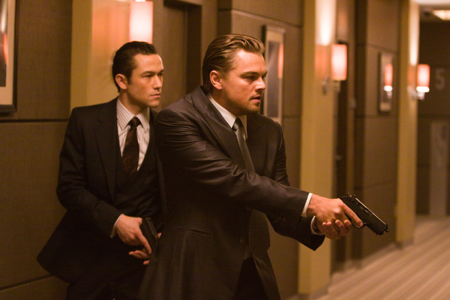
Dreams Within Dreams Within Dreams…Fights in a Spinning Hotel Lobby…LEONARDO DICAPRIO!!
These are some of the many reasons why I believe that Inception will end up being a Future Classic Movie. When the movie first came out a couple of summers ago, everyone flocked to the theaters to catch it due to the super-mysterious plot at the time and mainly because of this being the first follow-up of director Chrstopher Nolan’s since this little old flick called The Dark Knight came. But once the dust settled at this film’s exciting conclusion (oh…darn you spinning top!), the conversations and endless debates on its plot details never seemed to stop.
Joseph Gordon-Levitt and Leonardo diCaprio in INCEPTION
Instead of being a one-note, too gimmick-ridden film, Inception proved to be a multi-layered film that still drives multiple repeat viewings (with no pun about its main dream plot intended). On top of this, its clever odes to the action, sci-fi, and psychological thriller genres help this go a long way in being a good long-term future classic movie that never seems to get old. Inception to me will definitely be one of those awesome flicks to turn on 10, 20 years from now and be a good way to spend a Sunday afternoon.
Along with Inception playing on a future classic movie channel, the one person who I strangely see taking on hosting duties on movie marathons in the future is actor/comedian Joel McHale of The Soup and Community fame. The man may not a super well-known respected actor and is currently just really known for drawing up goofy laughs, but I see that his years of being a good steady host on Soup could one day translate to a neat little side soundtrack for a nice afternoon movie marathon.
To recap really quickly, the Future Classic Movies (FCM) Blogathon involves predicting films that will still be drawing audiences on TV, or a chip in our brains, or whatever form of communication exists, 30 or 40 years from now. The vast majority of the posts involve films made during or after 2000; these will be as old then as the ones we watch on TCM now.
My FCM pick is The Artist (2011). Regular readers of this blog know that I adore this film. It is a little miracle — a silent film premiering in the 21st century. It was made by people who really love movies and stocked their film with tons of homages, tributes and shoutouts to the classics. It has romance, humor, suspense and melancholy. The acting in it is superb. It was beautifully written, art-directed, and shot. There is something about it that makes me cry every time I see it. (I’ve actually plunked money down to see this three times. Once I was actually on vacation.) It was nominated for 10 Academy Awards, and it won five: Best Director, Best Picture, Best Costume Design, Best Score and Best Actor. But none of these reasons are why I chose this film to endure into the middle of this unpredictable 21st century and beyond.
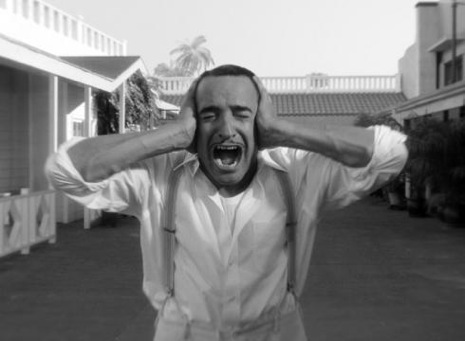
Sometimes it’s all a little too much…Jean du Jardin as George Valentin
Every day our lives get a little more complicated and a little more technological. As recently as 2006, the vast majority people had only a vague idea of what Facebook was. No one had heard the term “social media.” Phones were decidedly dumb; they made calls, and that was about it, at least in the US, where SMS hadn’t yet caught on. Now billions of people are using social media every day. Approximately 20,000 tweets go out every 10 seconds. You can watch a movie, video-chat with someone on the other side of the world, or run a business, all from a smartphone. And the pace of new technology only seems to accelerate rapidly. Economically, the upheaval of 2008 seems to have stabilized somewhat but lots of people lost their jobs and homes, and technology is ending some jobs and creating others. Everything in life is changing so quickly that the term “radical transformation” comes to mind, although nothing is happening quite that fast. I love all the technology, but sometimes even I feel a little overwhelmed, a little bit blindsided…a little bit like George Valentin. He would understand if he was here, because this is what The Artist is at least in part about: coping with change. (It’s about love, loyalty, friendship, the creative process, paying it forward, and really great shoes as well. But I digress.)
The world the characters inhabit is completely shaken with the advent of sound, and they each provide an example of a different coping strategy, from stubborn disregard (George) to grudging acceptance and pragmatism (Al Zimmer, the director played by John Goodman) to leveraging new opportunities that open up and helping others to reconcile themselves with a new reality (Peppy). We’ll all have to adapt, and since we’ll be adapting well into the foreseeable future, this film is always going to be relatable and relevant. There’s a few people out there who didn’t like this film. To those people I say, get used to it…The Artist isn’t going anywhere, and neither are the rest of these picks, all films that I believe will persevere:
Many thanks to everyone who participated in the very first blogathon I’ve ever run. I hope you had as much fun writing these as I did reading them. To paraphrase a title…there will be more 🙂
I’ve been to the movies two weekends in a row now (for The Avengers and Dark Shadows), and am definitely looking forward to three of the films I saw trailers for.
I was probably going to see Lawless anyway, due to my being a sucker for anything to do with Prohibition and the presence of Tom Hardy, Gary Oldman, Jessica Chastain and Mia Wasikowska, all of whom I believe to be talented actors. Hardy, Shia Labeouf and Jason Clarke play “the infamous Bondurant Brothers: bootlegging siblings who made a run for the American Dream in Prohibition-era Virginia” (per the film’s site). Their livelihood is threatened when the lawmen sent in to stop them demand a piece of the action. The film is based on Matt Bondurant’s novel The Wettest County in the World, which he based on stories of his own family. The Player-style pitch: “It’s like Bonnie and Clyde with The Untouchables and some Godfather thrown in.” The trailer sets up the conflict, but, unlike a lot of trailers, it doesn’t show you how it’s going to end. I love the look of this film, the desaturated colors with lots of shadows and night shots. It took me a minute to recognize Guy Pearce as a menacing FBI agent. Hardy is always a standout for me, he transforms himself for every film, and I’m looking forward to seeing him and his Tinker Tailor Soldier Spy co-star Oldman in their scenes together. Lawless will debut at the Cannes Film Festival; its US release date is August 31.
In End of Watch, Jake Gyllenhaal and Michael Peña star as cops in south central L.A. who are as close as brothers. They are modern-day cowboys, looking for dope, money and guns …until they get on the wrong side of a scary cartel. The car chases and drug busts have documentary look, with handheld and dashboard-camera footage, giving the film a rushed, urgent quality that matches the subject matter. The film was written by David Ayer, who was also responsible for Training Day and The Fast and the Furious. I’m gonna go out on a limb here and say that Watch is going to do for JG what Jarhead and Prince of Persia failed to do—make him a blockbuster action star. Jarhead wasn’t actually an action picture, but it was marketed like one, which didn’t work, and Prince of Persia had too many Disney/fantasy elements for people to take it seriously (though it is one of those films that I’ll stop to watch every time I find it when I’m flipping the channels and happen upon it.) If the trailer is any indication, End of Watch is gritty, violent and riveting. US release date is September 28.
Argo, directed by Ben Affleck, is based on a covert operation detailed in recently declassified US government documents. In 1980, when Iranian revolutionaries took over the American embassy in Tehran, 66 Americans were held captive for 444 days. Apparently there were also six who managed to escape to the Canadian embassy. Knowing these six were in incredible danger, the White House took a chance on a crazy scheme…send in operatives masquerading as a film crew working on a sci-fi film. I really love Affleck’s film The Town and it looks like this will have the same adrenaline-producing suspense and true-to-life characterization, with a little more humor as it parodies Hollywood. It will be interesting to see how he blends the drama of the extraction with the comedic elements. Argo will be released on October 12.
In my 2011 Year-End List, I chose The Artist as one of the 2011 movies I was dying to see but couldn’t until 2012. Well, I did get to see it — twice! — and I have to say it’s one of my favorite movies of last year…this year…any year. I even modified my banner…yeah, it’s that good.
The film offers a special thrill for fans of classic movies, because it pays tribute to them, yet it’s thoroughly modern. Without giving too much away, I noted homages to classics like Sunset Boulevard, A Star Is Born, and Singing in the Rain (see below). Director Michel Hazanavicius shot at 22 frames per second, instead of the standard 24, to give the film a little of the jumpiness so characteristic of silent movies. Music is used more centrally than in a sound film, to emphasize moods or events. But the way sound is used and the way shots are framed are thoroughly 21st century. Also, it is a rare silent that has the high contrast of the deep blacks and crisp whites that Hazanavicius and his DP, Guilllaume Schiffman, were able to produce. I don’t want to say too much because I want everyone to see this movie on the big screen if possible…but even at home, it’ll still be stunning.
I so love seeing a movie made by people who love classic movies that I decided to try to put all the references I could think of together. NB: I have a complex about spoiling things for people…I hate to do it! So: There may be spoilers below…if you haven’t seen The Artist you might want to wait until you see it…and then come back and add the movie references you find! I know I’ve missed some.
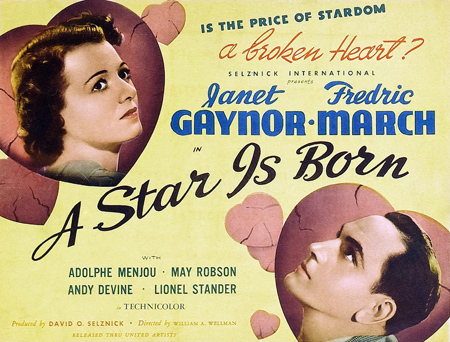
Poster - A Star Is Born (1937)
The basic idea that propels the film is familiar to viewers of all three versions of A Star Is Born: a young woman who wants to be an actress (Peppy Miller, played by Bérénice Bejo) works her way up from extra to top-billed talent, aided greatly by an established actor (George Valentin, played by Jean Dujardin), whom she meets in a chance encounter. Her career skyrockets while his is fading. TCM is running the 1937 and 1954 versions of Star on Feb. 26, so if there are any more specific points in common I’ve missed, I might be able to pick them up then.
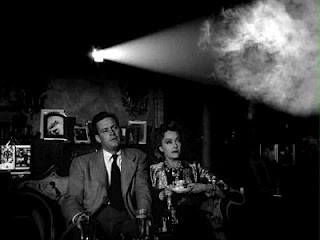
Joe Gillis (William Holden) and Norma Desmond (Gloria Swanson) in the screening room
The Artist shares a thread with Sunset Boulevard: The proud (though faded) star who is disdainful of change and has a kind chauffeur. Like Norma Desmond (silent star Gloria Swanson), George Valentin has no use for talkies. Both like to relive their pre-talkie glory days by watching their old movies. I can see him nodding vigorously in agreement as she declaims, “I am big. It’s the pictures that got small” or “We didn’t need dialogue. We had faces!” Unlike the protagonists in the above-named films, thank goodness George is ultimately a more sane and hopeful figure.
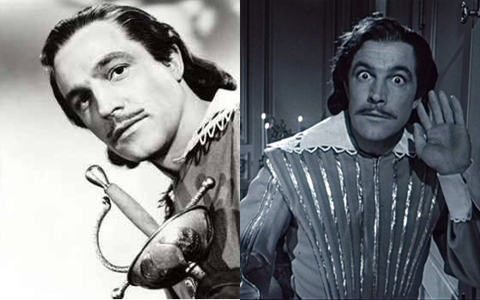
The Artist takes place at around the same time Singin’ in the Rain is set, and in the same context, and there are quite a few similarities between the two films. Like Don Lockwood (Gene Kelly), George has an acting partner, Constance (Missi Pyle), whose transition to talkies was rough. Her sound test reminded me a lot of the work done by Lina Lamont (Jean Hagen) in Singin’ (above). Kelly as an actor seems to have been a major influence. Dujardin gives George the same athletic style of movement as Kelly. I wish I could have found a still of Dujardin in the swordfight scene; with the thin moustache. he really resembles Kelly as D’Artagnan in The Three Musketeers (1948) or in The Dueling Cavalier (the movie within a movie in Singin’).
Early in The Artist, the scene where George is having breakfast with his disapproving soon-to-be ex-wife Doris (Penelope Ann Miller) references the breakfast montage in Citizen Kane. Hazanavicius’ use of mirrors reminds me a lot of Kane. Also, when George finds a room full of belongings that he had to sell (that’s all I’m going to say), it reminded me of the shot at the end of Kane, depicting the dead man’s vast and largely meaningless collection of stuff.
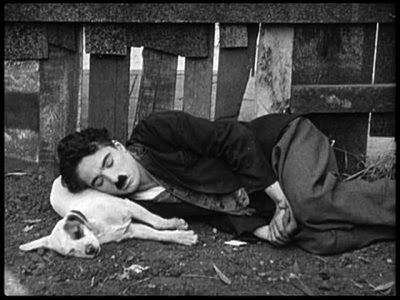
In Charlie Chaplin’s A Dog’s Life, The Little Tramp’s dog is always getting his human out of a jam, as is George’s dog (played by Uggie). I know there are probably references to other silent films, especially the staircase scene where George, on his way down, meets Peppy, on her way up. I have a lot to learn about silents though, so I will have to discover them as I work through them. Many thanks to @tpjost, for his help with this post. If you want to learn or talk about silents, definitely follow him on Twitter.
UPDATE: From sharp-eyed and knowledgeable film fans @caralluch and @Kinetograph (you really should follow them :)): The dance number at the end of The Artist is a lot like Fred Astaire and Eleanor Powell’s tapdance to “Begin the Beguine” in The Broadway Melody of 1940. Also, @caralluch alerted me to Hazanvicius’ use of mirrors, which recalls Ernst Lubitsch’s Trouble in Paradise. And, though @Kinetograph wasn’t the first to notice the use of part of Bernard Hermann’s Vertigo score in the scene where Peppy drives frantically across town to save George, he did give me the heads-up on that and also similarities with 7th Heaven, which I haven’t seen. So there are more specifics in the works.
UPDATE: Vincent from Carole & Co (dedicated to the fabulous Lombard) has written a great review of The Artist that includes some similarities that I missed.
What do you all think? What did movie references in The Artist I miss? Let me know below 🙂







 Paula's Cinema Club