In Bride, a sequel to the wildly successful Frankenstein (1931), Boris Karloff returns as the Monster and Colin Clive reprises his role as Dr. Henry Frankenstein. This installment of one of the first horror movie franchises sees Dr. Frankenstein forced by another mad scientist to make a match for the Monster, with scary and sad results.
By 1943 Karloff had given up the mantle of the Monster, so Universal passed it to another one of their horror icons, Bela Lugosi. It seems as if the studio felt that one creature was good, but two was even better. So the film has the Monster facing off against the Wolfman, played by Lon Chaney Jr.
Seeing these two excellent examples of Universal horror classics is particularly appropriate this Halloween season as 2012 is the studio’s 100th birthday. And while you can see these movies at home (The Bride of Frankenstein is included on the newly released Universal Classic Monsters: The Essential Collection box set), seeing them on a big screen, like the Redford’s, adds much to the experience. Why not see these films as they were seen when they were first released —in a movie palace?
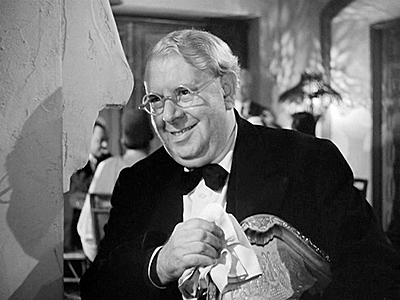
With his assortment of lovable supporting roles — befuddled yet helpful uncles and friends, slightly curmudgeonly shop owners, eccentric producers — S.Z. “Cuddles” Sakall is pretty much the definition of a Hollywood character actor. His variations on a discombobulated theme, often tinged with sly wit, charmed American audiences from the early ’40s through the mid-’50s, yet he’d been acting for 30 years before he ever set foot in Hollywood.
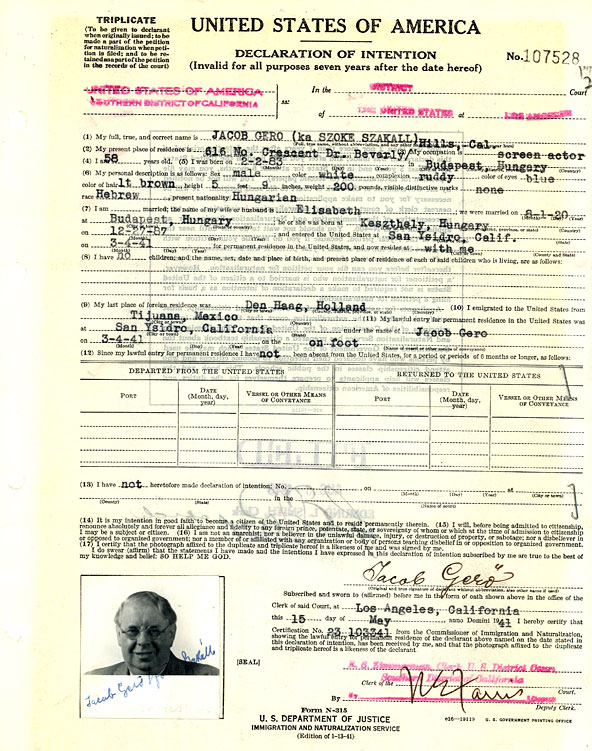
Who the heck is Gerö Jenö? That is S.Z. Sakall’s birth name, sometimes translated from his native Hungarian as “Jacob Gerö,” which is what appeared on his U.S. citizenship paperwork. Most sources say he was born in 1883, on February 2 in Budapest. (In case you were wondering, he was a Capricorn Aquarius.) Edit: Someone rightly commented that Feb. 2 is Aquarius, it’s squarely in the sign, not sure I got Capricorn from.
By the early 1900s, Gerö Jenö was writing scripts for musical-comedy theatre in Hungary. Several sources mention that he took his stage name, S.Z. Sakall, from the Hungarian phrase “szoke szakall,” in English “blond beard,” which he apparently grew to look older. He started acting at the age of 18. In the early ’20s, he moved to Berlin and appeared in his first film in 1927.
He continued working on stage and in film in Vienna and Berlin, and briefly had a production company, until 1933, when the Nazis took over Germany. Sakall, who was Jewish, had to go back to Hungary. In 1940, Hungary joined the Axis, giving the Nazis control of most of Europe. Many — Jews and others who objected to the regime — who were able to leave, did so. Those in the film industry made their way to either London or Hollywood, and formed an essential part of American and western European moviemaking for the next two decades, exerting tremendous influence on both the style and content of films. A look at the cast and crew list for Casablanca (1942) has a fair proportion of these refugees: director Michael Curtiz; composer Max Steiner; and actors Paul Henreid, Conrad Veidt, Peter Lorre, and Sakall.
RENAULT: Carl, see that Major Strasser gets a good table, one close to the ladies. CARL: I have already given him the best, knowing he is German, and would take it anyway.
I can’t help but wonder how Sakall was affected by these lines and others in Casablanca. Perhaps the proximity of art to life was the reason Sakall at first refused the role of Carl the math-professor-turned-headwaiter, even though his Yankee Doodle Dandy director and fellow Hungarian Curtiz was helming, and the cast included top-name talent. Pure speculation on my part. What I do know is that all three of his sisters, his niece, and his wife’s brother and sister were murdered by the Nazis.
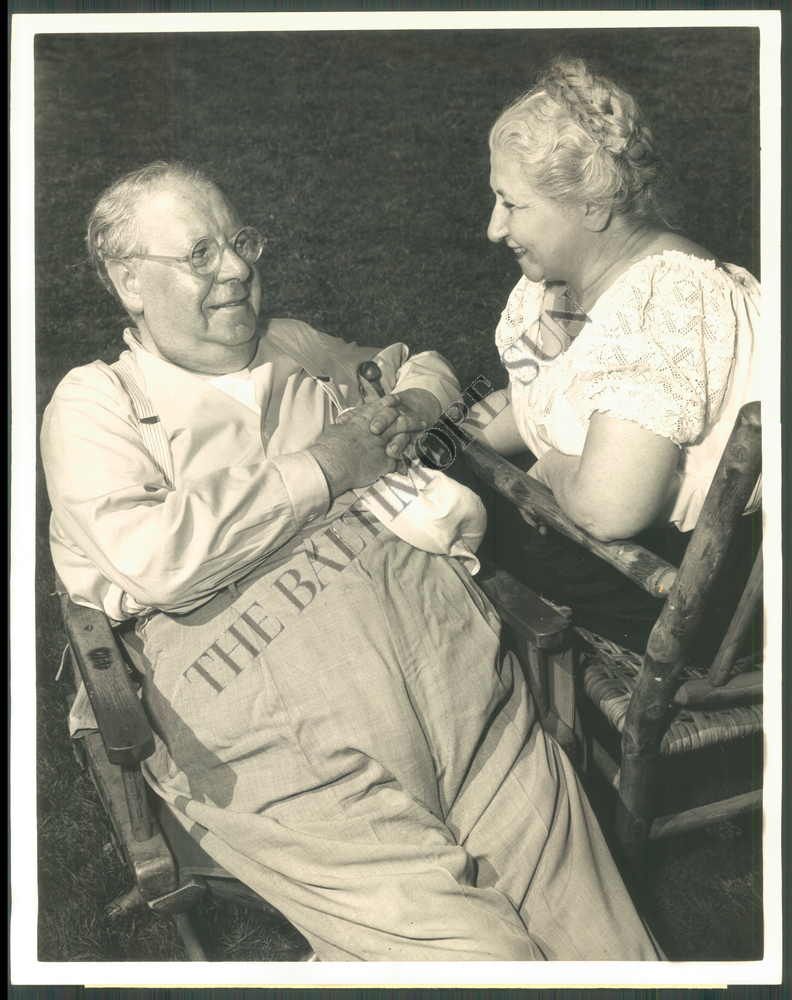
1948 photo from The Baltimore Sun: HAPPY HOLLYWOOD WEDLOCK — S.Z. (“Cuddles”) Sakall and his spouse Boeszike (he can pronounce it) have enjoyed nearly 30 years of wedded bliss. Boeszike comes to work with Cuddles nearly every day to help him with his lines, and bits of business, and for them love’s young dream is still way up there on rosy cloud No. 1. Cuddles, assisted by Boeszike, is soon to be seen in Warner Bros.’ “Whiplash.” / From: Warner Bros. Studio / Burbank, California
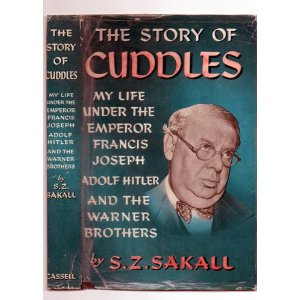
I don’t know for sure when Sakall acquired his famous nickname, Cuddles, or who gave it to him — his TCM clip cites Jack Warner as the source, but I’ve also heard that Doris Day coined it. He was first credited as “S.Z. ‘Cuddles’ Sakall” in 1945’s San Antonio.* I’ve read that he wasn’t fond of his nickname, and also that his charm, basic niceness and, um, cuddly exterior made it entirely appropriate both in film and in life. In 1954, Sakall published his wonderfully-titled memoir, The Story of Cuddles: My Life Under the Emperor Francis Joseph, Adolph Hitler and the Warner Brothers. The book is out of print and the one used copy I could find goes for $480.10. If anyone wants to buy me this for Christmas…I’m just saying. He passed away from heart failure in 1955.
It wouldn’t be going out on much of a limb to say Cuddles is best-known for Casablanca. So it is fitting that Humphrey Bogart, Sidney Greenstreet, John Qualen, the film’s producer Hal Wallis, its director Michael Curtiz, its composer Max Steiner, and S.Z. “Cuddles” Sakall were all laid to rest in Forest Lawn Memorial Park in Glendale, California.**
My Top Three Cuddles Roles
Ball of Fire Sakall plays one of 7 professors attempting to produce an encyclopedia. Because they’ve been cloistered in a mansion for 9 years, the group reacts strongly when showgirl Sugarpuss O’Shea (Barbara Stanwyck) turns up. As kindly physiology professor Magenbruch, he delivers many of his lines with a touch of mischief…his area of academic study is sex.
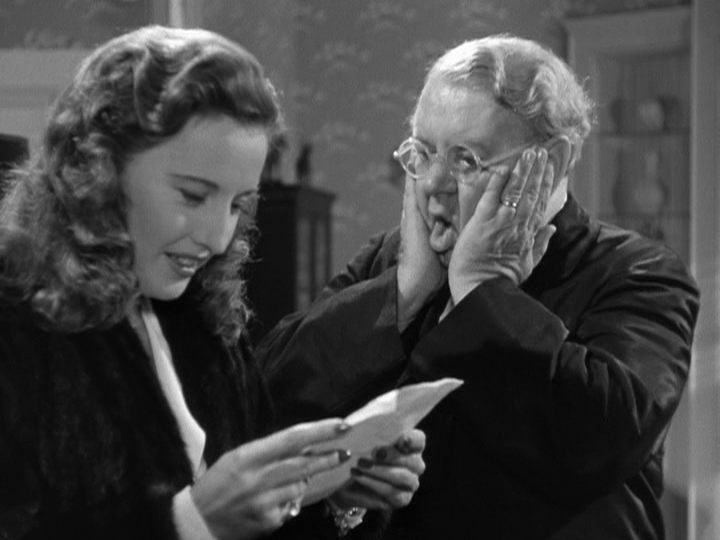
Christmas in Connecticut Sakall reunited with Stanwyck for this screwball comedy about a homemaking columnist who isn’t married and doesn’t have any kids. Cuddles plays her good friend, a chef named Felix, who is soon promoted to uncle. In my opinion, this is the quintessential Cuddles role, featuring all the befuddlement and exasperation for which he is known, together with the classic phrase, “It’ll be hunky-dunky,” Cuddle-ese for “hunky-dory.”
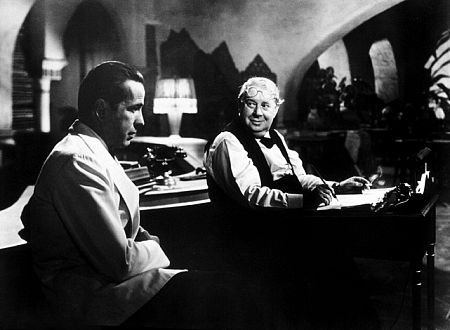
Casablanca As mentioned above, Sakall was unwilling to appear in this film. He tried to get Warner Brothers to pay him four weeks’ work, but the studio would only agree to three. His name was misspelled in the credits. But the character is essential to the story and serves as a sympathetic counterpoint to Humphrey Bogart’s brusque Rick.
*San Antonio starred Errol Flynn as a cowboy fighting cattle rustlers and Alexis Smith as the singer who falls in love with him. Sakall plays the singer’s manager, who repeatedly refers to riderless horses as “empty horses.” This phrase was most likely borrowed from, and a dig at, Casablanca director Michael Curtiz, with whom Flynn and David Niven notoriously clashed while filming Charge of the Light Brigade. (Niven called his second autobiography Bring on the Empty Horses.) There is at least one other connection to Casablanca: Dan Seymour, who played the bouncer Abdul, appears uncredited in San Antonio. The entire film is available on YouTube.
** Sakall’s nearest famous neighbors at Forest Lawn are the Ruggles brothers. Actor Charlie is in the same row; director Wesley is in the next row, across from Charlie.
A while back, I happened upon possibly the only site that may be a bigger time suck than tumblr….the Fan Magazine Collection put together by Media History Digital Library (MHDL). This remarkable archive contains full-page scans of magazines that you can browse through or even download to your computer for later consumption.
All’s well at M-G-M “the happy lot:” (L to R) Madge Evans, Robert Montgomery, Marie Dressler, John Gilbert, Anita Page, Joan Crawford and Clark Gable. Photoplay, May 1932.
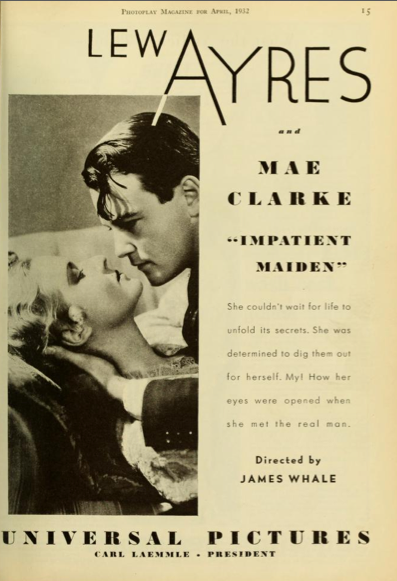
The star of the show is MHDL’s complete set of Photoplay magazine, comprising all the issues from 1914 until 1940. These magazines are a gold mine for the classic movie fan…in just one issue, I found publicist-approved info like Mary Pickford’s secret for staying slim (hint: skip lunch), Clark Gable’s explanation of some pesky rumors, Myrna Loy and Carole Lombard’s hairdo tips, and addresses for all the stars, plus tons of images. They are also fascinating cultural artifacts, a window into U.S. society’s past concerns (which haven’t actually changed all that much.) This site will occupy more of your time than you probably can spare.
Joan Blondell. Photoplay, May 1932.
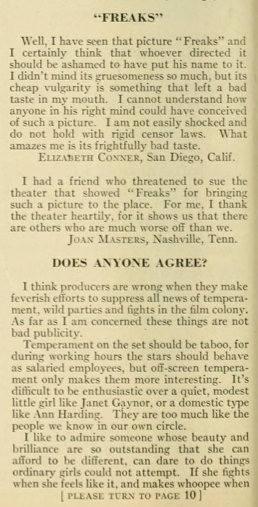
One of Photoplay’s interesting and often hilarious features is “The Audience Talks Back,” in which fans air their critiques and grievances. It’s like Twitter…only longer and on paper:
“No matter what the critics write, the audience always has the final word” — Letters to Photoplay, May 1932.
I cannot even imagine the work that went into scanning these, and MHDL has even more collections…for instance, the Early Cinema archive covers several publications from 1904 to 1919. All the collections are listed here. MHDL is a non-profit organization, “dedicated to digitizing collections of classic media periodicals that belong in the public domain for full public access…We have currently scanned over 400,000 pages, and that number is growing.” The scanning is paid for by collectors and donors, so if you see the value in any of this, please support their work — there’s a “Donate” button in the right sidebar.
There’s a few sure things in life, and one is that I’ll watch A Stolen Life, a mistaken-identity melodrama in which Bette Davis plays twins, every time it’s on TCM. A while ago, my friend Tonya from Goosepimply Allover sent me a link to a parody of the film, called “A Swiped Life,” from The Carol Burnett Show. If you’ve seen the film, you’ll find it hilarious. You can tell Burnett really studied Ms. Davis’ speech patterns and facial expressions…and then way over-emphasized them.
They also did a parody of Double Indemnity, called “Double Calamity.”
And one more…a “tribute” to Fred and Ginger. Roddy McDowall is excellent in the Edward Everett Horton role:
What really strikes me about these spoofs is that, at some point, these movies were well-known enough for jokes and references about them to be understood by enough people that it was a regular feature on a national network TV show. Now with the wide variety of entertainment options, there isn’t any one film, TV show, book or musical act that everyone is familiar with.
Also, even though I’ve enjoyed the occasional episode of Jersey Shore, I can’t help but wish there was something as smart and fun as The Carol Burnett Show on TV now.
UPDATE: In the interests of completism, here is the immortal Carol Burnett Gone With The Wind parody, “Went With The Wind:”
Interesting week on TCM. Leslie Howard month wraps up and Summer Under The Stars kicks off with two of my favorites, John Wayne and Myrna Loy. As always, all times are Eastern.
Monday, July 30
9:30 p.m. Island in the Sky (1953) ***TCM PARTY***
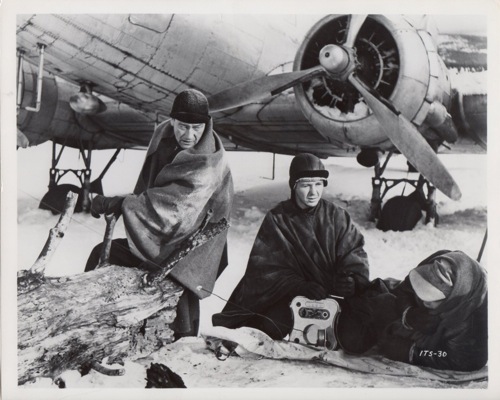
Captain Dooley (John Wayne) is the pilot of a plane that crashes “so far north that the area is barely on the map.” He’s in charge of the stranded crew, which has very limited provisions, only a wood fire for heat and barely any juice for the radio signal. Can the Duke keep everyone alive until they’re rescued? Look for us on Twitter with #TCMParty…watch and tweet along with our guest hosts @biscuitkitten and @ScribeHard.
Tuesday, July 31 Star of the Month: Leslie Howard
8:00 p.m. The Scarlet Pimpernel (1935)
This is one of my favorite Leslie Howard films ever. In the 1790s, an apparently shallow British nobleman, Sir Percy Blakeney (Howard), defies the evil French revolutionary Chauvelin (Raymond Massey) by spiriting his fellow aristocrats away from the guillotine and out of France. Also starring the beautiful Merle Oberon as Lady Marguerite Blakeney and luxuriously produced by Alexander Korda, this is perhaps not the most realistic film ever made about the French Revolution, but it may be the most fun.
Beginning early Wednesday at 1:30 a.m., TCM has booked three mystery films starring Joan Blondell: There’s Always a Woman (1938), co-starring Melvyn Douglas and Mary Astor; The Famous Ferguson Case(1932), directed by Lloyd Bacon; and Miss Pinkerton (1932), with George Brent. I haven’t seen any of these, but Blondell’s sassy presence is enough to get me to set the DVR.
Wednesday, August 1 John Wayne Summer Under The Stars kicks off today. It’s difficult to go wrong with anything on the schedule…seriously…it’s John Wayne. If you need to start somewhere, and can only DVR one movie today, I recommend Stagecoach (1939), The Searchers (1956) or Rio Bravo (1959).
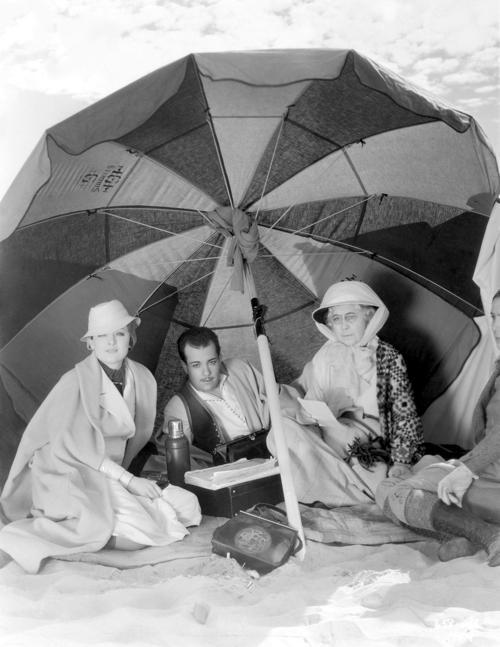
1933: (Left to right) Hollywood stars Myrna Loy (1905 – 1993), Ramon Novarro (1899 – 1968) and Louise Closser Hale relax in the sun during takes for the Metro-Goldwyn-Mayer production THE BARBARIAN. (Photo by Margaret Chute) via doctormacro.com
Thursday, August 2 Myrna Loy
Loy is another favorite of mine who is mostly known today as Nora Charles in The Thin Man series, but she made around 80 films before she became a star in 1934 with the first of those films. So the films she made before that are lesser-known. There’s five of them this morning beginning with The Great Divide (1929) at 6:00 a.m. and including The Naughty Flirt (1931), The Barbarian (1933), When Ladies Meet (1933), and The Prizefighter and the Lady (1933). Then tonight at 8:00 p.m., Loy has a supporting but pivotal role in William Wyler’s The Best Years of Our Lives, one of the best movies ever made. It’s also our ***TCM PARTY*** for tonight. Look for us on Twitter with #TCMParty…watch and tweet along!
Friday, August 3 Johnny Weissmuller What can I say, a lot of people dig Tarzan pictures. Maybe I’ll check some of them out.
Saturday, August 4 Marilyn Monroe
The film I haven’t seen today is Clash By Night (1952) and it’s got an interesting director and cast. Directed by Fritz Lang, it stars Barbara Stanwyck, Robert Ryan and Monroe. I’m expecting something in noir, seeing as Lang directed M, The Woman in the Window, Scarlet Street, The Big Heat, etc.
Sunday, August 5 Claude Rains
You can’t really go wrong with anything today either. I say that a lot. If I’m forced to pick, I’ll go with The Invisible Man (1933) and Mr. Skeffington (1944). Did you know that in addition to being a great actor, Rains was an acting teacher? Two of his most famous students were Laurence Olivier and John Gielgud.
Dana Andrews and the films he made have long been favorites of mine so I was delighted when I found out that Steve Reginald (aka @sreggie) of Classic Movie Man was putting together a Dana Andrews Blogathon. The following is my contribution; see the rest of the excellent posts here.
I’ve chosen Boomerang! (1947), directed by Elia Kazan. The film is based on an actual case of an innocent man being convicted of murder in Connecticut in 1928 (though the city was changed from Stamford to Bridgeport). Kazan wanted to meld the documentary style of a newsreel with Hollywood moviemaking techniques, and he succeeded — this film is the direct ancestor of the “fact-based” docudramas with which we’re so familiar today. It was supervised by the same producer as the March of Time newsreels, Louis de Rochemont, much of it was shot on the run in real locations, and there’s no score. Despite this, Kazan later expressed dissatisfaction with the film, and with his star.
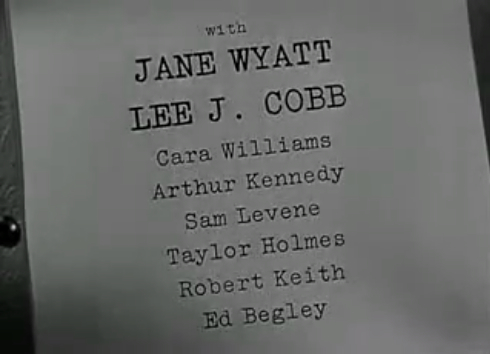
The no-nonsense credits — names typewritten on the plain white pages of a script, turned by an unseen hand — reflect the bare-bones staging of the film. The voice-over introduction makes it clear that arresting an the wrong person can happen anywhere: “people are the same everywhere,” it admonishes. Then the fast-paced action kicks off with the murder: The victim, a minister, is shot off-screen. The townspeople react with shock, disbelief and sadness that such a well-known and beloved man could be shot to death just like that; even the local hoodlums throw some money together for a wreath. We see the minister’s life in an economical flashback. He was part of the “reform” government that cleaned up the town, and he knew a lot of peoples’ secrets. The perpetrator could have been anyone. The description of the murderer is appropriately vague: “a man in a dark coat, light hat, medium build.”
Andrews plays State’s Attorney Henry Harvey, who is based on the DA in the real case. He’s first seen around 10 minutes in, when police chief “Robbie” Robinson (Lee J. Cobb) goes to Harvey’s office to give him an update. It’s clear that the case is already a pressure cooker. The local paper, a property of the reform government’s opposition, is taking the opportunity to make the police, and by extension, the incumbents, look incompetent. Editorials in print and on the radio are agitating the citizenry, neighbors are bickering, and even Harvey’s wife Madge (Jane Wyatt) is after him about the case. It’s no surprise that the shadow side of human nature would begin to dominate. When a “tramp” matching the description is found in Ohio, with a gun of the same caliber that killed the minister, and admitting to having left town when the murderer supposedly would have, he’s arrested and brought back to Connecticut. He’s actually a WWII veteran named Waldron (Arthur Kennedy), who is right out of the Army and can’t find a job. The police torture a confession out of him and the case goes to an inquest, which proceeds as you might expect.
Harvey is at first keen to convict Waldron, practically bounding up the stairs to tell the Chief that ballistics says the bullet and the gun match. But before he takes the next step in the process and indicts Waldron, the attorney decides to chat with him in his cell. This scene is when Andrews really begins to shine. He starts out stern, but as he listens to the prisoner’s story — Waldron has had a lot of bad luck after five years in the military — he shows us the faint glimmers of doubt beginning to creep into Harvey’s mind. Something just isn’t right. It soon becomes even more clear that the “authorities” are concerned with something other than justice — staying in office, getting elected, escaping public ridicule — except Harvey. Because when court is in session, and everyone is expecting an indictment, Harvey declares that Waldron is innocent. The rest of the film is a kind of trial, as Harvey recalls witnesses from the inquest and introduces new evidence to prove his statement true, all the while ending his political career.
Andrews is always underrated, but never more than by the director of Boomerang! Kazan is quoted on the TCM site as saying,
There was very little you could do with Dana….He could learn three pages in five minutes. He had a fantastic memory, even though he’d been up late drinking the night before. He’d come to work, dress up, and we’d roll him out. His style was okay in the movie, because he was playing a lawyer, and essentially there wasn’t supposed to be too much going on inside of him. But unfortunately that kind of acting leaves you with the feeling that there was nothing really personal at stake.
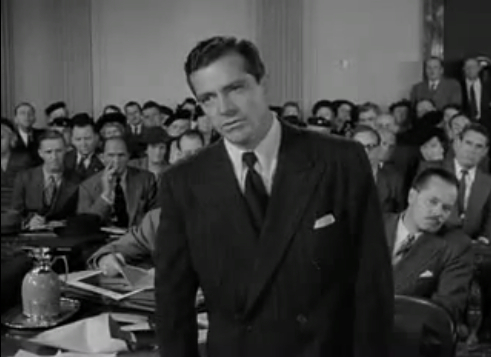
Maybe Kazan felt this way because this was an early work (his third feature), and he was still perfecting his style, but I can’t help but think he’s seeing a different film. Maybe he forgot to watch Andrews in the scene in the courtroom where, in order to recreate the crime, Harvey has one of his assistants shoot him with the loaded murder weapon. Andrews certainly isn’t melodramatic (though at one point, as Harvey deals with a gun-toting, blackmailing political hack, we do see a flash of Lt. McPherson from Laura). His performance is subtle and controlled, as in appropriate for a prosecutor, but it’s a very authentic. His Harvey isn’t perfect, just that rare person who will temper his ambition to see justice served. One of the ways Andrews makes him real is that he behaves differently at home than he does at work. (Most people do, maybe even you.)
This film isn’t on DVD, and Fox pulled most of it down from YouTube (hence the mediocre screenshots), so keep an eye for it on TCM. You don’t want to miss one of Dana Andrews’ best performances.
UPDATE:Boomerang! is actually available from ClassicFlix or via Amazon. You could do a lot worse than buying this film. Thanks Stephen!
Not that anyone noticed that I stopped doing my weekly TCM picks, but there’s a very simple reason. My subscription to Now Playing, the TCM monthly magazine, ran out and I forgot to renew. Evidently I’m quite reliant on it because I missed two months of it and it’s too difficult to do picks without it. Everything is back to normal this month. Just so you know 🙂
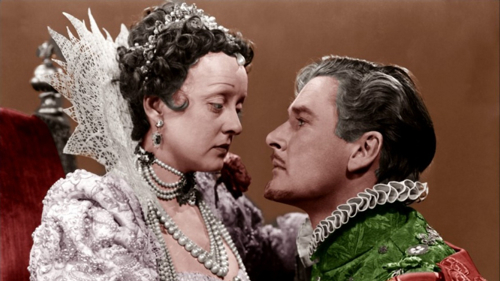
Apparently Bette Davis (as Queen Elizabeth I) slapped Errol Flynn (as the Earl of Essex) so hard during the filming of Elizabeth and Essex that he saw stars.
Monday, June 4
8:00 p.m. The Private Lives of Elizabeth and Essex (1939) ***TCM PARTY***
Possibly in honor of Elizabeth II’s real-life Diamond Jubilee, TCM has two Elizabeth I-related films tonight, the #TCMParty Private Lives at 8:00 and The Virgin Queen (1955) following at 10:00, both with Bette Davis as Britain’s best-loved monarch. (I just conducted a scientific poll via Google search and she is the one royal about whom people have the least bad things to say.) Watching her run a country while trying to keep the Earl of Essex (Errol Flynn) and Walter Raleigh (Richard Todd) in line is quite a treat. Apparently Davis and Flynn were no more well-matched than their characters and feuded during filming to the point of physically injuring each other. Despite this, or because of it, this is a great period drama, with beautiful costumes, sets and lighting. Watch for Herbert Marshall and Joan Collins in Virgin Queen. Watch and tweet along with #TCMParty.
There’s a couple other people in the picture but whatever.
Tuesday, June 5
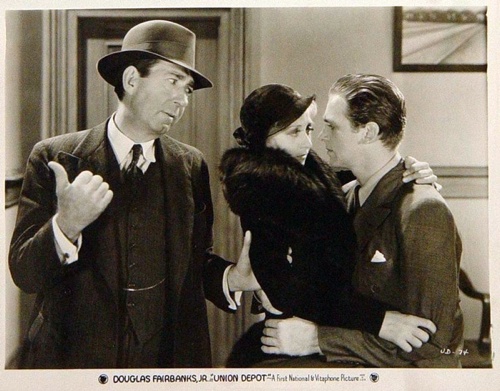
12:45 a.m. (Weds) Union Depot (1932)
A rather racy-sounding pre-code picture chosen for the presence of Joan Blondell and the fact that it takes place in real time, 20+ years before High Noon.
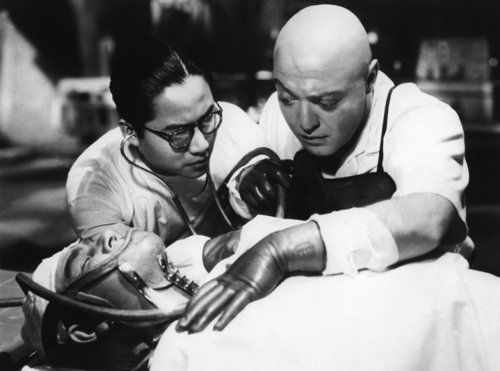
Looks like Orson Welles borrowed heavily from Peter Lorre’s look in Mad Love for the older Charles Foster Kane.
Wednesday, June 6
TCM has scheduled a bunch of 1930s horror films for daytime, several of which —Island of Lost Souls, Mark of the Vampire, The Hunchback of Notre Dame (1939) — have the gorgeous Expressionistic cinematography I love so. I’ve chosen two I’ve not yet seen. Doctor X (1932) at 7:45 a.m. was directed by the versatile Michael Curtiz (Casablanca) and is sung about in “Science Fiction/Double Feature,” the first number in The Rocky Horror Picture Show. Mad Love (1935) at 3:30 p.m. shares a cinematographer, Gregg Toland, and some details with Citizen Kane. This film is one of several based on the novel Les Mains d’Orlac and it will be interesting to compare to The Hands of Orlac (1924), which starred Conrad Veidt as the recipient of the titular evil hands.
Thursday, June 7
8:00 p.m. Jailhouse Rock (1957) ***TCM PARTY***
This is one of the best Elvis Presley movies, along with Loving You and Viva Las Vegas. Unfortunately, it’s also his only his third movie, and he made quite a few more. However, nobody delivers a classic line such as “That ain’t cheap tactics, honey. That’s just the beast in me” better than Elvis. With special #TCMParty guest host @CitizenScreen.Watch and tweet along
Friday, June 8
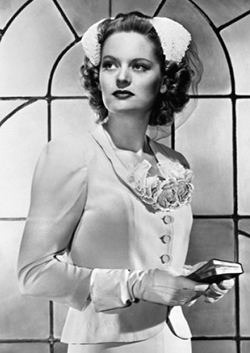
TCM has scheduled an unofficial block to honor Alexis Smith on her birthday. Born in 1921, this Canadian actress, though not as well-known today as some of her contemporaries, had a career in movies, stage and TV for more than 50 years.
7:45 a.m. Dive Bomber (1941)
Smith had uncredited roles in 12 films before landing this, her first credited role, opposite Errol Flynn and Fred MacMurray as the girl who comes between them in a WWII drama made just before the U.S. entered the war. (Her last film role was in Age of Innocence (1993)).
9:30 a.m. The Constant Nymph (1943)
I won’t even front like I like this movie. I find it very odd and at times ridiculous. Joan Fontaine is supposed to be a teenager who separates her composer cousin (Charles Boyer) from his wife (Smith). (Seriously, am I the only one who thinks this is weird?) By the end of the film, I felt they deserved each other. But I’m going to watch it again just for Smith, as I’ve read this was her breakthrough role which led to her parts in Night and Day (1946) and The Two Mrs. Carrolls (1947).
There’s a great summary of today’s TCM Gothic offerings here, courtesy of Classic Movies Examiner Jennifer Garlen.
Saturday, June 9
5:30 p.m. The Train (1965) ***TCM PARTY***
In the waning days of World War II, a French railway inspector who is also a member of the Resistance (Burt Lancaster…just go with it) is ordered by the Nazi-in-charge (Paul Scofield) to get a train through to Germany no matter what. Which wouldn’t be a big deal, except that nearly every important piece of art left in France is on that train. Directed by John Frankenheimer, this excellent film is an unpredictable chess match that’s as near to an anti-war statement as you’ll get in a WWII picture. Look for us on Twitter with #TCMParty.
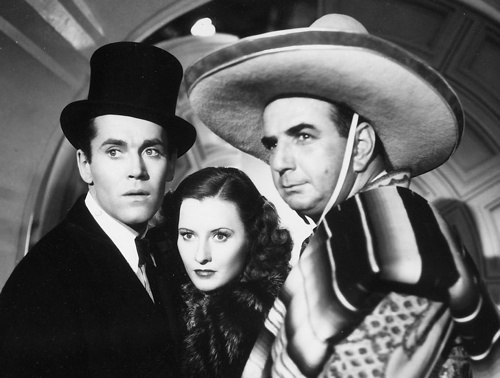
Henry Fonda, Barbara Stanwyck, and someone in a sombrero
midnight The Mad Miss Manton (1938) The Lady Eve co-stars Barbara Stanwyck and Henry Fonda made this lesser-known comedy three years before Eve. Let’s see…great chemistry in a comedy/mystery with Hattie McDaniel…i’m so there.
Sunday, June 10 JUDY GARLAND’S 90th BIRTHDAY
You can’t really go wrong with anything today.
Given the premise of what film and cinema may look like 40 years hence, I’ll opt for the convenience of handheld devices, flatscreen home entertainment centers and personal 3-D glasses, now that the very first, infant steps of the future Blue Sun Consortium so well-loved in Firefly has put out a bid for the AMC chain of theaters here in the U.S.
Now, as to what cinephiles, movie buffs and assorted hormonally-driven teens will want to view. The sky and its opposite end of the spectrum are the limit. Though Classics will always be present to fall back on. Be it for nostalgia sake. Or just to sit back and experience what good really is and can be. There will always be a healthy clutch of films in dust laden cans ready to be spun up on a projector. Or taken to a lab to be cleaned up, re-mastered and brought back to life in whatever form of medium is in use at the time.
To that end, allow me to prognosticate and put forth three choices for what may be viewed and enjoyed by those of all ages in the future.
Bringing Up Baby (1938)
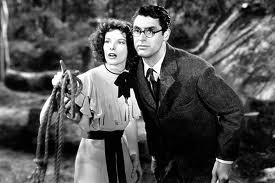
The definition of screwball comedies of the 20th century stars Cary Grant as David Huxley, a clumsy, mild-mannered paleontologist with Harold Lloyd glasses. Deep in the Sisyphian task of assembling the skeleton of an ancient Brontosaurus, David only needs one bone to complete the task. To add to his stress, David is engaged and soon to be wed to a woman of means whose family can supply extra funding for David’s museum.
Cary Grant gets mixed up with Katharine Hepburn and her zipper in BRINGING UP BABY
Seeking surcease, David decides to play some golf the next day and meets a striking, fast-talking Katherine Hepburn as Susan Vance, madcap extraordinaire and niece of his future mother-in-law. Susan plays by her own rules and speaks her mind. The repartee between David and Susan is as over-layered, stepped-on, and Hawksian as it is flat-out hilarious! With David constantly trying to catch up when to two meet again at a resplendent, elegant restaurant and night club.
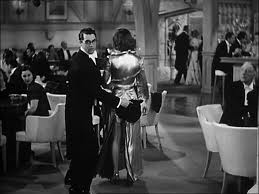
Rapid-fire banter turns into a whispered argument that segues into an accidentally ripped and torn skirt of Susan’s evening gown. Which David tries to cover as best he can with his top hat and quick turns as they seek club’s front door. For a quick trip to Susan’s family’s palatial manse and manicured grounds. Where David is introduced to kith and kin, including a leopard from Brazil named ‘Baby’ and a terrier named ‘George,’ who slyly buried the essential Brontosaurus bone the ‘intercostal clavicle’ somewhere beyond the house while ‘Baby’ ambles away into the night.
Desperately seeking George
What follows is a primer on comedic timing, quips, pratfalls and stalking through foggy woods and narrow streams. Interspersed with choruses of “I Can’t Give You Anything But Love” which Baby likes, as David and Susan search high and low. Accidentally break windows while seeking assistance. Run afoul of the law and are locked up in the Constabulary’s jail. Where Susan takes on the voice, slang and body language of a gangster’s moll. An incredibly funny few moments that involve a second leopard and mistaken identities. Until a friend of the family arrives and straightens things out.
David goes his way. Susan and Baby go theirs. The intercostal clavicle is recovered and Susan takes it to a now busy David high atop the incomplete Brontosaurus on tall scaffolding to make amends. When Susan sees a nearby flimsy ladder…
Casablanca (1942)
The film that solidified Humphrey Bogart as a romantic leading man still manages to pack a heck of a lot of story and tell it well within its 102 minutes. Wondrously crowded, well designed and executed sets transport to a stylized Morocco, Casablanca, its shadowy casbahs and Rick’s Cafe Americain. The hub of all things curious and worth noting by the Vichy constabulary and its German occupiers.
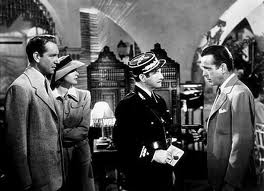
Paul Henreid, Ingrid Bergman, Claude Rains and Humphrey Bogart in CASABLANCA
Bogart plays Rick Blaine, expatriate American cafe and casino owner with a fixed roulette wheel that pays on 22. Who drinks alone, plays chess against himself. Has few friends. Is rarely impressed. While exuding an air of supreme clever confidence. Master of his own fate in a corner of the world where suspicion runs rampant and others beg, borrow and steal for exit visas and a way out.
Enter into this world skullduggery, Ilsa Lund. Spectacularly gorgeous Ingrid Bergman. Rick’s old flame from happier times in Paris, just before the Germans rolled in. Unfortunately, Ilsa has brought her husband along. Suave and elegant Victor Laszlo. Leader of the Free French movement and Public Enemy #1 of Conrad Veidt’s Major Heinrich Strasser and his minions. Who would be quite content to keep Ilsa and Victor right where they are.
Who, but director Michael Curtiz and writers Philip and Julian Epstein could wrap a deliciously moody love story around this foundation? As Rick politely reintroduces himself to Ilsa. Sparks flare to life. Aware that she and Victor are in need of a pair of exit visas that Rick possesses. The possibilities are endless as emotions sway. I’ll leave it right there for you to draw your own conclusions.
Goodfellas (1990)
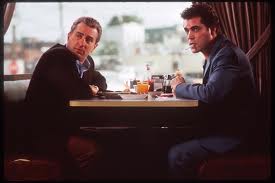
The life of Henry Hill. A Brooklyn kid who says, “As far back as I can remember. I always wanted to be a gangster,” is given the full blown Martin Scorsese treatment. In full blown, lush color. From Henry’s early years hanging out on street corners and parking cars for the meetings of made men he idolized. To huge tips being taken under the wing of slow moving, always cautious ‘Paulie’ Cicero. Henry climbs up the lower tiers of organized crime. Befriending a young young Joe Pesci giving wondrous psychotic life to Tommy DeVito and his friend, Jimmy ‘The Gent’ Conway, played with low-key deliberation by Robert De Niro.
Robert De Niro and Ray Liotta in GOODFELLAS
Life is good as Henry dumps school in favor of selling hijacked cigarettes to any and all. Until he is arrested for the first of several times. Surprisingly, the pinch helps rather than hinders Henry’s slow, yet steady climb up the criminal corporate ladder. Henry, now played by a smooth faced, lean Ray Liotta is all style and flash, but not a lot of substance. Part of Jimmy’s crew, Henry learns the ins and outs of the finer points of hijacking semi tractor trailers along the New Jersey Turnpike. When not robbing Idlewild Airport of its employees’ payroll. or burning down restaurants or clubs slowly taken over by Paulie and his friends.
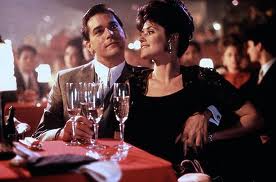
Henry falls in loves with, pursues and courts Karen. A stunning Lorraine Bracco with visits to famed New York nightclubs. Filmed in Steady Cam from the rear entrance. Through the kitchens and to a quickly laid out ringside table in time for Henny Youngman and complimentary champagne. Then taking the time to brutally beat a competitor close to death with a pistol who. Making Karen an accessory after the fact, by giving her the pistol to hide.
Ray Liotta and Lorraine Bracco enjoy the good times in GOODFELLAS
The good life continues. Henry marries Karen. The money rolls in and heists get bigger and bigger. Until one night when a made man runs afoul of Tommy. Is killed messily and buried somewhere Upstate. Then exhumed six months later when Jimmy finds out the land is going to be developed. The wheels start to come off. As Henry takes a mistress and Karen finds out. Threats are made and Paulie tells Henry to get back with Karen. Henry does. Then he and Jimmy go down to Florida to collect some betting markers and draw a delayed bust from the FBI.
Henry discovers drugs behind bars, though life there is better than for most. Against Paulie’s wishes, he continues in the trade as a major heist goes bad. And those involved get very sloppy and spend very conspicuously. Then pay for it rather sloppily to the strains of ‘Layla’ by Derek and the Dominoes. I’ll end it here, lest I get into Spoiler Territory.
Overall consensus
I’ve chosen three films which have stood the test of time. Masterpieces assembled by directors with the clout and ability to get superior writers, cinematographers, set designers. Then turn it all over to superior casts anxious to make their marks. Creating benchmarks that have aged well and improved with time. And will be amongst the first chosen decades from now.
What do you think of Jack’s picks? Are there other films that are already considered classics now and will remain so?
Monday, April 23
There seems to be a lot of good ’20s-’30s stuff on this morning and into the afternoon that I have never seen before, including most of the all-silent Laurel & Hardy block:
6:30 a.m. Putting Pants on Phillip (1927)
7:00 a.m. You’re Darn Tootin’ (1928)
8:00 a.m. Habeas Corpus (1928)
8:30 a.m. Big Business (1929)
9:00 a.m. Double Whoopee (1929)
9:30 a.m. Angora Love (1929)
There’s a Western block beginning at 8:00 p.m., including Ambush, Ride Lonesome with Randolph Scott, and Geronimo. One of my few favorites, Stagecoach, is on at 1:00 a.m. (Tues.). I don’t think anybody needs to see this quite as many times as Orson Welles, who reportedly watched it 70 times while he was making Citizen Kane, but I’m still going to DVR it.
Tuesday, April 24
8:00 p.m. The Way We Were (1973) ***TCM PARTY***
This day is singer/actress/director/Taurus Barbra Streisand’s 70th birthday and TCM is celebrating with a bunch of her movies beginning at 8 p.m. and going on into Wednesday morning. Our TCM Party, guest hosted by @CitizenScreen, is probably one of the best of Streisand’s films and certainly one of the most referenced in TV and movies. Complicated and serious Katie (Streisand) is in love with her total opposite, easygoing Hubbell (Robert Redford). Their different approaches to life drive them apart against the scary backdrop of the McCarthyist witch hunts of the 1940s. Join us by tweeting with #TCMParty…my late mother would be proud.
Wednesday, April 25
3:00 p.m. Crossplot (1969)
In the 1960s, an adman woos women at all hours and, with his loyal secretary’s help, manages to successfully deal with clients as well. Not Don Draper…Roger Moore, apparently as an art director, with his future M, Bernard Lee, in a supporting role. Yeah, I’ll be setting the DVR.
Thursday, April 26 Directed by John Cromwell
8:00 p.m. Sweepings (1933) Of Human Bondage (1934) director John Cromwell’s first film at RKO is a comedy about a department store founder (Lionel Barrymore) who works his fingers to the bone to build a legacy for his underwhelmed children.
Friday, April 27
8:00 p.m. Stage Door (1937) ***TCM PARTY*** Chosen by the TCM Party people (or those who voted anyway), tonight’s film follows the girls who stay at the Footlights Club, a boarding house for struggling New York actresses. It’s fun and snappy, with much of the dialogue improvised or taken from the stars’ actual conversations and re-written by the director, Gregory La Cava (My Man Godfrey). The cast includes Katharine Hepburn, Ginger Rogers, Ann Miller, and Lucille Ball. Tweet along with #TCMParty.
Saturday, April 28 Trevor Howard Block
Almost always described as a scene-stealer, Howard was never a big Hollywood star but he worked steadily for five decades. TCM’s got five of his films, beginning with The Third Man at 8 p.m. and continuing with the heartbreaking Brief Encounter (which basically established British film in the US), Mutiny on the Bounty (1962), The Charge of the Light Brigade (1968), and The Golden Salamander. His performance in Third Man is so appropriate to the character…quiet, understated, but so persuasive.
Sunday, April 29
7:00 a.m. The Falcon Takes Over (1942)
Yes, this is a poorly disguised version of the novel Farewell, My Lovely, which the producers bought from Raymond Chandler for a measly $2000 and bizarrely grafted onto another writer’s detective character. The title was even pinched from another film, The Saint Takes Over. But George Sanders is in it, so it’s here.
12:45 a.m. (Mon.) A Modern Musketeer (1917) ***TCM PARTY***
Our resident silent film expert @tpjost is hosting this TCMP, in which Douglas Fairbanks plays both D’Artagnan of The Three Musketeers and a contemporary version thereof, a guy whose gallantry and daring can match any 17th century swashbuckler. Look for us on Twitter with #TCMParty.
Monday, April 2
6:45 a.m. Born to Dance (1936)
Eleanor Powell and James Stewart in a good old-fashioned (by that I mean, sorta corny) musical full of mistaken identity and misunderstandings.
Tuesday, April 3
9:45 a.m. The Fugitive Kind (1960)
Film version of Tennessee Williams’ play Orpheus Descending, directed by Sidney Lumet and starring Marlon Brando, Anna Magnani and Joanne Woodward. A really weird movie.
8:00 p.m. Lover Come Back (1961) ***TCM PARTY***
Tonight’s Doris Day block begins with this ad-biz comedy in which Day and Rock Hudson play account execs for rival agencies. Their work philosophies and client relations skills are drastically, hilariously different (to say the least). Guest hosted by @mercurie80. Find us on Twitter with #TCMParty.
Wednesday, April 4 Doris Day Block
Tonight TCM spotlights Doris Day’s dramatic talents in four films: Midnight Lace (1960), Storm Warning (1951), The Winning Team (1952), and Julie (1956). Disturbingly she is beset by creepers in two of them.
Thursday, April 5
8:00 p.m. Please Don’t Eat the Daisies (1960) ***TCM PARTY***
A drama critic and his wife have a difficult period of adjustment when they decide to move from New York City into the suburbs. Find us on Twitter with #TCMParty.
Friday, April 6
9:45 a.m. Jewel Robbery (1932)
Don’t miss William Powell as a well-mannered jewel thief who’s fallen in love with his mark (Kay Francis). Their chemistry is pretty close to what he had going with Carole Lombard and Myrna Loy. Did I mention it’s a pre-Code?
12:45 p.m. The Man with Two Faces (1934)
This sounds really interesting. Edward G. Robinson plays an actor trying to shield his sister from her murderous husband, who seems to have her under some kind of hypnotic spell.
Saturday, April 7
3:00 p.m. The Great Escape (1963) ***TCM PARTY***
It is well-known to you all that I have a thing for World War II movies; not all of them are good, but this one is. A bunch of Allied soldiers try to dig their way out of a German POW camp — it’s the sworn duty of every British officer to attempt to escape! Based on a true story, it stars Steve McQueen, James Garner, Richard Attenborough, Charles Bronson and James Coburn. Find us on Twitter with #TCMParty.
Rita Hayworth Block
I’ve seen the first two of these and not the others but I doubt you can really go wrong.
8:00 p.m. Gilda (1946)
10:00 p.m. The Lady From Shanghai (1948)
11:45 p.m. Fire Down Below (1957) With Robert Mitchum and Jack Lemmon. Personally I’d tune in just for that.
2:00 a.m. (Sun.) The Happy Thieves (1961)
Sunday, April 8
TCM features mostly Christian-themed films today. One that caught my eye airs at midnight, Leaves from Satan’s Book (1919), a Danish silent film directed by Carl Theodor Dreyer. It depicts various historical events from the point of view of the “disheartened” Satan.
TCM Week spotlights a highly subjective selection of the week’s essential or undiscovered films on the Turner Classic Movies channel to help plan movie viewing, DVR scheduling or TCM Party attendance. All times are EST.

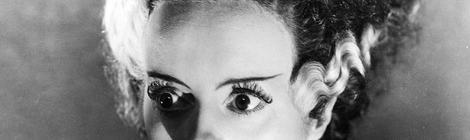
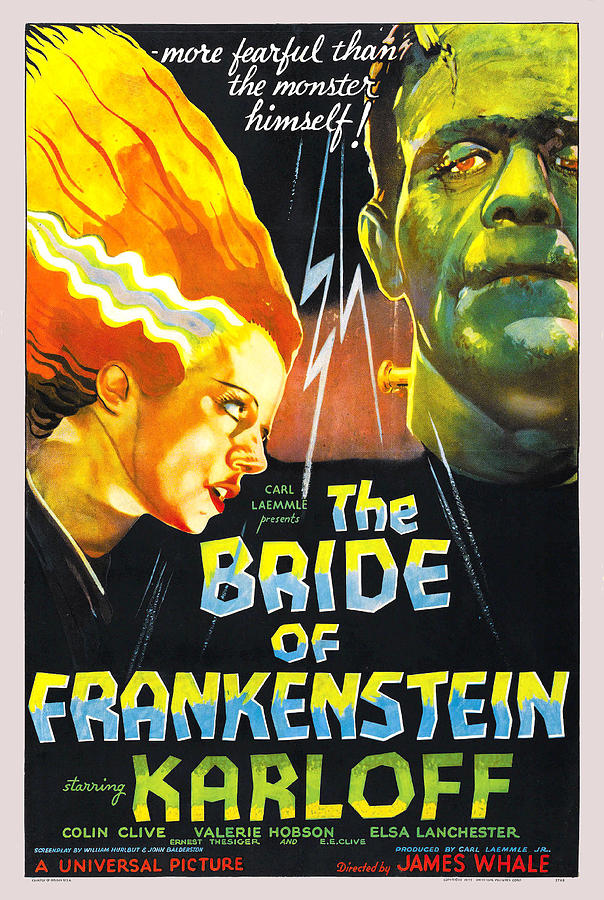 In Bride, a sequel to the wildly successful Frankenstein (1931), Boris Karloff returns as the Monster and Colin Clive reprises his role as Dr. Henry Frankenstein. This installment of one of the first horror movie franchises sees Dr. Frankenstein forced by another mad scientist to make a match for the Monster, with scary and sad results.




 Paula's Cinema Club