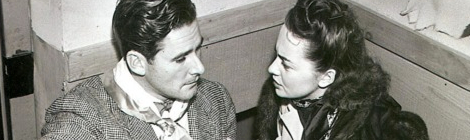
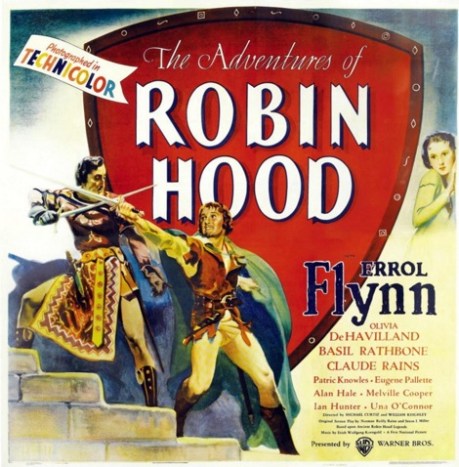
I don’t have a clever title, just a bunch of facts about one of my favorite actors, Errol Flynn, who was born on this day in 1909. The Adventures of Robin Hood was one of the first classic films I ever saw on a big screen, and the impression he made on my 11-year-old mind is basically indelible.
Ida Lupino and Flynn co-starred in Escape Me Never, which flopped; their friendship was a success. She is quoted as saying, “I loved Errol Flynn, who was one of my dear, dear, dear friends…He was just marvelous. Fun and well, a very kind person, very sensitive.” She gave him addressed him as “The Baron,” while he called her “Little Scout.”*
Two decent movies in which Flynn plays against type as uptight stuffed shirts are That Forsyte Woman (1949) with Greer Garson, and Cry Wolf with Barbara Stanwyck, which I like because it’s really Gothic and odd.
“Women won’t let me stay single, and I won’t let myself stay married.” Flynn was married three times. His first wife, Lili Damita, had been married to Michael Curtiz, whom Flynn disliked (per IMDB). He met his second wife at the courthouse where she worked in the snack bar…he was on trial. And according to his third wife Patrice Wymore, Flynn called her parents “to formally ask for my hand in marriage.” (Check out her gallery.)
Per IMDB, his autobiography, “My Wicked Wicked Ways,” was originally going to be called “In Like Me.” His daughter Rory’s web site is InLikeFlynn.com.
Flynn had a weak heart and had survived tuberculosis and malaria. He was classified 4-F and, despite repeated attempts to enlist in the military, couldn’t serve in World War II. Per IMDB, this was his only regret in life. He had his first heart attack in 1942.
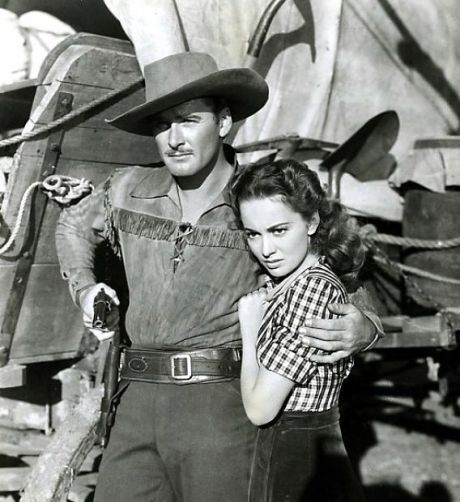
He co-starred in eight films with Olivia de Havilland, but apparently they never hooked up in real life, which is a shame. They seem to have gotten along very well. She talks about him starting around the 3:10 mark of this clip:
I don’t think it’s any coincidence that de Havilland is in all three of my favorite Errol Flynn movies — Robin Hood, Captain Blood and Dodge City.
Flynn and de Havilland…something about Dodge City…these two are all you really need
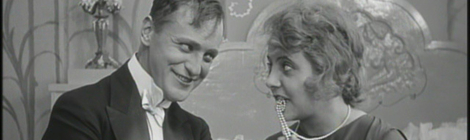
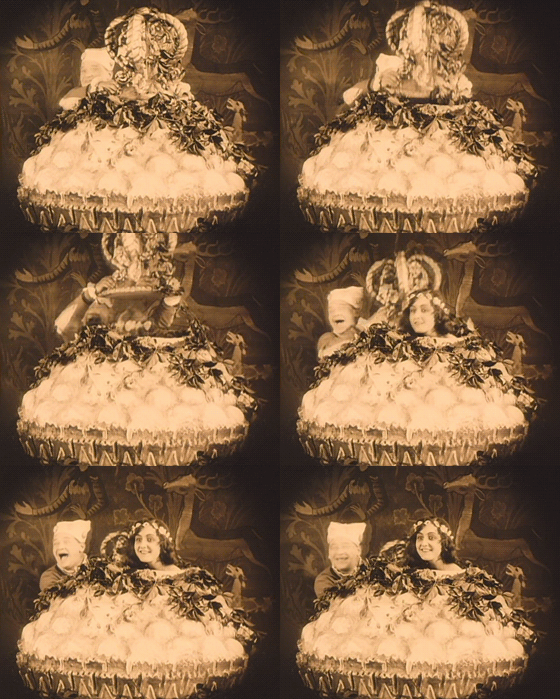
Ossi’s father is the Oyster King of America and she has decided that she deserves nothing less than a European prince. Nucki is the penniless prince in question but a few cases of mistaken identity later, all plans are in shambles. Hidden amongst the the wacky hijinks is some pointed social commentary courtesy of director Ernst Lubitsch.
“I’ll buy you a prince!”
When most people think of silent German cinema, the phrase “romantic comedy” does not spring readily to mind. Classics like Nosferatu and The Cabinet of Dr. Caligari may get all the glory but German filmgoers of the silent era liked light films just as much as their American counterparts.
And the Germans had a secret weapon: Ernst Lubitsch.
While he was brought to Hollywood on the strength of his historical spectacles, Lubitsch’s great talent lay in sophisticated romantic comedy. Any fan of classic…
This review contains spoilers. Just about every sentence is a spoiler!
I have to admit my expectations for Man of Steel were pretty high. And it did get pretty close. If I was giving out grades, it would get a B, maybe even a B+. But an over-reliance on explosions and effects for the IMAX/3D crowd unfortunately dilute the impact of an otherwise excellent movie.
The good:
Henry Cavill as Superman and Amy Adams as Lois Lane. As I expected, Cavill expertly conveys the humility, goodness, and dry wit that work for this character. His American accent is perfect (and pretty neutral for Kansas…but this guy has worked all over the continent apparently). Let’s face it, it doesn’t hurt that he’s as handsome and almost incredibly fit as a Superman should be. Adams is convincing as a determined reporter who just can’t leave well enough alone. She isn’t sassy, just strong-willed. I liked that the character didn’t immediately go to pieces at her first sight of Superman…that’s not right for a hardboiled reporter, which is what Lois should be. These two have an easy chemistry that I’d like to have seen more of (more on that later).
In addition, I’m glad the writers found a rather clever way out of the conceit of Lois not knowing who Superman is, one that both strengthens the Lois character and furthers the plot. The idea that Superman’s identity is a secret to Lois was never believable to me — she’s a brilliant reporter and she can’t figure it out right away? Plus it’s always annoyed me that she didn’t recognize him supposedly because of his glasses, probably because I wear glasses myself. I think I basically look the same with or without them!
The casting. I think it’s excellent, from Russell Crowe and Ayelet Zurer as Clark’s birth parents, to Diane Lane and Kevin Costner as his adoptive ones, from Richard Schiff as the requisite scientist, to Christopher Meloni and the ever-reliable Harry Lennix as a military colonel and general respectively, it just works. Michael Shannon is an appropriately detestable Zod and parallel to Kal-El/Clark. And why didn’t it occur to anyone to cast Laurence Fishburne as a cranky newspaper editor before this? I really liked his take on Perry White. In addition, care was taken with the younger versions of Clark so that the actors playing the character at different ages actually look plausibly alike.
The structure of Superman’s back story. While the circumstances surrounding his birth kick the film off, much of Clark’s childhood is recounted in a series of flashbacks, which are triggered by seemingly ordinary occurrences in his life. While a couple of the people I saw this with were annoyed by it, I found it to be naturalistic and quite easy to follow.
Spot-on depiction of the severe ADD resulting from Superman’s powers. Sitting in a classroom at school, young Clark is bombarded with hundreds of stimuli, well-represented on film. Although I don’t have it nearly as bad, if you’ve ever wondered, that’s basically what it’s like.
The religious references. Superman is like Moses — a foundling, outcast from “normal” society — and he’s also like Jesus — Kal-El/Clark Kent was uniquely conceived, he is 33, he excels at turning the other cheek, and he sacrifices himself to save humanity. Also Jor-El (Crowe) becomes a computer-driven “ghost,” who believes Clark will be received as “a god.” All of this taps into elementary archetypes and helps to overcome the fact that we don’t really see enough motivation for Superman to save the people of Earth. Other than his parents, the only person who treats Clark with any shred of decency is a kid whose life he saves. So why should he bother? That’s why.
The not so good:
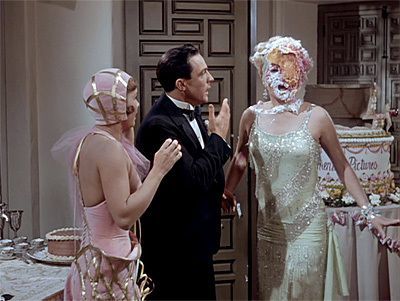
This is a CANDID, people. How do you mess this up?
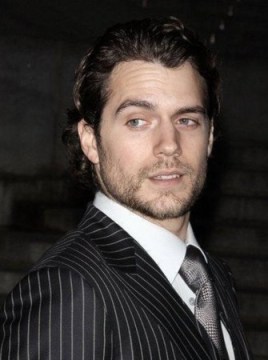
Cavill’s hair. I thought it was impossible to botch perfection but somehow they managed to goof up Henry’s look, at least part of the time. His hair style and color change from scene to scene and it became a distraction. This is very minor compared to…
Not enough interaction between the characters, and too much big multi-stage battle between Zod and Superman. The mass destruction of Metropolis goes on way too long, becoming tedious. This film has a handle on epic, particularly the flying scenes and big beautiful images, courtesy of director Zack Snyder and DP Amir Mokri. What interaction there is, worked well; I just wanted more of it. I wish there was a way to magically re-distribute some of the time spent on dismantling skyscrapers and put it into the characters’ relationships. It’s this unbalance that tips Man of Steel from excellent to pretty good.
I was recently pleasantly surprised to find that the talented and prolific Movies, Silently had very sweetly presented me with the Super Sweet Blogging Award. Thanks very much! I LOVE these 🙂
The rules:
1. Thank the Super Sweet Blogger that nominated you.
2. Answer 5 Super Sweet questions.
3. Include the Super Sweet Blogging Award in your blog post.
4. Nominate a baker’s dozen (13) other deserving bloggers.
5. Notify your Super Sweet nominees on their blogs.
Oops!
The questions: 1. Cookies or cake?
Wow, this is a tough one. I think cake because gluten-free cake is usually better than GF cookies. (I don’t have celiac or anything, I just feel better when I eat less gluten.)
Surprise! [Gif by Trevor]2. Chocolate or vanilla?
Chocolate. Vanilla is good too, then strawberry or raspberry. We are talking about ice cream, right…?
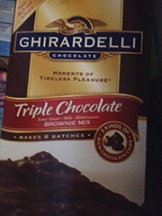
These can be had for a very reasonable $10 for 6 batches at your friendly neighborhood Costco
3. Favorite sweet treat?
If I have a sweet tooth, just about anything with chocolate in it will do. But my all-time favorite is Ghirardelli Triple Chocolate brownies. Yes, from a box. Like Movies, Silently, if I have some time, I make flourless chocolate cake. This recipe from Nigella Lawson is pretty good.
4. When do you crave sweet things the most?
I guess after I’ve eaten something really spicy. That said, it doesn’t happen that often. My real problem is anything fried and/or salty. Potato chips and french fries are my biggest diet problem.
5. Sweet nickname?
Not especially…my family called me Jitterbug as a child because I couldn’t sit still. I’m a lousy dancer though.
I understand that these awards aren’t everyone’s cup of tea and that everyone is busy, so if you would prefer to answer the question in the comments below, or not answer at all…that’s fine by me, I’ll still think you’re sweet. Also, to keep the award moving, I tried to pick people who to my knowledge have not yet received a Super-Sweet (with one exception, bwahahaha). The graphic is by me, feel free to use or not.
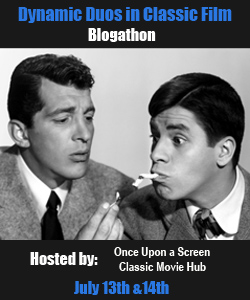
Laughs, love, danger and adventure – TIMES TWO! It’s the Dynamic Duos in Classic Film blogathon!
In a co-host gig with the fabulous Classic Movie Hub(@ClassicMovieHub), Once Upon a Screen (@CitizenScreen) is happy to announce this upcoming blogathon event dedicated to perilous, precarious and/or personable pairs.
Dynamic Duos in Classic Film blogathon
The duos can be…
Romantic:
Professional partners:
Adversaries:
Siblings:
Or non-human, for that matter. But they must be classic – in the traditional sense, which for this event is designated to any film, character, personality, etc. before 1970 in order to stay true to the themes of both host sites. You can be as creative as you want – any on-screen duo you wish to write about is welcome.
The details:
When: July 13 – 14
If you are interested in taking part, and we hope you are, please follow these…
On December 29, 1940, FDR coined the phrase “The Arsenal of Democracy” in a speech declaring that the United States would provide military aid to countries fighting the global threats of Nazi Germany and Imperial Japan. While he was referring to America as a whole, Detroit has rightfully claimed the title as its own. Indeed, the Detroit Arsenal Plant continues to operate to this day.
While World War II was won by the soldiers, airmen, sailors, and marines who braved enemy fire and paid the ultimate price, they were supported by factory workers here in Detroit and across America. During the war, Americans built roughly 50,000 Sherman tanks and 18,400 Liberator bombers, half of them by Ford Motor Company. Thus, when the Nazis destroyed a Sherman tank or shot down a B-24 Liberator, another tank or the plane would appear, relatively quickly. When the Allies knocked out a Nazi tank…
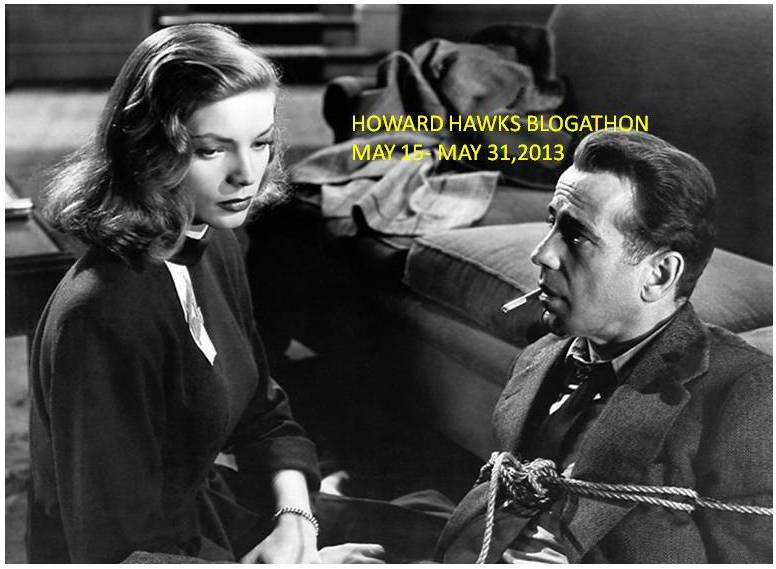
This post is part of the Howard Hawks Blogathon organized by Ratnakar at Seetimaar – Diary of a Movie Lover. The blogathon began on May 15 and runs through May 31. Check out these posts, there’s no one more deserving of a two-week tribute from some great bloggers than Hawks.
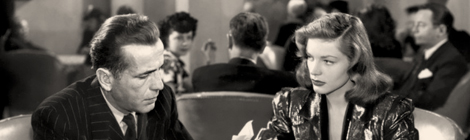
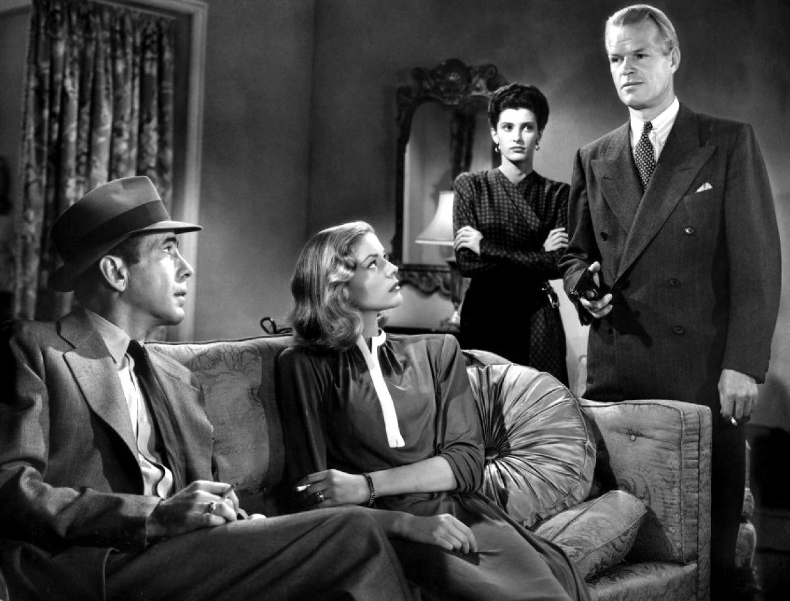
The image above is taken from Hawks’ The Big Sleep, which has a reputation for being a great yet somewhat incomprehensible film noir. No one can really deny the gritty atmosphere created by Hawks and his team, or the unmistakable chemistry between the leads, Humphrey Bogart and Lauren Bacall, which Hawks displayed to great effect. But, due to factors beyond Hawks’ control, the plot is a bit difficult to follow, supposedly even for the author of the book on which the film was based, Raymond Chandler. Any Google search will turn up the story that, when asked (by Hawks and the film’s writers) which character killed another, Chandler didn’t know either.
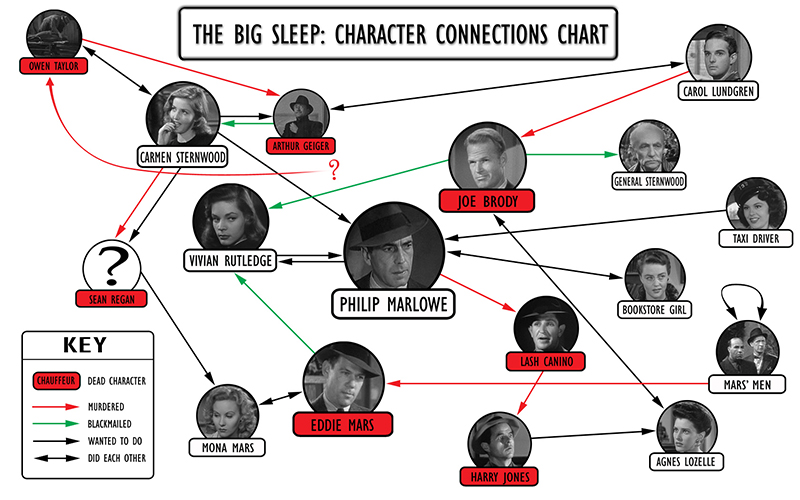
Whether the Chandler anecdote is true or not, it is certain that the transition to film further complicated the author’s already convoluted novel. How did this happen? Spoiler alert: There are plenty in here! If you haven’t read or seen The Big Sleep and you care about spoilers, stop reading and come back once you have read or seen it. Even if you have read the book or seen the film, you might want to refresh your memory before reading the rest of this post. This SparkNotes plot summary of the book is the briefest I’ve found. A diagram is always helpful as well.
Mostly accurate diagram from The Reelist. Though images from the film are used, the events depicted are those of the book.
Two major circumstances upon which the book’s cohesion depends ran afoul of the Hays Production Code. The first was that Carmen Sternwood (Martha Vickers in the film) kills Sean “Rusty” Regan (before Marlowe enters the story), making her older sister Vivian Regan (Vivian Rutledge in the film, played by Lauren Bacall) both a widow and an accessory to murder. The second is that Arthur Gwynne Geiger, who is blackmailing Carmen with compromising pictures, is a pornographer who is in a homosexual relationship with Carol Lundgren (who murders Joe Brody because he thinks Brody killed Geiger). Whew! Anyway, neither of these plot points could stand under the Code. The identity of Regan’s killer is fuzzy in the film; it’s implied, but never actually stated, that Eddie Mars killed Regan for messing around with Mars’ wife. Mars then evaded justice and collected blackmail from Vivian by convincing her that Carmen killed Regan. Neither the pornography, illegal in 1944, or the homosexuality are ever referred to; thus Sternwood family chauffeur Owen Taylor’s motivation for killing Geiger is unclear, and Lundgren’s motivation for gunning down Brody is greatly diminished. So that’s one layer of complication.
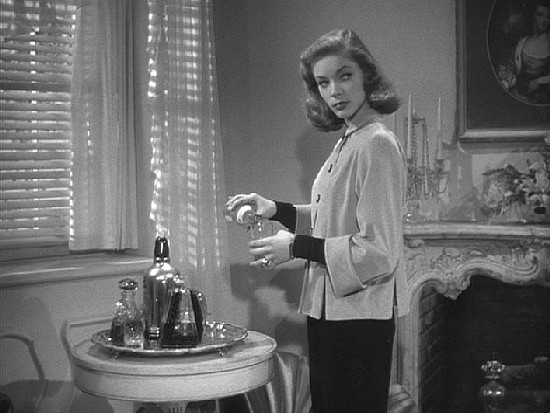
“I sat down…and looked at Mrs. Regan. She was worth a stare. She was trouble.” Lauren Bacall as Vivian
Further changes which don’t seem to significantly affect the plot were also made to the source material, to amplify Bacall’s role and strengthen Marlowe and Vivian’s relationship. Vivian is present in two major scenes from which she is absent in the book, one at Joe Brody’s apartment, and one at Eddie Mars’ hideout near the end. In the latter scene, it is Vivian, not Mona Mars, who unties Marlowe, helps him to escape, and accompanies him back to LA. There is a scene of her singing at Eddie Mars’ casino which is reminiscent of her début, Hawks’ To Have and Have Not. And her last name is changed to Rutledge; she is still a widow but not Regan’s, which arguably reduces any incentive she may have to find Regan. Some of these changes affect later scenes in the film, but they don’t seem to affect the overall action of the story.*
In the book, Vivian is not present in the scene at Joe Brody’s apartment. Her presence has no material affect on the plot though, because she’s gone by the time Brody is shot by Carol Lundgren
However, there are actually two versions of The Big Sleep, and this is where things really start to get cloudy… The first version, which is closer to the book, began shooting in October of 1944, and was completed in January 1945. Though it was ready for release in March of that year, it was shelved, and ultimately not released in its original form, for two reasons. First, World War II was rapidly winding down and Warner Brothers, like the rest of the studios, was looking to fast-track war-themed properties into cinemas as quickly as possible. A detective story without a time-sensitive theme could wait. Thus, Bacall’s film with Charles Boyer, Confidential Agent, though shot after Sleep, was released before.
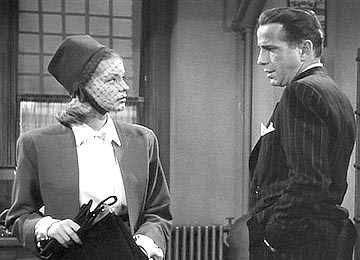
Which brings us to the second reason another version of Sleep exists: Bacall received reviews so horrible that they seemed to wipe out all the acclaim she’d received for To Have and Have Not. I’ve seen the film and I think they were overreacting. She is certainly miscast as an English aristocrat; the role should probably have gone to Margaret Lockwood or someone like that. But it’s Bacall, and she isn’t as awful as these reviews were. At any rate, her agent, Charles Feldman, who was also Hawks’ agent, wrote a letter to studio head Jack Warner, asking him to order a re-take of a scene which particularly bothered Feldman, known as the “veil scene,” and essentially requesting that “insolent and provocative” scenes, like those in Have Not, be added to Sleep, in order to save Bacall’s career and the film. Warner did order a re-take of the veil scene and the addition of more sassy scenes with Bogart and Bacall. Hawks re-assembled most of his cast and crew and filmed these in January of 1946.
The “veil scene” was cut and replaced with the scene in which Marlowe and Vivian prank the police.
For the 1946 version, which is the version usually shown on TCM and for big-screen revivals, Bacall’s part was further enhanced, and the plot further obscured. For instance, when Marlowe brings Carmen home from Geiger’s house, instead of leaving her with Norris the butler, Marlowe brings Carmen upstairs to Vivian’s bedroom, giving them an opportunity for a saucy exchange. This forces an alteration to the scene in Marlowe’s office which takes place the next day; Vivian can no longer say she wasn’t home the night before. The scene was dubbed over; if you look really closely, you can see it is a little off.
There are other changes, but perhaps the most important one is the deletion of an exposition-rich scene in the DA’s office, in which all the facts were laid bare as Marlowe is questioned by District Attorney Wilde and Captain Cronjager of LAPD. Don’t recognize those names? Both characters were completely cut, as they didn’t make sense without the scene. But it was replaced with this, one of the greatest extended double entendres ever:
To the great credit of Howard Hawks and his cast and crew, most critics and fans appreciate the mood of the film, the noir tawdriness of the characters, and the incandescent spark between Bogart and Bacall, and overlook, or even love, the disorder of the action. The Time magazine review of August 26, 1946 stated, “the plot’s crazily mystifying, nightmare blur is an asset, and only one of many,” and commended Bogart and Hawks for their work. Roger Ebert viewed both versions in 2009, and preferred the 1946:
The new scenes add a charge to the film that was missing in the 1945 version; this is a case where “studio interference” was exactly the right thing. The only reason to see the earlier version is to go behind the scenes, to learn how the tone and impact of a movie can be altered with just a few scenes….As for the 1946 version that we have been watching all of these years, it is one of the great film noirs, a black-and-white symphony that exactly reproduces Chandler’s ability, on the page, to find a tone of voice that keeps its distance, and yet is wry and humorous and cares.
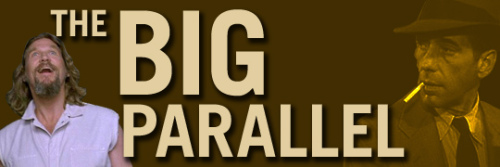
Possibly the most famous fans of The Big Sleep are Joel and Ethan Coen, who paid homage to it with their 1998 classic The Big Lebowski. (A classic doesn’t always have to be old.) There are many connections between the two films, and the best post I’ve seen on the subject is The Big Parallel by John at the droid you’re looking for. Check it out.
* Another aspect of the story that doesn’t seem to affect, well, anything really, is that we’ll never know who killed Owen Taylor. This is the question that so confounded Chandler and everyone else. As stated above, the Sternwood family chauffeur, who was in love with Carmen, killed Geiger because the latter was blackmailing her. Taylor was found murdered in the Sternwood family Packard, sunk off Lido Pier. I’ve read the book and watched both movies a couple of times, and I don’t believe it’s in there. We’ll never know for sure I guess, but I vote for Norris, the butler.
Aka straightup random, possibly non-original, musings about a classic… I have mixed feelings about any film adaptation of The Great Gatsby. It’s a Top 5 book of mine, and I just don’t know if a good film can be made of it. The writing is just too beautiful. For instance:
I looked back at my cousin, who began to ask me questions in her low, thrilling voice. It was the kind of voice that the ear follows up and down, as if each speech is an arrangement of notes that will never be played again. Her face was sad and lovely with bright things in it, bright eyes and a bright passionate mouth, but there was an excitement in her voice that men who had cared for her found difficult to forget: a singing compulsion, a whispered “Listen,” a promise that she had done gay, exciting things just a while since and that there were gay, exciting things hovering in the next hour.
Or how about:
Already it was deep summer on roadhouse roofs and in front of wayside garages, where new red gas-pumps sat out in pools of light, and when I reached my estate at West Egg I ran the car under its shed and sat for a while on an abandoned grass roller in the yard. The wind had blown off, leaving a loud, bright night, with wings beating in the trees and a persistent organ sound as the full bellows of the earth blew the frogs full of life. The silhouette of a moving cat wavered across the moonlight, and turning my head to watch it, I saw that I was not alone—fifty feet away a figure had emerged from the shadow of my neighbor’s mansion and was standing with his hands in his pockets regarding the silver pepper of the stars. Something in his leisurely movements and the secure position of his feet upon the lawn suggested that it was Mr. Gatsby himself, come out to determine what share was his of our local heavens.
And one more:
I began to like New York, the racy, adventurous feel of it at night, and the satisfaction that the constant flicker of men and women and machines gives to the restless eye. I liked to walk up Fifth Avenue and pick out romantic women from the crowd and imagine that in a few minutes I was going to enter into their lives, and no one would ever know or disapprove. Sometimes, in my mind, I followed them to their apartments on the corners of hidden streets, and they turned and smiled back at me before they faded through a door into warm darkness. At the enchanted metropolitan twilight I felt a haunting loneliness sometimes, and felt it in others—poor young clerks who loitered in front of windows waiting until it was time for a solitary restaurant dinner—young clerks in the dusk, wasting the most poignant moments of night and life.
Again at eight o’clock, when the dark lanes of the Forties were five deep with throbbing taxi-cabs, bound for the theatre district, I felt a sinking in my heart. Forms leaned together in the taxis as they waited, and voices sang, and there was laughter from unheard jokes, and lighted cigarettes outlined unintelligible 70 gestures inside. Imagining that I, too, was hurrying toward gayety and sharing their intimate excitement, I wished them well.
I could go on and on, but most people have read it at least once, and you either like it or you don’t. The 1974 movie, though lovely to look at, doesn’t really capture much of the “racy, adventurous feel.” It’s a bit inert.
Mia Farrow, Robert Redford
Although I’ve sworn off reading any reviews or blog posts about Baz Luhrmann’s version until I’ve seen it, I’ve nonetheless gathered that Luhrmann’s version may be a little more like how I imagined things from the book. At least it seems the parties are going to be appropriately wild. I’ve also gathered that there are a lot people who haven’t seen the movie yet but are less-than-thrilled to downright ticked off about it. It’s loud, frenetic, obnoxious, shallow and hollow. Well…yeah. Is that not what Gatsby and his world are? Is that not why Nick ends up back in the Middle West?
‘If Fitzgerald could claim he lived in the Jazz Age then, we live in the hip-hop age. So I wanted to make a translation,’ says Luhrmann, adding that the novelist – a failed screenwriter – was also fascinated by cinema. ‘Then, the big thing was sound; now, it’s 3-D.’
And Luhrmann felt that the story continues to resonate today with its themes of corruption and financial improprieties, greed, reckless pursuits of pleasures, disillusionment, cynicism and the excesses of the rich.
An article, “What Baz Luhrmann Asked Me About The Great Gatsby,” by James L. W. West III, professor of English and general editor of the Cambridge Edition of the Works of F. Scott Fitzgerald, who consulted on Gatsby, suggests that Luhrmann was extremely interested in getting the details right, while still modernizing the story. Luhrmann’s approach seems appropriate to me. Besides, frenetic is his thing. The source material is still relevant. If Luhrmann wants to lure some teenagers in with current music artists and 3-D…isn’t that his right? Who knows, they might learn something. I can’t guarantee it’s any good, but all I ask is, see it before you trash it.
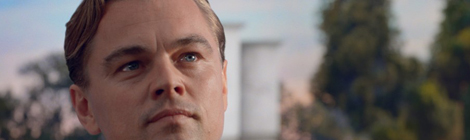
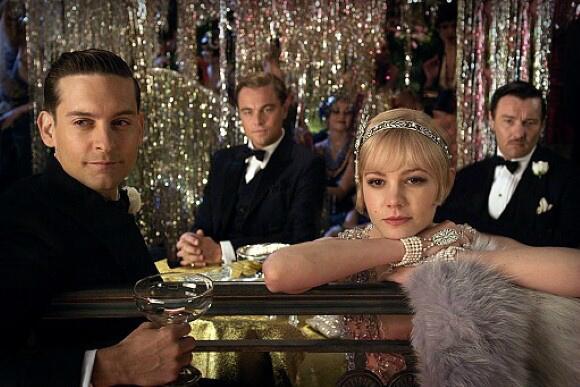
“The party has begun…” GATSBY (2013): Tobey Maguire, Leonardo DiCaprio, Carey Mulligan and Joel Edgerton
I’d be derelict in my duty if I didn’t mention the film’s design and marketing. Not only are the poster and the web site stunning, but on the site you can learn about the context and the making of the film in quite a bit of detail, and you can make your own wallpaper and stationery from your own Gatsby-fied monogram.
I could not resist this.
This won’t rescue a lousy movie of course, but it is kind of cool. They also have some interesting cross-promotions going on. The “JG” monogram you see on everything was designed by Tiffany and Co. with Luhrmann’s company Bazmark, and they’ve got some Gatsby merch, the Ziegfield Collection, a collaboration with costume designer and art director Catherine Martin.
The most authentic brand partner to me is Brooks Brothers, the brand F. Scott Fitzgerald wore and wrote about.
There are also deals with Fogal, Moet & Chandon, and the Plaza Hotel. Even if Luhrmann needed these long-established luxury brands to finance the film, they certainly were well-chosen. Most are referenced in the novel or linked with Fitzgerald himself. The close association serves to reinforce the fidelity to the period and also, perhaps unintentionally, strengthens one of the messages — that conspicuous consumption, in which Gatsby, Daisy, Tom, Fitzgerald, and just about everyone else indulges, is an eternal part of human nature.
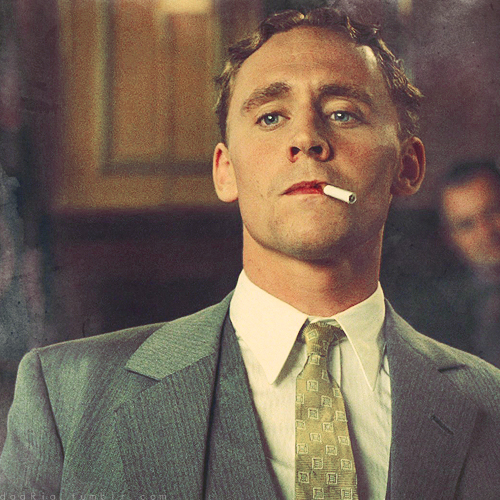
You didn’t seriously think I’d do a GATSBY post without a pic of Tom Hiddleston as Fitzgerald…did you?
Ratnakar has chosen one of my favorite directors, Howard Hawks, for a blogathon May 15-31, 2013. I’ll be writing about THE BIG SLEEP. Will you join us?
Howard Hawks, a name that evokes to me memories of a group of hunters, chasing down a rhino in the wilds of Africa, one of the most epic action scenes ever in movie history. Hatari was the first Howard Hawks movie I saw on the big screen, and was fascinated by the scenes of the animal hunts, especially the rhino capture. And that made me explore some of his earlier movies.
Howard Hawks to me was one of the greats of Hollywood’s Golden era, a man who directed movies that just about covered all genres. He could switch from zany screwball comedies like His Girl Friday to Westerns like Rio Bravo to a noir classic like The Big Sleep with ease. He was not a director you could slot in a specific genre, war, noir, Westerns, big screen adventure, screwball comedies, he just about covered all bases. He was…


















 Paula's Cinema Club