Libraries of books have been written about World War I. Historians still debate why the murder of Archduke Ferdinand and his wife Sophie resulted in a global war between countries that didn’t have any interests in the Balkans. They argue over why the generals of Great Britain, France, and Germany made the same mistakes over and over again between 1914 and 1918. Others argues that, actually, the generals didn’t perform that badly at all given the circumstances of the time.
There is no way to answer these questions in a simple blog post. Rather, I want to briefly describe how Stanley Kubrick’sPaths of Glory (1957) portrays The Great War, and to answer the question asked of every movie that portrays historical events, is it accurate? I’ll be honest. I’ve loved this movie since I first saw it in graduate school (while my main focus was medieval Europe, my secondary…
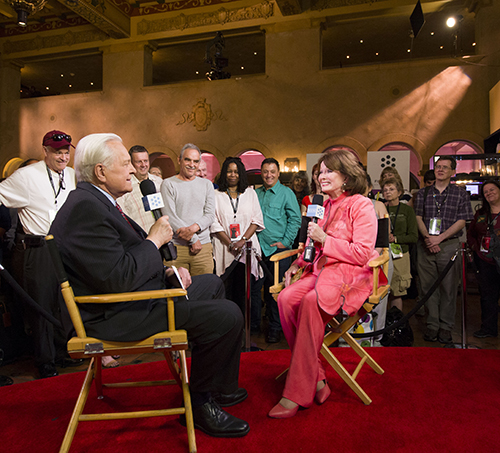
TCM’s host Ben Mankiewicz also did a media call on the Wednesday before TCMFF actually started.
As before, some highlights:
Lawrence Carter-Long, TCM’s co-host for The Projected Image, their series on portrayals of disability on film, will be back. Mankiewicz said, “I learned more from Lawrence Carter-Long than anyone else in 10 years with TCM….He is a resource we’ve used since and will continue to use.”
Mankiewicz loved that TCMFF included Airplane! as part of this year’s travel theme “when it looks like the whole thing was shot for $4.95. ‘See LAX…the inside of an airplane.’ Nonetheless, that’s a travel movie.”
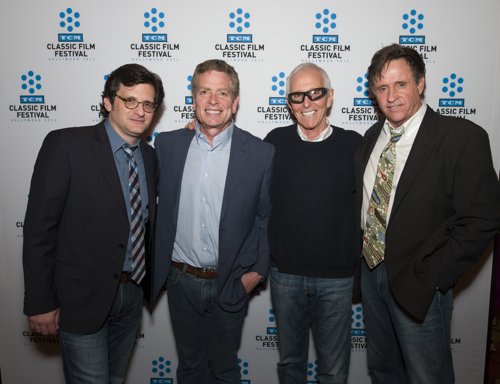
TCM host Ben Mankiewicz with David Zucker, Jim Abrahams and Robert Hays at Saturday’s screening of AIRPLANE! Photo courtesy of TCM
Film Noir Foundation’s Eddie Muller is coming up on TCM Friday nights with a series of around 20 films noir. Mankiewicz likes neo-noirs, particularly three involving John Dahl — The Last Seduction, Kill Me Again, and Red Rock West. “I’d love to make a case for us to show those, those are great films. You can clearly see Dahl had a keen appreciation of ’40s and ’50s film noir.”
TCM is featuring more films from the ’70s and ’80s, but not because there’s some kind of age requirement. “We have a very open mind as to what makes a classic movie. It’s not about years removed from a movie…the movies have to have some emotional connection for people. Because we learned that two-thirds of our audience is under 49 years old, we realized very quickly that most people have not seen most of our movies when they came out, or anytime even close to when they came out. So how did these movies become important to them? It’s probably through family connections, they watched with their parents or grandparents, or, what happens to me sometimes, because we shoot so far ahead, I don’t know what we’re showing, and like you guys, I’ll stumble on to a movie on a Saturday afternoon. As we get better perspective on movies, which does come with time, and as more of those titles become available, I suppose that you might see more ’70s and ’80s movies on TCM, but I always say that with a caveat: nothing is going to stop us from showing the movies we already show….In that sense, our programming won’t change. We always, always want to find something that will be relevant and emotional for our audience. There were a lot of great filmmakers in the ’70s, I think more so than the ’80s, if i could sort of flippantly dismiss an entire decade, which, by the way, was important to me. It’s what I grew up with, what are you gonna do? I can’t change when I grew up. So, i think you’ll see more ’70s and ’80s movies, but not to the extent that we’ll change what we already show.”
He has some choice in which movies he hosts on TCM, but not as much as you might think. “Charlie (Tabesh, TCM’s programmer) knows what I like, but in the end, I’m an employee.”
Re: a 16-year-old girl’s crush on Farley Granger: “It’s not gonna work out for her.”
Mankiewicz believes the Production Code was the result of Fatty Arbuckle’s three trials.
I also got to interview Mankiewicz for some of the shortest-seeming 15 minutes in my life ever. He isn’t the first interviewee from whom I’ve cadged refreshments, but he is nicest.
What’s your process for hosting on TCM? Anywhere from one day to three or four weeks before, they start sending me scripts. And I go through every one of them, and put them in my voice, add stories, take stories out. Same process for Robert. Some of them, when movies start coming back, I realize that what they sent is essentially what I wrote three years earlier, cos I’ll be like, i wrote this and then I’ll change it again, because I’m like, oh that sucked. That’s the basic process. The research department in Atlanta keeps track so that we don’t repeat the same stories. It takes a while to go through 200 scripts. We shoot them all basically in a row in a week. And by the way, it’s super-easy to get confused. I don’t pretend to not have to look stuff up.
Ben Mankiewicz’s notes. Photo by me
[At this point, I’d forgotten the questions I’d prepared. I also remembered something Robert Osborne had said earlier in the day; he studies up on people he’s going to interview because once a reporter looks at his/her notes, it’s no longer a conversation. Yikes. I decided to wing it.] Quentin Tarantino has a litmus test for potential girlfriends. He shows them Rio Bravo to see what their reaction is. Not that you would have something like that now, but did you ever have a film like that, and if so, what was it?
Good question. No, not off the top of my head, is there a film that did that. But I would know whether I connected with people based on what they liked, no question. Obviously from the time I was getting serious about girls, if a girl thought Fletch was stupid, obviously I’m not gonna go out with her. But that was at a time when I had no appreciation of classic movies. I mean, now, no question, I love Rio Bravo, that makes Tarantino so cool. I gotta find a cool answer to that. To me, like somebody who wouldn’t appreciate A Face in the Crowd, or wouldn’t be blown away by that, I couldn’t possibly have a serious friendship with them. That movie just gets me every time. It was so prescient, 53 years ahead of time. And also, if you’re not moved by Casablanca, if you make fun of Casablanca — whatever, we’re not sleeping together. Well, we might sleep together. But I’m not gonna call you.
You said you weren’t always into classic movies…what were some of the first ones that pushed you in that direction? My mom showed me North by Northwest. It’s funny how memory plays tricks on you, because I remember saying to Mom that I didn’t want to watch it because it’s black and white. She gets me to watch it, and it’s not black and white….And I remember thinking, this is really cool, and that guy is cool. Like all of a sudden. And it’s not like I didn’t know who Cary Grant was. But I associated him with something that I knew instinctively I was going to not like. When I went to college, I was always looking to do things as easily as possible. I took a film course at Tufts pass-fail, thinking this is going to be the easiest thing in the world. I was such an idiot. I wrote a paper, that counted for more than half the grade, on Santa Fe Trail. And I started doing the research. These guys weren’t in the Army together at the same time, this is all a wildly nonsensical re-imagination of how history worked. But they’re going after John Brown. The movie is made in 1940, and clearly, John Brown is a Hitler-ian figure in the movie, and I wrote about the historical context, and how, ironically, they’d screwed up history. And I loved writing the paper. It was so good. I got an A+. I remember thinking, I don’t think the professor thinks anyone wrote a better paper in this class. And of course, my thought wasn’t, I should pay more attention to film. My thought was, I can’t believe I took this class pass-fail. I cannot believe that I’ve just given away an A. So it was developing then. And then I went out to LA after I graduated, just to see family out here, and I went to a couple of parties, and I was introduced as Ben Mankiewicz, and people would say, “From the Hollywood Mankiewiczes?” And I’d say, yeah, and they’d be like, Hollywood royalty. Happened twice. And I was like are they thinking of someone else? It just started to come together how much my family mattered to a very small group of people, but it mattered a lot to that group.
Which actors/actresses working in Hollywood today would have done well in the Old Hollywood system, and vice versa? [This is a recurring question of mine.] I think a lot of the big stars then would have done well today. There’s no question, Clark Gable would have been a star, Cary Grant. Those are easy ones. Bogie. John Wayne. From now, George Clooney could work in any era. Robert Downey Jr., any era. If you own the screen now, the way those guys do…not only are they enormously talented, not only can they play a variety of roles, but they have that screen charisma. Clooney was my first thought, but I’m not sure that Downey isn’t a better answer. I don’t even really like the Sherlock Holmes movies, but he’s got a thing. Johnny Depp owns the screen. They are too charming not to succeed. The talent and looks that Ryan Gosling has, of course he’d succeed. Jessica Chastain, Jennifer Lawrence, no question. Chastain even looks like it. I don’t think there’s any doubt there. Penelope Cruz is another one. I don’t know how the language issue would have worked then. Maybe she’d have made Spanish-language movies, but she would have been a big star. Matt Damon would have been a star, and he’s not even that good-looking. Not in the same league as those other guys. For him, he just sort of exudes charm. He makes it work in so many different roles. I think there are many others. I don’t think things are even remotely lost in Hollywood right now. There are a lot of reasons now why Hollywood is totally f*cked up but that said, there’s still great stars, there’s great producers, and there’s great movies. But frequently the ones that get the most attention and marketing are embarrassments. But there’s still great movies being made.
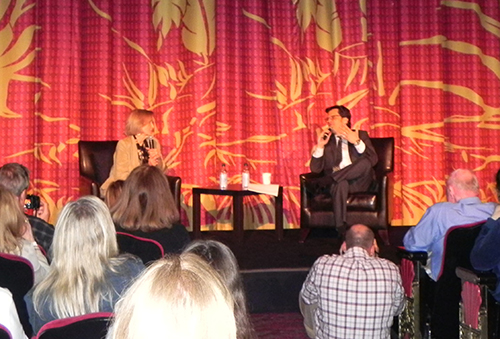
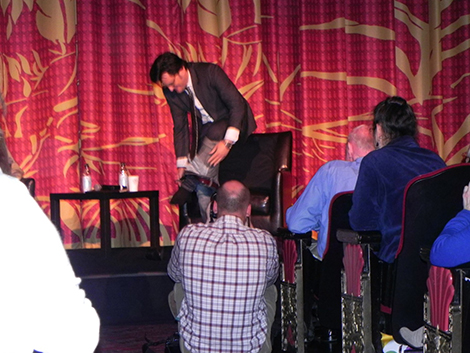
Eva Marie Saint and Mankiewicz before ON THE WATERFRONT, Friday night at TCMFF. It must be pretty cool to be friends with someone from one of your favorite movies 🙂 Photo by meSaint apparently likes to razz Mankiewicz about his wearing jeans all the time, so he took them off. Saint responded, “You almost gave me a heart attack.” Photo by me
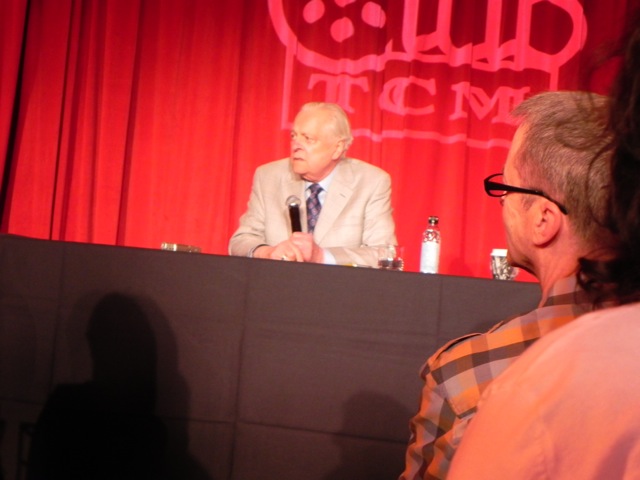
On the day before the Turner Classic Movies Classic Film Festival [TCMFF] officially started, the bloggers (and probably some traditional media too) gathered in the Blossom Room of the Roosevelt Hotel, aka Club TCM. I barely kept it together when Robert Osborne strolled in. I confess I’m a little in awe of him.
Photo by me.
[Osborne, on the other hand, is unflappable. On Sunday, confronted with boos and hisses at Grauman’s (he was talking about new owner TCL’s imminent IMAX conversion), he responded, “Don’t throw anything. Well, if you do, throw a Porsche.” As Porsche was a sponsor at the Festival, Osborne got to drive one all weekend and had just told us he really enjoyed it. Maybe you had to be there.]
Many others have covered this media call so I will relay what I thought was most interesting:
He didn’t know when he took the hosting job with TCM that he would be helping people to heal from illness or get through unemployment, or running a film course. I and many others can attest that he does both. Osborne wasn’t very enthused about the TCM Cruise in the beginning but “it’s so much fun now.” The people on the cruises sort themselves out by favorite star: “You go into a room, ‘OK now the Bogart people are going to be here at 5 o’clock, the Cagneys are going to be in Studio B at 4:30, the Stanwyck people…’ ”
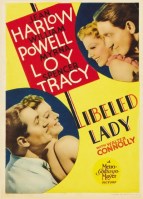
On the studio system & the Production Code: “For a long time, the studio system got so smacked down, and even people who were around at the time and had complained about it realize now that it was a great system…it worked very well. I also think that some of the best movies were great because there was a censorship thing….I don’t think the screen’s been improved by the fact that you can do or say anything you want onscreen that you want to say, because it’s now I think in the hands of people that don’t have any taste, and don’t know where the line should be….The [1946] Postman Always Rings Twice is much sexier than the one that was made [in 1981]. They’re doing it right on the kitchen table, and it’s not nearly so interesting. There were certainly bad things about the studio system and bad things about censorship, but there were good things that came out of it. I don’t think there’s anything like wit on film anymore. You see movies from the ’30s and ’40s, like Woman of the Year or Libeled Lady — they didn’t hammer you over the head with the comedy, there were no bodily fluid jokes like we have today. Having a cap on some of that stuff so that people had to sneak around it made it a little more clever.” He’s philosophical about the Grauman’s conversion, possibly because he’s co-owner of the only movie theatre in Port Townsend, Washington State. They recently upgraded to digital projection. “[Digital] is going to put a lot of small-town theatres out of business. So I’m for anything that’s going to restore theatres or make them more relevant. It’s very sad, because people love to go to the movies, and it’s going to be cut out for a lot of people….we did raise the money in Port Townsend, but only because of the kind of town it is.” Cher was super-professional during her filming for April’s Friday Night Spotlights. Osborne quipped, “No diva at all. It was a little disappointing actually.” They are both Tauruses, though Cher is on the cusp. I’m just saying.
Osborne interviews Ann Blyth on Saturday, April 27. Photo courtesy of TCM.
He was looking forward toFunny Girl, The Razor’s Edge, Cluny Brown, and Desert Song at TCMFF; and particularly to talking to Ann Blyth: “You can’t believe she’s in her 80s, and she’s so nice. I want to talk to her about how, when she was so effective as a mean daughter [Vida in Mildred Pierce], that you hated so much, why that never affected her career, and why she was never cast in a part like that again. She was able to not be typecast and that amazes me.” The “bosses at TCM” were surprised that younger people get into the channel [!!!] but Osborne wasn’t because they stop him on the street. He believes they will pass their love for classic movies on to their children, as so often their families did for them, and “hopefully it will go on forever, and hopefully you will all go on forever.” The feeling is mutual, Mr. Osborne.
A while back, I happened upon possibly the only site that may be a bigger time suck than tumblr….the Fan Magazine Collection put together by Media History Digital Library (MHDL). This remarkable archive contains full-page scans of magazines that you can browse through or even download to your computer for later consumption.
All’s well at M-G-M “the happy lot:” (L to R) Madge Evans, Robert Montgomery, Marie Dressler, John Gilbert, Anita Page, Joan Crawford and Clark Gable. Photoplay, May 1932.
The star of the show is MHDL’s complete set of Photoplay magazine, comprising all the issues from 1914 until 1940. These magazines are a gold mine for the classic movie fan…in just one issue, I found publicist-approved info like Mary Pickford’s secret for staying slim (hint: skip lunch), Clark Gable’s explanation of some pesky rumors, Myrna Loy and Carole Lombard’s hairdo tips, and addresses for all the stars, plus tons of images. They are also fascinating cultural artifacts, a window into U.S. society’s past concerns (which haven’t actually changed all that much.) This site will occupy more of your time than you probably can spare.
Joan Blondell. Photoplay, May 1932.
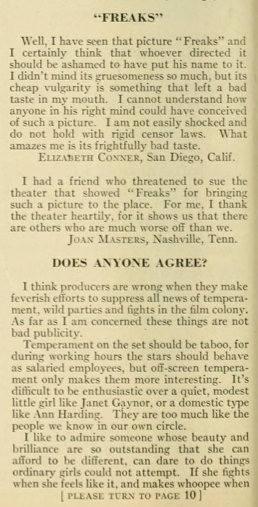
One of Photoplay’s interesting and often hilarious features is “The Audience Talks Back,” in which fans air their critiques and grievances. It’s like Twitter…only longer and on paper:
“No matter what the critics write, the audience always has the final word” — Letters to Photoplay, May 1932.
I cannot even imagine the work that went into scanning these, and MHDL has even more collections…for instance, the Early Cinema archive covers several publications from 1904 to 1919. All the collections are listed here. MHDL is a non-profit organization, “dedicated to digitizing collections of classic media periodicals that belong in the public domain for full public access…We have currently scanned over 400,000 pages, and that number is growing.” The scanning is paid for by collectors and donors, so if you see the value in any of this, please support their work — there’s a “Donate” button in the right sidebar.
TCM Week spotlights a highly subjective selection of the week’s essential or undiscovered films on the Turner Classic Movies channel to help plan movie viewing, DVR scheduling or TCM Party attendance. All times are EST.
Monday, February 27
As I’ve been saying all month, with the 31 Days of Oscar (ending March 2), it’s really difficult to go wrong. There’s a lot of well-known ones on the schedule for today, so I wanted to spotlight 1947’s Boomerang (3:00 p.m.), a lesser-known film noir considered by its director Elia Kazan to be his “breakthrough film,” in which he applied newsreel-style documentary techniques to Hollywood storytelling. However, he didn’t really value his star, Dana Andrews, so I’m interested to see how it all worked out. Nominated for Best Screenplay.
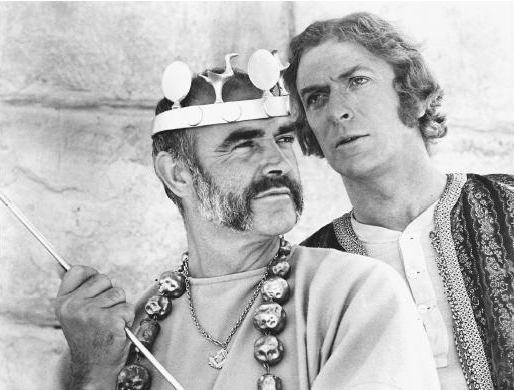
Tuesday, February 28 The Man Who Would Be King (1975) ***TCM PARTY***
John Huston directs a story by Rudyard Kipling in which a couple of ne’er-do-well British Army officers (Sean Connery and Michael Caine) are mistaken for gods and live it up…until the day they’re found out. Nominated for Best Art Direction, Costume Design, Film Editing and Best Adapted Screenplay. Check out #TCMParty on Twitter…watch and tweet along!
Wednesday, February 29
6:00 a.m. The Thief of Bagdad (1940)
I was so surprised to read about the tortuous production of this film. If it had a Facebook profile, its relationship status would be “It’s complicated.” And yet it turned out perfectly. Starring Conrad Veidt as the evil Jaffar and Sabu as the titular thief; directed by Ludwig Berger, Michael Powell and Tim Whelan (see what I mean?)
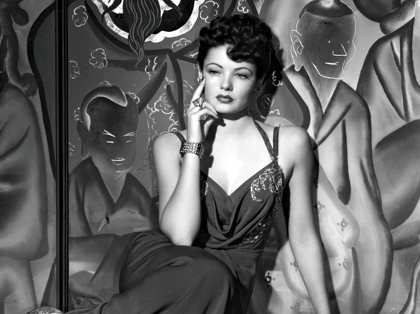
Gene Tierney as Poppy in The Shanghai Gesture.
8:00 p.m. The Shanghai Gesture (1941)
“[A] tale of murder and mayhem in a Chinese bordello” directed by Josef von Sternberg of The Blue Angel and Morocco fame. Nominated for Best Art Direction and Musical Score.
Thursday, March 1
10:30 p.m. From Here to Eternity (1953) ***TCM PARTY***
Various military personnel (Burt Lancaster, Montgomery Clift, Frank Sinatra) and their wives/girlfriends (Donna Reed, Deborah Kerr) experience trials and tribulations in the days leading up to the attack on Pearl Harbor. Won Best Picture, Director (Fred Zinneman), Screenplay, Supporting Actor (Sinatra), Supporting Actress (Reed), Cinematography, Editing, and Sound Recording. Nominated for Best Actor (Clift and Lancaster), Actress (Kerr), Costume Design, and Score. Check out #TCMParty on Twitter…watch and tweet along!
Friday, March 2
2:00 p.m. A Guy Named Joe (1943)
WWII pilot Pete (Spencer Tracy) is shot down and sent back to Earth to show a newbie flyer (Van Johnson) the ropes. Complications ensue when Ted begins courting civilian pilot Dorinda (Irene Dunne), who was Pete’s girl. I love this movie…guaranteed waterworks. Nominated for Best Writing (Original Story).
11:30 p.m. 2001: A Space Odyssey (1968) ***TCM PARTY***
Check out #TCMParty on Twitter…watch and tweet along!
Saturday, March 3
8:00 p.m. Some Like It Hot (1959) ***TCM PARTY***
I watch this every time it’s on and I think I recommend it every time. Jack Lemmon and Tony Curtis play musicians on the run from gangsters; the only band they can join is women-only. The grand-daddy of Tootsie, Mrs. Doubtfire, and Bosom Buddies. The 31 Days of Oscar ends on Friday, but I just want to point out that Hot won Best Costume Design and was nominated for Best Director, Actor (Lemmon), Art Direction, Cinematography, and Writing. Check out #TCMParty on Twitter…watch and tweet along!
Sunday, March 4
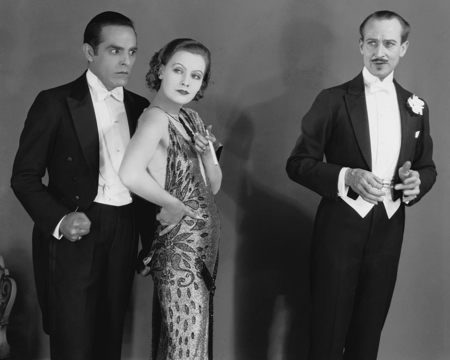
12:15 a.m. (Mon.) The Temptress (1926)
As I’ve mentioned before, I don’t know too awful much about silents. But I’m learning. This is one and it stars Greta Garbo as a, um, temptress.
4:00 a.m. (Mon.) La Jetée (1962)
A short film about time travel, created almost entirely from still photos, La Jetée influenced works as varied as a Sigue Sigue Sputnik video and 12 Monkeys.
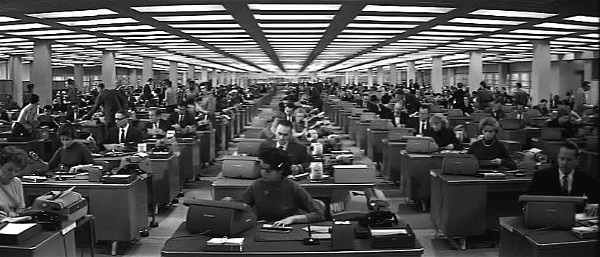
With the 2012 Oscars less than a week away, Ruth at Flix Chatter came up with an amazing idea: A bunch of bloggers each pick a past year’s Best Picture winner and defend (or not) its merits and win-worthiness. I chose the year 1961. There’s no question that the Best Picture Oscar race that year was an interesting one. All the films in the contest had mighty talent behind and in front of the camera; some had sweeping scope, literary sources, and/or exotic locations. The eventual winner, The Apartment, relied on a deceptively simple concept and a very focused, contemporary setting to work its magic. The apartment of the title is that owned by C.C. “Bud” Baxter (Jack Lemmon), one of thousands of workers at the bottom of the pecking order at a giant insurance company in New York City. So many people work in the company’s offices that the start and stop times of the business day are staggered, so that there isn’t too massive of a crowd trying to catch the elevators at the same time.
At some point before the movie begins, Bud had lent the key to his conveniently located residence to one of the office higher-ups. Soon the key was in high demand by married execs who needed a place to entertain their mistresses. Bud doesn’t want to rock the boat, and he does want to get ahead, so he’s agreed to every request. Not that it’s easy on him. Bud has to find something else to do between the end of the business day and 8 p.m., when his “tenants” are supposed to be out. They eat all his food, drink all his booze, and leave their dirty dishes around. It seems he’s got it made, though, when he gets promoted after the execs give him rave reviews. Called upstairs to see the sleazy vice president of personnel, Jeff Sheldrake (Fred MacMurray), Bud receives a promotion, complete with an office that has a window. There is only one condition…Bud must now loan his key exclusively to Sheldrake, which Bud agrees to do. Soon after, Bud discovers that the lovely company elevator operator Fran Kubelik (Shirley MacLaine) is Sheldrake’s mistress. Although Bud hasn’t quite figured it out yet, he is in love with Fran. When circumstances throw them together, his life really gets complicated.
Anonymous corporate office life, c. 1959
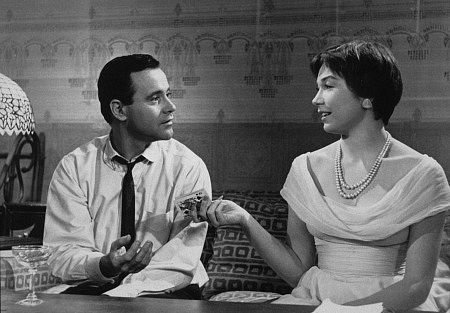
Billy Wilder directed and co-wrote the film and much of the time it has the trademark seriocomic vibe of another Best Picture nominee he wrote and directed, Sunset Blvd. (1950). The Apartment is both a satire of American corporate society, which seems not to have changed much since the late ’50s/early ’60s, and a charming, bittersweet romantic comedy. Wilder uses stunning wide shots of hundreds of desks or a seemingly endless park bench to emphasize the anonymity and facelessness of modern life, while using tight shots to signal the growing intimacy between Bud and Fran. His script laid the groundwork for really memorable, three-dimensional characters. The acting is uniformly great; Lemmon and MacLaine, who have some of the best chemistry ever, are perfect as two neurotics who take a while to realize they’re meant for each other. Fred MacMurray is astonishingly effective as one of the worst cads in a movie ever.
Shut up and deal: Jack Lemmon as Bud, Shirley MacLaine as Fran
The Academy recognized The Apartment with 10 Oscar nominations, of which it won Best Picture, Director, Screenplay (Written for the Screen), Art Direction, and Editing. Lemmon and MacLaine were both nominated as well, but competition was tough that year. Burt Lancaster, Trevor Howard, Laurence Olivier, and Spencer Tracy received nods for Best Actor, while MacLaine contended with Elizabeth Taylor, Greer Garson, Deborah Kerr, and Melina Mercouri. (Lancaster and Taylor were the winners. MacMurray wasn’t nominated at all, which I find inexplicable.)
In the Best Picture category, The Apartment faced formidable competition from four other excellent films, all of which were set in the past: The Alamo in 1836 Texas, Elmer Gantry in small-town America in 1927, Sons and Lovers in London and Welsh coal mines in the early 20th century, and The Sundowners in 1920s Australia. And I would argue that, The Apartment, set in contemporary New York City, deserved to win, because it has retained its relevance and has the most to say about modern American life.
The questions dealt with in The Apartment — What are you willing to give up to get ahead? Which is more important, love or money? — resonate in everyday life possibly even more today. It’s easy to see oneself in Bud, Fran or possibly even Sheldrake (though I hope not the latter). Even more people are working in offices than in 1960 and can readily relate to its situations and dilemmas. If anything, corporations are even larger and more faceless, and even more depends on a person’s ability to survive workplace politics, doublespeak and backstabbing. If, God forbid, anyone wanted to do a remake set in the 21st century, a different location, a few mobile phones, and some laptops would be all that is necessary to update it.* Yes, elevator operators and giant metal adding machines are a rare sight in 2012. But greed, manipulation, deception, and infidelity, as well as love, friendship, and generosity are all still alive and well. And the small scale and everyday setting of The Apartment makes its comedy and wisdom universal. Oscar-wise, The Apartment was a great choice.
*The location change is absolutely necessary because I don’t believe there is any way an entry-level employee could afford a place in the west Sixties, just half a block from Central Park, but I am told that wild Christmas parties still occur, though I’ve never been to one.
TCM Week spotlights a highly subjective selection of the week’s essential or undiscovered films on the Turner Classic Movies channel to help plan movie viewing, DVR scheduling or TCM Party attendance. All times are EST. Monday, February 6 Plenty of WWII movies today as TCM takes us to Eastern Europe and The Netherlands as part of the travel-themed 31 Days of Oscar.
4:15 p.m. Once Upon a Honeymoon
The rare Cary Grant movie I haven’t seen, in which his character tries to rescue Ginger Rogers’ from her ill-advised marriage to a Nazi.
6:15 p.m. To Be or Not To Be 1942 A crazy bunch of thespians including Carole Lombard and Jack Benny cope with the Nazi occupation of Poland and attempt in their own eccentric way to aid the Resistance.
8:00 p.m. Foreign Correspondent 1940 ***TCM PARTY*** Britain was at war with Germany but the Blitz hadn’t yet begun, and the USA’s entry into WWII was over a year away, when Alfred Hitchcock started shooting Foreign Correspondent. As the newsreel-style trailer suggests, the plot is ripped from the headlines. American newspaperman Johnny Jones (Joel McCrea) is dispatched to Europe to get the truth about the growing international crisis. Jones,with the help of a British reporter (George Sanders), attempts to unravel the asssassination of a Dutch official, as the leader of the Universal Peace Party (Herbert Marshall) and his daughter (Laraine Day) complicate matters. Hitchcock definitely intended to sway US hearts and minds, but he also created a suspenseful, compelling and underrated film, one of my all-time favorites.Find us on Twitter with #TCMParty…watch and tweet along!
Tuesday, February 7
8:00 p.m. Decision Before Dawn 1952
Along with Powell and Pressburgers The Life and Death of Colonel Blimp, this is one of the few films made during or just after WWII that portrayed Germans as potentially noble human beings instead of bloodthirsty killing machines.
Wednesday, February 8 11:45 a.m. The Search 1948
I’ve never seen this film, shot in documentary style in still-ruined Nuremberg after WWII. A boy (Ivan Jandl) who survived a death camp is adopted by an American soldier (pre-stardom Montgomery Clift) while the boy’s mother (Jarmila Novotna) looks for him.
8:00 p.m. State Fair 1933 ***TCM PARTY*** Hosted by @hockmangirl
Love and drama among farmers’ sons & daughters at the Iowa state fair in this “affectionate slice of Americana.” Find us on Twitter with #TCMParty…watch and tweet along!
Thursday, February 9
10:45 a.m. The Public Enemy 1931
James Cagney’s portrayal of a volatile street criminal on the South Side of Chicago made him a star.
10:30 p.m. Written on the Wind 1956
Douglas Sirk’s dramatic commentary on the American upper class, starring Rock Hudson, Lauren Bacall and Robert Stack.
Friday, February 10
3:00 a.m. Portrait of Jennie 1948
A starving artist (Joseph Cotten) finds inspiration when he falls in love with a beautiful girl (Jennifer Jones) who just happens to be a ghost.
Saturday, February 11 8:00 p.m. Wait Until Dark 1967 ***TCM PARTY*** This movie scares the heck out of me…Audrey Hepburn plays a blind woman held captive in her home by evil thugs. Find us on Twitter with #TCMParty…watch and tweet along!
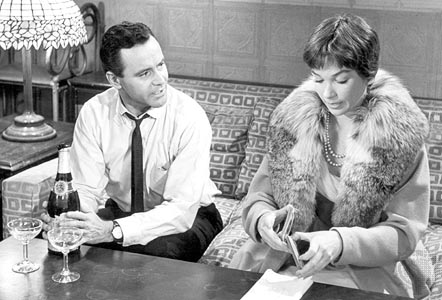
Jack Lemmon and Shirley MacLaine in The Apartment
10:00 p.m. The Apartment 1960 ***TCM PARTY*** Bud Baxter (Jack Lemmon), an ambitious employee, thinks it’s a good idea to let his married boss (Fred MacMurray) use his apartment for trysts with girls from the office. Until the elevator operator Bud’s in love with (Shirley MacLaine) is one of those seduced and abandoned. It’s a pointed satire of corporate (im)morals, with some comedy, sweetness, and chemistry between Lemmon and MacLaine to take the edge off. Find us on Twitter with #TCMParty…watch and tweet along!
Sunday, February 12
10:15 a.m. It Should Happen to You 1954
Another of my favorite Jack Lemmon movies, it also happens to be his first film, which eerily predicts the rise of reality stars who are famous for being famous, all hype and no talent. Judy Holliday is an unemployed model who gambles with her last dime on a billboard with her name on it and wins. But is fame all it’s cracked up to be?
Due to the SOPA blackout, I am a day late with my Cary Grant birthday post, but I am no less sincere. Writer’s block is troubling me for the second time in two weeks as I try to be original about how handsome, charming, and debonair he was, both in his movies and apparently in real life. As Audrey Hepburn said to him in Charade: “Do you know what’s wrong with you? NOTHING.” OK, that was dialogue between their characters…but still. And though at least some of the time American acting is about playing oneself, I also think Grant was a great actor. I’m thinking of Roger O. Thornhill’s disorientation and distress in North by Northwest, Johnny Aysgarth’s furtive shadiness in Suspicion, and John Robie’s desperation in To Catch A Thief.
My favorite Cary Grant moment, right at this moment, is his entrance in Indiscreet. He’s just there suddenly when Anna (Ingrid Bergman) turns around and she reacts pretty much as I would expect. The clip is here, he apparates in (yes, I do mean apparate) around the 7:55 mark.
I think probably the best tribute ever to Cary Grant has been done, by Michael Caine, courtesy of TCM:
So what’s your favorite Cary Grant movie, scene, or line? Leave a comment!
TCM Week spotlights a highly subjective selection of the week’s essential or undiscovered films on the Turner Classic Movies channel to help plan movie viewing, DVR scheduling or TCM Party attendance. All times are EST.
Monday, January 16 — Before Spike (Lee)
For Martin Luther King, Jr. Day, TCM is featuring a day of films related to how Americans dealt with race and racial issues. My top choice is The Defiant Ones (1958) at 6:15 p.m. Tony Curtis and Sidney Poitier play two men—one white, the other black— who escape from prison in the South. They despise each other, but they are literally chained together and have to learn to cooperate if they’re going to survive. At the time, American films hardly ever addressed racial inequity and almost never starred African-Americans. Neither actor was afraid to play against their usual likability; both Curtis and Poitier were nominated for Best Actor Oscars. The film also received nominations for Best Actor in a Supporting Role (Theodore Bikel), Best Actress in a Supporting Role (Cara Williams), Best Director (Stanley Kramer), Best Film Editing (Frederic Knudtson), and Best Picture. It won Best Black-and-White Cinematography and Best Writing, Story and Screenplay – Written Directly for the Screen. There’s no question that it’s an old-fashioned movie; Spike Lee felt that Poitier’s character was the prototype of the “Magical Negro.” But it does propose that if we don’t get to know those who are different from us, we’ll never respect or like each other either…something that as a society we still need to work on.
Tuesday, January 17
6:15 p.m. Saturday Night and Sunday Morning
Everybody’s workin’ for the weekend…especially Arthur Seaton (Albert Finney), a rebellious young Brit who works in a factory all week and just wants to unwind with a few pints and his best friend’s wife on his days off. Based on Alan Sillitoe’s novel of the same name, both book and film were part of the Angry Young Man movement in literature and cinema trending in Britain from the mid-’50s to the early-’60s. Saturday Night shares the same sensibility as Look Back in Anger, Room at the Top, A Taste of Honey, Billy Liar and The Loneliness of the Long Distance Runner. They’re a bit melodramatic, but these were the first British films to focus on the working class and portray their everyday lives. You might find the mood or some of the dialogue in Saturday Night familiar…this film and its movement have been an enduring influence on British (and thus, eventually, American) popular culture. For example, Morrissey of The Smiths borrowed lines directly from Saturday Night and generally made the AYM attitude a lifestyle; both the Stranglers and the Arctic Monkeys have albums named after this film.
1:30 a.m. (Wed.) Diary of a Chambermaid (1946)
Paulette Goddard plays a maid who records her impressions of the houses where she works. A rare chance to see Jean Renoir’s version of a novel of the same name by French writer Octave Mirbeau. Remade in 1964 by Luis Buñuel.
Wednesday, January 18 — Happy Birthday, Cary Grant
TCM honors the birthday of one of my favorite actors of all time with 12 hours of movies beginning at 6:15 a.m. If you can only watch one or two of these, my personal advice would be to choose from those in which sparks fly between Grant and his female co-stars, all great talents in their own right.
8:15 a.m. Topper (Constance Bennett)
10:00 a.m. Holiday (Katharine Hepburn)
noon In Name Only (Carole Lombard)
1:45 p.m. My Favorite Wife (Irene Dunne)
Happy birthday to all you hardworking, stylish Capricorns out there as well. Take some time for you and watch your knees. Love you guys.
8:00 p.m. The World of Harry Orient ***TCM Party***
Last night I saw a clip on TCM of Star of the Month Angela Lansbury describing her character in this as less than intelligent and not very nice. Sounds like a departure from type for her (although she wasn’t very pleasant in State of the Nation). She also said that she and co-star Peter Sellers improvised most of their dialogue, so this should be pretty interesting. Find us on Twitter with #TCMParty…watch and tweet along!
Thursday, January 19
Though his best-known films were done with Powell & Pressburger, cinematographer-director-genius Jack Cardiff had a lot of career outside of that collaboration. Tonight TCM has four films in which Cardiff worked with other directors, and while they might not be the greatest in terms of direction, acting, or writing, they certainly have effective and beautiful cinematography. If Faber & Faber are reading this, please bring out another edition of Cardiff’s book Magic Hour…the cheapest copy I can find is around $100!
8:00 p.m. Under Capricorn I see what you did there TCM
10:15 p.m. The Master of Ballantrae Roger Livesey Alert
midnight The Prince and the Showgirl The making of this film was apparently fraught with tension between stage-trained Laurence Olivier and Method proponent Marilyn Monroe. It formed the basis for the book and the film My Week with Marilyn.
2:00 a.m. Pandora and the Flying Dutchman
Friday, January 20 Bright Leaf (11:15 a.m.) caught my eye. I’ve never seen it but the cast includes Gary Cooper and Lauren Bacall, although she is apparently not the female lead; Patricia Neal is. It was directed by Michael Curtiz (Casablanca). Also of note is tonight’s Essential, A Letter to Three Wives. Joseph L. Mankiewicz (All About Eve, Suddenly Last Summer) wrote and directed this soapy look at three different crumbling marriages.
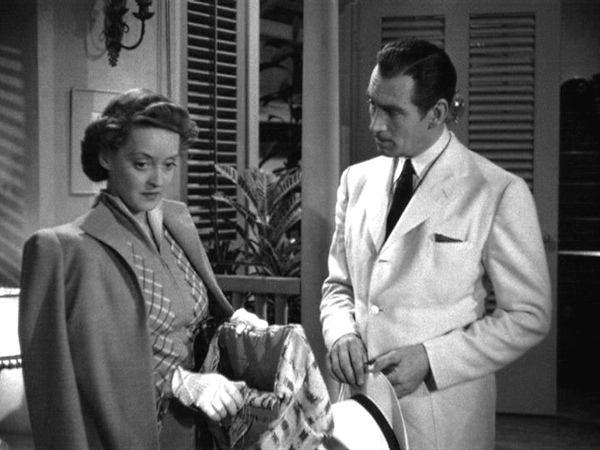
Was it self-defense or…gasp!…murder? Bette Davis and James Stephenson in The Letter
Saturday, January 21
midnight The Letter (1940)
Ms. Bette Davis is at her best as a woman claiming it was self-defense when she shot and killed a man one night in Malaysia. My favorite Bette Davis movie.
Sunday, January 22
8:00 p.m. Murders in the Rue Morgue (1932)
One of three films tonight starring Bela Lugosi, who along with Boris Karloff, provided many of Universal’s thrills and chills during the early ’30s.
2:00 a.m. (Mon.) Night of Cabiria
I’m not really all that familiar with Federico Fellini’s work, having only seen La Dolce Vita, but I wanted to give those who are a heads up.
So TCM fans…what are you watching this week? Any favorite Cary Grant movies? Leave me a comment!
I’ve had a horrendous case of writer’s block this week, trying to come up with something original to say about Orson Welles’ 1958 film noir masterpiece, Touch of Evil. As I noted last August, it’s practically impossible to say anything that hasn’t already been said about Welles and his work. After all, there are countless books and movie blogs rightly singing their praises, and Touch of Evil has long been regarded as a great of the film noir genre. But I’ve got to add my $.02 because Detroit Film Theatre is showing the film on Saturday, January 14 at 4:00 p.m. as part of their DFT 101 series. So I’ll just list why I’m so looking forward to this opportunity to see it as it was meant to be seen:
Touch of Evil is arguably the last in the film noir classic cycle. Welles’ own Citizen Kane is considered an important influence on what would eventually come to be known as film noir, and it’s clear that he had mastered the elements of film noir style, exemplified by his use of chiaroscuro lighting and subjective camerawork. Welles also wrote the film’s script, which contains most of film noir’s thematic elements. A hero (Charlton Heston as a Mexican narcotics officer named Mike Vargas) lost in a labyrinth of shadiness and duplicity, shadowed streets, corruption, and seedy characters. In Welles’ hands, it’s a feast for the eyes.
Welles also stars in this, his last American film, taking on the role of corrupt, alcohol-soaked cop Hank Quinlan. Quinlan’s jurisdiction is Los Robles, a seedy town on the Texas side of the U.S.-Mexico border where all sorts of crime occurs, but Quinlan seems to be the worst. We see him slowly losing even the pretension of moral authority, as he conspires against Vargas, endangers Vargas’ wife (Janet Leigh), plants evidence, drinks to excess, and generally acts as judge and jury, convicting anyone he doesn’t like, usually a Mexican.
It will be a joy to see the film’s opening sequence, a three-minute, 20-second long take, on the big screen. We are shown a bomb being armed and concealed in the trunk of a Cadillac, which we then follow over the border in an amazing continuous shot, that ends with the explosion of the bomb.
As Tana (Marlene Dietrich) might have said about the 1958 version of Touch of Evil, “Honey, you’re a mess.” Welles wasn’t allowed to control the film’s final cut. The studio’s version placed the credits over the long take, added a musical soundtrack to it, and added some scenes to the rest of the film — apparently the film’s plot was deemed to intricate for the average moviegoer. Thankfully, DFT will be showing the 1998 restoration, which was based on a painstaking 58-page memo Welles sent to the head of Universal Studios (who ignored it), so that what we see on Saturday will be as near to what Orson Welles intended as possible. Don’t miss it!







 Paula's Cinema Club