
The Great Debate Blogathon: THE CONSTANT NYMPH (1943)

The practice of “hate-watching” is not one I really understand. I don’t judge or begrudge anyone who does it, but my standard reaction to coming across a movie, TV show, or song on the radio that I don’t like is to change the channel. My knowledge of filmmaking is nothing like encyclopedic, but I know enough about it to understand that a movie of any quality is a synthesis of many different individuals’ ideas and expertise into a collective whole, and that getting any movie made is nothing short of a small miracle. My respect for anyone who has actually made a movie generally keeps me from saying a lot of negative things about the result or the people involved.

However, all of my equanimity goes out the window when the movie concerned is The Constant Nymph. For those who haven’t seen it:

Fourteen-year-old Tessa (Joan Fontaine) is hopelessly in love with handsome composer Lewis Dodd (Charles Boyer), a family friend. Lewis adores Tessa, but has never shown any romantic feelings toward her. When Tessa’s father dies, Lewis contacts her late mother’s wealthy family so they’ll take care of Tessa and her sisters. Lewis becomes taken with Tessa’s haughty cousin Florence (Alexis Smith) and the two soon marry and head off for Florence’s estate in England. Meanwhile, Florence sends Tessa and her sister Paula (Joyce Reynolds) off to finishing school. The girls run away from school and Tessa moves in with Florence and Lewis. Florence soon becomes consumed with jealousy over the bond between her husband and Tessa. (via IMDB)

This is the film I named as my pet peeve in a recent TCM Party podcast, and after a re-watch, I can tell you, that opinion stands. I know the majority is against me here, including lead actress Joan Fontaine herself; per several sources, this was her favorite of her films. But I just don’t like it.

The odd part about it is, The Constant Nymph has all the ingredients to be a favorite of mine too. I adore both Fontaine and Alexis Smith, and the supporting cast includes three of the best character actors ever, Charles Coburn, Peter Lorre, and Dame May Whitty, though she isn’t given a whole lot to do.

Behind the camera were some of the pre-eminent pros of the studio era. Cinematographer Tony Gaudio shot so many of my most-liked pictures that he could easily hijack this post — including, but not limited to, The Adventures of Robin Hood, Dawn Patrol, and The Letter (1940). Orry-Kelly designed the gowns. Erich Wolfgang Korngold wrote the score. And the director, Edmund Goulding, also helmed Grand Hotel (1932), Dark Victory, and Dawn Patrol, with uncredited stints on Queen Kelly and Hell’s Angels. (Yes, I have a thing for Dawn Patrol. So sue me. Have you seen Errol Flynn in it?)

So what happened? Why do I feel that the befuddled doctor’s statement “It is my opinion that you are much more than slightly mad” applies to anyone who would sit through Constant Nymph a second time?
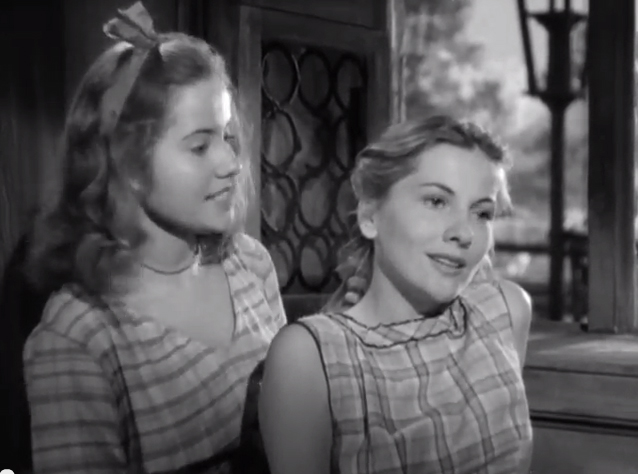
CN-Paula-TessaTo begin with, teenaged Tessa is, to me, a very rare misfire for Fontaine. She is beautiful in a fresh, unspoiled way, lively and mischievous. She just doesn’t seem like a teenager. I know times are different now and maybe that’s why. But I find her character grating and excessively artificial, and she’s in almost every scene. Her sister Paula’s assertion, “The way you moon over [Dodd], it’s enough to turn one’s stomach” is unfortunately true for this viewer.

(As played by Joyce Reynolds, this Paula acquits herself fairly well compared with other characters that share my name. It’s a known fact that vast majority of them are awful. I confess it’s nice hearing Fontaine bawl out my name, though I much prefer Ronald Colman in Random Harvest.)

In addition, though as I said, times have changed, Tessa’s extreme youth makes the romance a little cringe-y to me. I’m not sure how old Dodd is supposed to be, which could be a oversight on my part, but Tessa is only 14 at the beginning of the film, and only months later becomes a real rival to her cousin.

Ironically enough, I somewhat agree with Charles Boyer’s assessment of Constant Nymph. To paraphrase his biographer, his objections to the script were that the positive qualities other characters attributed to Lewis Dodd simply were not present in the role as written, and that Florence was such an unsympathetic character that it made the whole love triangle questionable. Yes. And maybe.

I will admit that Boyer has never been a favorite of mine. Though Gaslight was released in 1944, the year after CN, I saw that film several times before I’d ever heard of CN, and perhaps I’ve never been able to forgive him. His character is ostensibly presented as a composer, Lewis Dodd. By that I mean, a grandiose, parasitic freeloader with adulterous tendencies. The whole film hinges on Dodd getting his creative mojo back…but he’s so narcissistic and pretentious that I can’t bring myself to care.

Tessa herself is also problematic. It’s all about her, so much so that once she knows she’s come between them, her reaction is to confess her love and her concern for her effect on the marriage comes off as false. And Dodd, as an ostensible adult, is even worse, saying he has no idea why he married Florence.
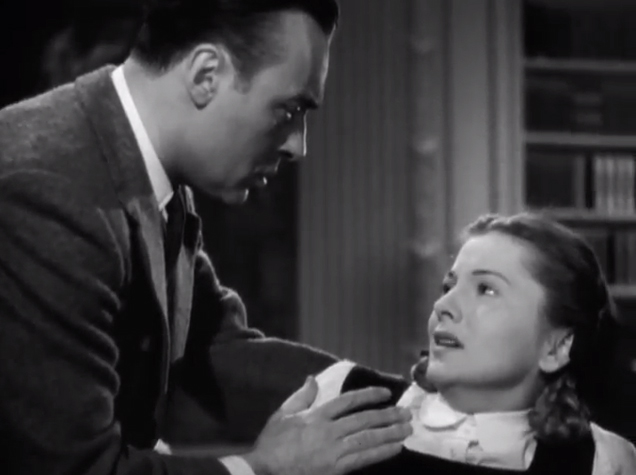
CN-Dodd-TessaIn short, Dodd and Tessa deserve each other. I have some sympathy for Florence, who is supposed to be a cold-hearted shrew, which is greatly to Alexis Smith’s credit…I just can’t figure out why she cares about a louse like Dodd. Another sympathetic character is Peter Lorre’s Fritz Bercovy, a basically decent, sane guy, who marries into this mess, courtesy of a union with another of Tessa’s sisters, Toni (Brenda Marshall).

Interestingly, both Flynn and Leslie Howard were considered for Dodd role, and though I love them both, I can’t imagine that either could have saved this for me. I might like it a little more, but I still wouldn’t seek it out.

Given the love evident on Twitter every time TCM schedules The Constant Nymph, I can only conclude that my opinion of it places me in the tiniest of minorities, although at the time, it was popular flop and a critical success. But if we all agreed on everything, the world would be a very boring place indeed. So enjoy it in all its glory…I’ll be catching up on my DVR queue.

blogban2

This post is part of the The Great Debate Blogathon hosted by Citizen Screenings and The Cinematic Packrat. Be sure and check out the other posts here.


The getTV Mickey Rooney blogathon MEGAPOST

The audience and I are friends. They allowed me to grow up with them. I’ve let them down several times. They’ve let me down several times. But we’re all family.

Mickey Rooney would have celebrated his 94th birthday this month, and in tribute, getTV is dedicating a substantial portion of the month’s programming to him. Kellee (@IrishJayHawk66) of Outspoken & Freckled, Aurora (@CitizenScreen) of Once Upon a Screen, and myself, Paula (@Paula_Guthat) of Paula’s Cinema Club, are thrilled to join forces with getTV for their first ever blogathon collaboration to celebrate Rooney’s career with The getTV Mickey Rooney Blogathon, running the entire month of September.

As the posts are published, I will update this list. Check back for great new Mickey Rooney posts throughout September.

All about getTV
getTV is a digital subchannel available over the air and on local cable systems dedicated to showcasing Hollywood’s legendary movies. The network, operated by Sony Pictures Television Networks, launched in February 2014. It features Academy Award® winning films and other epic classics titles. getTV distribution is close to covering nearly 70 percent of all U.S. television households across 65 markets, including 40 of the top 50 designated market areas (DMAs). The network is broadcast by Sinclair Broadcast Group, Univision Television Group and Cox Media Group owned stations and others. For information, visit getTV and connect with the network on Facebook and Twitter @getTV.

If you’d like to submit a blog post (or several) dedicated to Mickey Rooney – on his life, career, television work or a particular film – you can do so by submitting the entry to any one of the event hosts throughout the month of September.

Paula of Paula’s Cinema Club (leave comment below) – Twitter @Paula_Guthat
Aurora of Once Upon a Screen and Twitter @CitizenScreen
Kellee of Outspoken & Freckled and Twitter @IrishJayHawk66

blogathon2

We ask only that you please do the following:

  • Leave us a comment or send us a Tweet with your preferred Rooney topic
  • Let us know when you post your entry so we can promote it
  • Please copy @getTV on all tweets related to this event
  • Include the blogathon banner provided by getTV (above) in your post as well as the following statement:
    • “This post is part of The getTV Mickey Rooney Blogathon hosted by Once Upon a Screen, Outspoken & Freckled and Paula’s Cinema Club taking place throughout the month of September. Please visit the getTV schedule for details on Rooney screenings throughout the month and any of the host sites for a complete list of entries.”
  • Have fun!

Thank you!

getTV Mickey Rooney Blogathon: THE ATOMIC KID vs. BABY FACE NELSON by Jack Deth

As part of the getTV Mickey Rooney Blogathon, Paula’s Cinema Club is pleased to present this post by occasional contributor Jack Deth. He is also a regular contributor at Flix Chatter, so be sure and check out his posts there too.

Welcome, all and sundry!

When given the opportunity to examine, elucidate, and opine on Mickey Rooney, one of Hollywood’s busier actors of the 1930s and ’40s — opposite up and coming heavy-hitter Spencer Tracy in Boys Town, and countless young romantic musicals with Judy Garland, while being front and center in a string of shorts as very young man, “Mickey,” to a succession of lighthearted films about the travails of Andy Hardy — it’s the decade beyond that sparked my interest, in a quest to seek answers to the question: What now?

The 1950s presented Rooney with a string of offerings, some memorable, some not, which he took in a desire to put distance between himself and the characters most fondly remembered, cherished, and empathized with.

Two lesser-known films from this era caught my attention long ago, left their mark, and nearly demanded a second viewing, to see if that juvenile magic was still there. And for the most part, both films remain intact.

Without further ado. Allow me to proffer two distinct views of one of the more unsung character actors:
Breaking Away From Andy Hardy: A Mickey Rooney Double Feature
The first is a nearly forgotten, rarely seen, B & W post-Atomic Bomb comedy from 1954, directed on a miniscule budget by Leslie H. Martinson, and buttressed with the flimsiest of plots in and around the deserts of Nevada, New Mexico, and far southwest California.

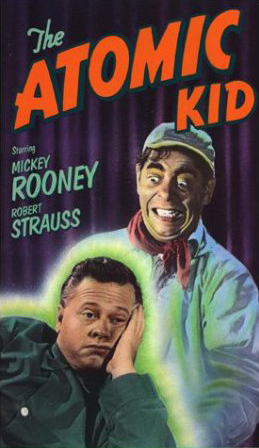
ATOMIC-KID-finalThe Atomic Kid (1954)
Where Mr. Rooney plays amateur archaeologist, mineralogist, and uranium prospector, Barnaby “Blix” Waterford. Down on his luck financially and romantically, Blix and his partner and longtime friend, Stan Cooper (marvelously gravel-voiced and slovenly Robert Strauss, who played Sgt. Stanislaus “Animal” Kuzawa in Stalag 17) hear a rumor about a mineral lode deep beneath the sands of New Mexico. (Read: the outreaches of government-owned and -facilitated White Sands Testing Range.)

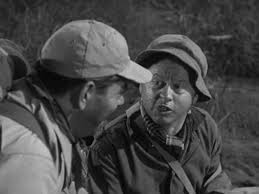
Atomic Kid~2 Blix and Stan approach the next-to-nothing town. Stan decides to wait and watch at a distance as Blix stumbles in, investigates, and eventually enters one standing clapboard home in the deserted, middle-of-nowhere “town,” sees mannequins fully dressed around a family kitchen table, feels hungry, and decides to raid the pantry for a peanut butter and sardine sandwich.

While far away in a sandbagged bunker, high-ranking Army officers and white-smocked scientists (amongst them, the always-reliable Whit Bissell) start the countdown for a Nuclear Test, then notice activity in the far-off rocks around mesas outside the “town.” Soldiers arrive. Stan tells them that Blix is somewhere in the “Test Town”. The countdown can’t be stopped or aborted. The bomb high atop a tower explodes!

A mushroom cloud rises. Winds gust and swirl dust and debris to all points of the compass rose. The dust settles and Jeeps and trucks arrive as guards set a perimeter. Stan and an entourage of scientists gather around outstretched Geiger counters.

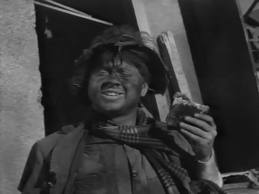
Atomic Kid~3The site is hot. Just shy of leveled. Testament to the weapon’s destructive power. As a sound is heard, a pile of rubble and shingles shift. And Blix twists and inches out. Sandwich scorched on one side. Obviously unscathed. But speaking at about six times normal speed, and radioactively hotter than a three dollar pistol. Questions abound as Blix is taken to a lab and soaked in a heavy water tank to leech off some Roentgens.

Refreshed and his speech back to normal, Blix is introduced to Nurse Audrey Nelson (Elaine Devry, aka Mrs. Mickey Rooney at the time). And his luck changes. Though it’s kept in check, kind of, with a wristwatch-like device that points to different levels of danger when Blix gets excited. Which becomes often and obvious, as light fixtures in the immediate area that were turned off suddenly have brightly glowing bulbs.

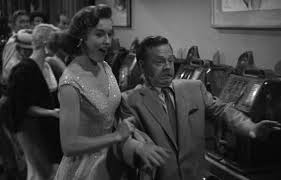
Atomic Kid~4With the passage of time. Men in dark suits and hats arrive, announcing themselves as the FBI, and want Blix to roam around Vegas and other spots to help flush out a Communist spy ring. Blix obliges. With Nurse Audrey safely ensconced in a hotel room nearby at first. Becoming inseparable with time. As contact is made, and the Commies being just as sloppy and ill-focused as you would imagine in the 1950s. Led by stalwart Robert Emmett Keane as “Mr. Reynolds,” and Peter Brocco as “Comrade Mosely.” Blix plays dumb, once delivered to the spies’ hideout. Becomes excited as future plans are laid bare. Pulls off some razzle dazzle with lights, lab equipment and appliances. As the spies panic and run into the waiting arms of the FBI.

After all the excitement settles down. Blix decides to throw fate to the wind and ask Audrey to marry him. Audrey is standoffish at first. Yet slowly agrees. Sealing the deal with a kiss that lights up the romantically darkened room, to the point that the FBI agents covertly watching from across the cul-de-sac have a fair idea of what’s going on.

What Does Mr. Rooney Bring To This Role?
Not really a buffoon, but more of life’s recipients of sad to bad tidings, enriching a rather flimsy plot and heightening the writing of a young upstart named Blake Edwards, in a “bread and butter” Republic Studios film that clocks in at 86 minutes.

Mr. Rooney also produced the film and used its budget frugally. Pinching pennies, though not really cutting corners, when necessary, while director Lewison uses Mr. Rooney’s talents as an ensemble player, if not the continuous focus of attention. All of the stock players have their times to shine. Especially Robert Strauss and Ms. Devry (the only woman in the cast), bouncing emotions off Mr. Rooney, who has lovely timing, and a penchant for riding the roller coaster from sad to ebullient and back again.

Is ‘The Atomic Kid’ a great film? No. Though it is a worthwhile diversion.And not just for its rarity.
A fairly well executed and streamlined into the near absurd. Not to be taken seriously. Outside of a fairly decent attempt to switch and take on a character a bit older and wiser than one which was a meal ticket only a decade earlier.


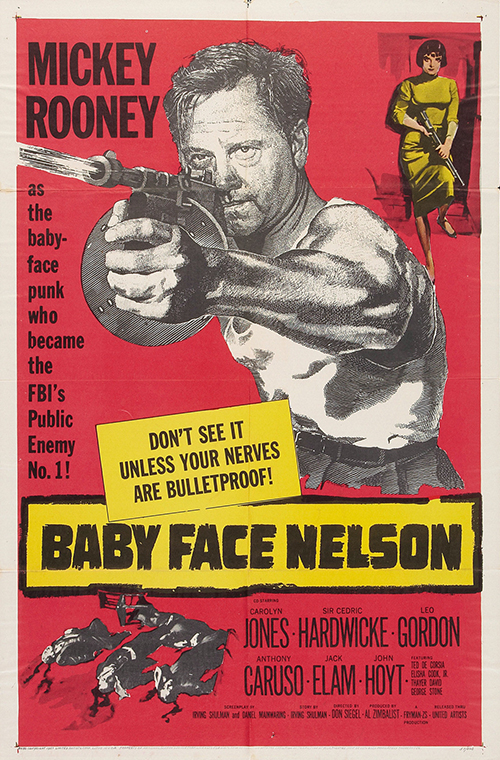
Which brings us to another journey of exploration, and a bit of exploitation, in a low-budget B&W United Artists release, directed by up-and-comer Don Siegel. And a screenplay, courtesy of Daniel Mainwaring (Out of The Past) and Irving Schulman.

BABY-FACE-NELSON-500w

Baby Face Nelson (1957)
Which opens with the standard honorarium to the FBI and its agents, then shifts to the shadow-swept confines of Joliet Prison and the release of shabbiily-suited Mr. Rooney, as low-rent nobody and recidivist criminal Lester M. Gillis, to the tender mercies of 1933 Illinois.

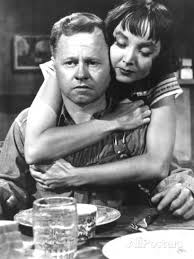
Baby Face Nelson~2Fully expecting to follow the straight and narrow. Gillis is offered a ride within seconds of the prison gates closing. A ride to see “Mr. Rocca” (Ted De Corsia), leader of a small gang of bootleggers on Chicago’s south side, who may have had a hand in sending Gillis to Joliet originally. No love is lost, nor manly hugs exchanged, as Rocca explains the reason for Gillis’ early parole.

A Union bigshot is making too much noise and needs to be taken care of. Pointed out by Rocca as they share the back seat of a touring car. Gillis is given a silenced pistol to do the job. Gillis wants none of it. He takes the Rocca paid for hotel room, bathes, and is off to see his girlfriend, Sue Nelson (beguiling Carolyn Jones, long before “The Addams Family”). She watches the register and buzzer to the back-room offices of one of Rocca’s many pool halls.

Kisses are savored and a date is set for three hours later, when Sue goes off shift. In the interim, Gillis reads that his intended target has been murdered. Detectives bust in, and find the silenced pistol taped to the roof of the room’s flush box. A classic frame. Gillis is arrested. Booked. And gets to see Sue through a mesh screen before being shipped back to Joliet.

Sue finds out when and where Gillis is be loaded on the train to Joliet, and intervenes. Stumbling before two armed guards as Gillis knocks both unconscious and Sue wheels around with a getaway car, to ambush and seek revenge on Rocca and his hideout’s deserted staircase. With that task accomplished, Gillis decides to take Sue’s last name as they go to see if John Dillinger (Professional Bad Guy Leo Gordon) could use an extra gun hand. Dillinger nicknames the new arrival “Baby Face”. Gives him a Thompson. And explains their next payroll heist.

Baby Face Nelson~3Cleverly executed, with the main guns hiding in a plumber’s van as the armored car arrived at the factory. Dillinger and his crew have the drop on the guards. A steam whistle shrills. And Nelson cuts loose. Dropping the three guards as they head off to lick wounds and hide out at the out-of-season Little Bohemia Lodge, where unlicensed and lecherous, “Doc” Saunders (Cedric Hardwicke) works on Dillinger, and starts flirting with the recently-arrived Sue.

Dillinger doesn’t want the heat of three dead bodies and cuts Nelson and Sue loose. The two head west to Minnesota and a string of bank and payroll robberies. Courtesy of architect and engineer “Fatso” Nagel (Jack Elam), who supplies schematics and blueprints. One robbery goes bad, Nelson is wounded, and decides to return to the one place no one will look. The Little Bohemia Lodge.

A group of FBI agents decide to play a hunch after Dillinger is betrayed and removed from the spotlight of “Public Enemy Number One”, and are spotted shortly thereafter. An agent (Dabs Greer) is shot and killed. Baby Face becomes a worthwhile substitute, as Nelson and Sue begin putting together their own gang, among them, Homer van Meter (Perpetual Sap Elisha Cooke, Jr).

A final job is suggested by Nagel, with the help of the FBI — a bank job, whose execution catches the Feds off guard, with the addition of tear gas grenades. Van Meter and the rest of Nelson’s gang locked in the bank’s vault. And a hail of gunfire as Nelson and Sue slip through the Fed’s dragnet.

I’ll leave it right here for spoilers’ sake.

What Does Mr. Rooney Bring To This Role?
An apocryphal and tabloid-splashed take one of the Midwest’s lower-tier desperadoes, heightening the folklore while bringing creepy life to a short and shallow man with an enormous chip on his shoulder.

Mr. Rooney fills the bill quite well. With mercurial mood swings, especially when and where Sue is concerned. Taking his anger out in grisly and cleverly edited ways. Letting his long-smoldering sociopath out to play and be glimpsed by Sue, who still loves him.

Backed up by a satisfactory Rogues Gallery of solid character actors of the day, on both sides of the law. Especially Mr. Hardwicke’s drunken “Doc” Saunders, Leo Gordon’s arrogant John Dillinger. And the building, grounds, lakes and dusty roadways around The Little Bohemia Lodge, a very familiar backdrop for several gangster and desperado films of the 1950s, ’60s and early ’70s. All under the touch of aspiring Don Siegel, adding another notch in his gun belt early on in his quest for greatness. And creating another noteworthy step towards branching out and away for Mr. Rooney!

This post is part of the getTV Mickey Rooney Blogathon hosted by Paula’s Cinema Club, Once Upon a Screen, and Outspoken & Freckled, taking place throughout the month of September. Please visit the getTV schedule for details on Rooney screenings throughout the month and any of the host sites for a complete list of entries. You can access the entire getTV schedule here and check to see if getTV is available in your area here.

blogathon2

Announcing the getTV Mickey Rooney September 2014 Blogathon

In April of this year the world lost Mickey Rooney, an entertainer whose career spanned an unbelievable nine decades. Born in Brooklyn, New York, on September 23, 1920, Rooney was on the Vaudeville stage almost before he could talk, and appeared in his first movie at the age of six. From there the movies became his life. With sidesteps into radio and television Mickey Rooney maintained an enviable relationship with audiences for nearly the entire span of his life.

The audience and I are friends. They allowed me to grow up with them. I’ve let them down several times. They’ve let me down several times. But we’re all family.

Mickey Rooney would have celebrated his 94th birthday this September, and in tribute, getTV is dedicating a substantial portion of the month’s programming to him. Kellee (@IrishJayHawk66) of Outspoken & Freckled, Aurora (@CitizenScreen) of Once Upon a Screen, and myself, Paula (@Paula_Guthat) of Paula’s Cinema Club, are thrilled to join forces with getTV for their first ever blogathon collaboration to celebrate Rooney’s career with The getTV Mickey Rooney Blogathon, running the entire month of September.

mickey-rooney-young-500w

As the posts are published, I will update the blogathon megapost. Check back there for great new Mickey Rooney posts throughout September.

All about getTV
getTV is a digital subchannel available over the air and on local cable systems dedicated to showcasing Hollywood’s legendary movies. The network, operated by Sony Pictures Television Networks, launched in February 2014.  It features Academy Award® winning films and other epic classics titles. getTV distribution is close to covering nearly 70 percent of all U.S. television households across 65 markets, including 40 of the top 50 designated market areas (DMAs). The network is broadcast by Sinclair Broadcast Group, Univision Television Group and Cox Media Group owned stations and others. For information, visit getTV and connect with the network on Facebook and Twitter @getTV.

getTV’s programming in September will include a Labor Day Marathon dedicated to Mickey Rooney as well as themed double features every Thursday at 7 PM EST, as follows:
Thursday, September 4 – Nautical Musicals
Richard Quine’s SOUND OFF, 1952: 7:00 PM ET; 10:40 PM ET
Richard Quine’s ALL ASHORE, 1953: 8:50 PM ET; 12:30 AM ET

Thursday, September 11 – Crime Tales
Peter Godfrey’s HE’S A COCKEYED WONDER, 1950: 7:00 PM ET; 10:40 PM ET
Richard Quine’s DRIVE A CROOKED ROAD, 1954:  8:45 PM ET; 12:25 AM ET

Thursday, September 18 – Military Comedy
Don Taylor’s EVERYTHING’S DUCKY, 1961:  7:00 PM ET; 11:10 PM ET
Richard Quine’s OPERATION MAD BALL, 1957: 8:50 PM ET; 1:00 AM ET

Thursday, September 25 – Young and Older Mickey
Roy William Neill’s BLIND DATE, 1934:  7:00 PM ET; 12:20 AM ET
Carl Reiner’s THE COMIC, 1969: 8:35 PM ET; 12:20 AM ET

You can access the entire getTV schedule here and check to see if getTV is available in your area here.
The getTV Mickey Rooney Blogathon

If you’d like to submit a blog post (or several) dedicated to Mickey Rooney – on his life, career, television work or a particular film – you can do so by submitting the entry to any one of the event hosts throughout the month of September.

Paula of Paula’s Cinema Club (leave comment below) – Twitter @Paula_Guthat
Aurora of Once Upon a Screen and Twitter @CitizenScreen
Kellee of Outspoken & Freckled and Twitter @IrishJayHawk66

blogathon2

We ask only that you please do the following:

  •     Leave us a comment or send us a Tweet with your preferred Rooney topic
  •     Let us know when you post your entry so we can promote it
  •     Please copy @getTV on all tweets related to this event
  •     Include the blogathon banner provided by getTV (above) in your post as well as the following statement:
    • “This post is part of The getTV Mickey Rooney Blogathon hosted by Once Upon a Screen, Outspoken & Freckled and Paula’s Cinema Club taking place throughout the month of September.  Please visit the getTV schedule for details on Rooney screenings throughout the month and any of the host sites for a complete list of entries.”
  • Have fun!

Thank you!

Participants
OPERATION MAD BALL – Once Upon a Screen
THE BLACK STALLION – Outspoken & Freckled
NATIONAL VELVET – Minoo for Classic Movie Hub
BLIND DATE – Paula’s Cinema Club
ALL ASHORE – Vintage Cameo
‘Andy Hardy’ vs. 1950s Rooney – Critica Retro
THE ATOMIC KID – Jack Deth
BREAKFAST AT TIFFANY’S – Girls Do Film
Rooney at Disney – Margaret Perry
HOW TO STUFF A WILD BIKINI – Blog of the Darned
STRIKE UP THE BAND – [This] Girl Friday
MY PAL, THE KING – Sister Celluloid
“The Comedian” on “Playhouse 90” – Caftan Woman
KILLER MCCOY – Another Old Movie Blog
BOYS’ TOWN – AnnMarie at Classic Movie Hub
IT’S A MAD, MAD, MAD, MAD WORLD – Maeghan
LOVE FINDS ANDY HARDY – Once Upon a Screen
BLIND DATE – Rob
BABES ON BROADWAY – The Hollywood Revue of 2014


British Invaders Blogathon: THE SECRET HISTORY OF MI6 is a movie waiting to happen…

This post is part of A Shroud of ThoughtsBritish Invaders Blogathon. Terry has been blogging there for an amazing 10 years. Happy blogaversary, Terry, and many many more!

britishinvadersaharddaysnight-500w
As you may know, one of my favorite film genres is the spy picture. I’ve spent enough hours with James Bond, Jason Bourne, Miss Froy, Captain Hardt, Gus Bennett, Hubert Bonisseur de la Bath, and Evelyn Salt to know a good spy story when I see one, or in this case, read one. And quite appropriately — since Britain’s spies dominate the world’s pop culture consciousness — it’s about as British as you can get.

Secret-History-MI6
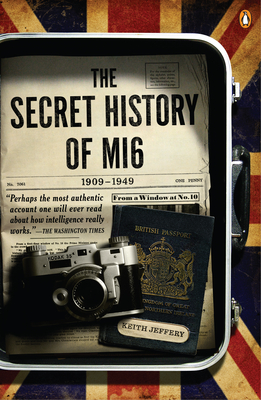
I love this cover design by Tal Goretsky, click through to visit his site

On the occasion of the 100th anniversary of Britain’s Secret Intelligence Service (MI6’s original and still official name) in 2009, its then-chief Sir John Scarlett commissioned Keith Jeffery, a History professor at Queen’s College Belfast, to write a history of the organization from its founding in 1909 through its adolescence in the early Cold War, 1949. The result is The Secret History of MI6, a fascinating tale of dedication, determination, occasional infighting, and patriotism.

Right away, I was surprised to learn that one of the most famous and highly-regarded intelligence services in the world was so underfunded that, at various times until the early 1940s, most personnel were not paid. So only those with sufficient private incomes could afford to work there, which would explain that upper-crust style that has carried through to many of the movies.

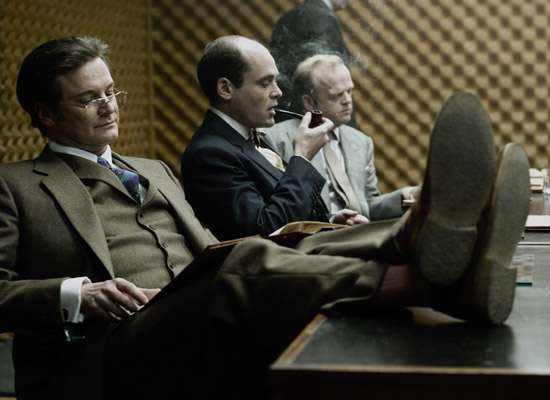
Colin Firth looking fine in a three-piece suit in TINKER TAILOR SOLDIER SPY  (2011)
Maybe someone should look into how these guys are paying for their snappy suits…I’m just saying. TINKER TAILOR SOLDIER SPY (2011)

Other aspects of the book will seem familiar as well. After all, the two authors who are arguably most responsible for our collective notions of how spies and spying work — Ian Fleming and David Cornwell (aka John LeCarré) — were both employed in British intelligence (Fleming was in naval intelligence, Cornwell in SIS). Graham Greene, another purveyor of espionage tales like Our Man In Havana, was recruited into SIS by his sister, Elisabeth, who already worked there. (His supervisor? Now-notorious double agent Kim Philby.)
For instance…the chief of the Service was always known by a single letter — not M, but C, from the last name of the first chief, Sir Mansfield Smith-Cumming. There is an actual Q or Quartermaster Branch, officially known as “Stores and Equipment Administration.” Q Branch’s first project, in 1915, was secret writing ink. Agents were often referred to by numbers, though not double-0s.

From the very beginning, many field agents and “local talent” did (and probably still do) enjoy the high life. As early as 1910, Cumming wrote in his diary that spies always wanted more money than their information was worth and “‘all…without exception make a strong point of [eating and drinking] in the best style and at the most expensive restaurants.'” Cumming himself was “a keen pioneer motorist and a hair-raisingly fast driver,” who helped found a yacht club and got his pilot’s license in 1913 when he was 54 years old.

universalexportsAnd, just like Austin “Danger” Powers, most British operatives conducted their business under their own names, usually with international business cover. Just like James Bond’s Universal Export. (A catch-all governmental office was also invented early on, specifically to provide cover — Passport Control, employees of which all have diplomatic immunity.)

On the other hand, there are the stories I hadn’t heard. Jeffery was faced with a tough task when he agreed to write Secret History. SIS routinely destroyed all its intelligence. Almost as soon as information was received at headquarters and distributed to the relevant department or office, the papers were burned. However, he managed to find material enough for several great movies or mini-series.

One aspect of espionage I never thought of before is the difficulty the British had in disguising the intel they got from the signals interception and decryption at Bletchley Park during World War II. Jeffery illustrates in several instances that If they had acted on everything they knew, it would have been obvious they had broken the code, and the Nazis would have changed it. I wonder if this will be addressed in The Imitation Game, the upcoming movie about Alan Turing.

Another movie-ready WWII story is that of the “Dick Jones” network, which ran very successfully in Tunisia, after a rough start. “Jones” was captured, imprisoned and sentenced when first dropped into the country in late 1942, but was released by the French authorities when the Germans invaded. He had organized well during his stay in prison and by November 1942, his network was supplying information “‘so operationally valuable that First Army were literally hanging on our daily signals to them.'” The network grew with “high grade morale,” which led to “low grade security,” and many were arrested in January 1943. Some were executed and “Jones” himself landed in Colditz Castle as a prisoner of war.

A biography of Cumming, the first chief of SIS, would also make an interesting film. Cumming endured various personal tribulations while fighting to keep the fledgling Secret Service alive and separate from other agencies and branches of government. Now universally acknowledged to have been the perfect choice for the job, he was basically making up the espionage playbook as he went along, and his position was never secure at the time. Aside from fast vehicles, he was fascinated by gadgets and tradecraft, and some of his techniques are still in use today.

The book also includes accounts of British/French espionage successes during WWII. One in particular is that of Marie Madeleine Fourcade, and I hope it gets optioned soon. Fourcade, born the same year as SIS, led the French Resistance network Alliance, which gathered intel about German logistics inside occupied France and transmitted it by various means to Britain. This was incredibly dangerous work, and many Alliance members were captured, tortured, and killed by the Gestapo. Fourcade herself was captured four times. She was released twice, and twice she escaped — once by disrobing and squeezing herself out of a cell window, and once by being smuggled out in a mailbag. She and all her network had animal codenames, thus the title of her book, L’Arche de Noé, or Noah’s Ark.

A few of the faces of courageous Marie Madeleine Fourcade, leader of the Alliance network in occupied France during World War II

 The Secret History of MI6 is a scholarly work and does sometimes get bogged in bureaucratic minutiae, but the vast majority of it is a compelling read. I do hope there will be a second volume, at least covering the rest of the 20th century.

Queen Elizabeth british flag parachute


Captain America Blogathon

Wow…this is such an awesome blogathon idea. The trouble is limiting it to just 10 movies. It looks like the deadline for the lists is March 31. Poor Cap…that’s a lot of movies.

fandangogroovers's avatarFandango Groovers Movie Blog

This isn’t the first blogathon I have organised, however it has been thrown together very quickly. I have just see an extended trailer for Captain America: The Winter Soldier. In it we see Steve Rogers make a note in a pocket note book. A list of things he missed out on in the time he was frozen that people have recommended he should catch up on. Towards the bottom of the list there are two movies Rocky and Rocky II. This got me thinking, what ten movies would you recommend a person who  had been frozen between 1943 and 2011.

 Captain America Blogathon

The make-up of the list is up to you. It could be an historical record of what he missed, something to cheer him up/take his mind of things or just your favourite movies from the period.

The movie is released at the end of the month in the…

View original post 66 more words

31 Days of Oscar: Week 5 — THE MOVIES

Wow, that was a quick month. This weekend is the 5th and final installment of 31 Days of Oscar blogathon, the Second Annual celebration of the Academy Awards, hosted by myself, Kellee of Outspoken and Freckled, and Aurora of Once Upon A Screen, and held in conjunction with Turner Classic Movies31 Days of Oscar.

Temple and Colbert banner  flat

Of course the 2014 ceremony is today happened on Sunday, March 2, so while you’re tuned into as we dissect the 86th version of the movie buff’s Super Bowl, check out these fabulous posts:

Margaret of The Great Katharine Hepburn tells us why Little Women (1933) is a very big deal.

Kelly of …On Popcorn & Movies recalls her experience seeing the 2011 Best Picture winner, The King’s Speech, at its first public viewing in Telluride.

Ruth of Silver Screenings writes that Paramount got its money’s worth for the $2 million it spent on Wings in Flyboys In Love and War.

Christy of Christy’s Inkwells gives us the backstory on A Man For All Seasons.

Iba of I Luv Cinema predicts who will be making the Best Pictures of the future in ‘Twas the Night Before the Academy Awards Ceremony.

I speculate wildly on how two Best Picture (and two Best Director) categories might change to the Academy Awards in Could more be more?

Aurora of Once Upon A Screen pays tribute to the “great, if underappreciated” George Stevens’ work on A Place in the Sun.

AnnMarie of Classic Movie Hub Blog analyzes You Can’t Take It With You, “a profoundly moving film that is as relevant today as it was over 75 years ago when it first hit the big screen.”

Em of The Vintage Cameo describes The Silent Inspirations of Titanic (1997), “deep-rooted images [that] would remain even in Cameron’s version nearly a century later.”

Nitrate Diva invites us to “Pick a letter and investigate” the ABCS of The Thin Man, “26 facets, factoids, and anecdotes” about this eternal favorite.

More of the Second Annual 31 Days of Oscar Blogathon:

Week 1 – SNUBS posts are here.
Week 2 – Music, Costumes, Cinematography, Writing, etc. posts are here.
Week 3 – Acting posts are here.
Week 4 – The Directors posts are here.

31 Days of Oscar: The Movies – Could more be more?

Our 31 Days of Oscar blogathon wraps up with Week 5 posts — The Movies. I’ve been thinking about the Best Picture category a lot lately, since I read Movies Silently’s Week 2 post, The Silent Oscars, in which she highlighted Academy Award categories that were lost with the advent of sound films. Near the beginning of her very informative post, she writes:

The first Academy Awards had several categories that were never repeated. The best picture award was divided in two, best production (Wings) and most artistic (Sunrise). Frankly, I think dividing best picture into art film and crowd-pleaser would be an excellent idea today but what do I know? The best director category was likewise divided into best dramatic director (Frank Borzage) and best comedic director (Lewis Milestone).

wings-sunrise
Two winners, both alike in dignity…WINGS and SUNRISE

Such interesting ideas. What would two Best Picture and two Best Director categories look like?

Having 20 different nominated films might get complicated, so it’s quite possible the Academy would return to limiting the Best Picture categories to five each. Also there would probably be some films that get nominated for both Best Production and Most Artistic. For instance, I think last year’s Best Picture, Argo, qualified for both. Would it have gotten lost between plausible Best Production nominees Django Unchained and Silver Linings Playbook and Most Artistic shoo-in Beasts of the Southern Wild?

playbook-jump
Among the nominees for Best Production…SILVER LININGS PLAYBOOK and…21 JUMP STREET?

On the other hand, separating directors into Best Dramatic and Best Comedic categories would probably have helped Argo director Ben Affleck to get nominated the same year (that he wasn’t is still a staggering snub in my book), though I think Ang Lee still would have won. My money would have been on Playbook director David O. Russell in the Comedic category, would he have gotten into the dramatic category as well? Who else would have gotten nominated? Phil Lord and Chris Miller for 21 Jump Street possibly? It’s hilarious. Seth McFarlane for Ted? Jay Roach for The Campaign? Jason Moore for Pitch Perfect? Would these films then get nominated in a Best Production category? Or would those nominations go to effects-heavier movies?

I’m not sure, but I do know that comedy has long gotten short shrift from Oscar. And I also know the Academy has tried all sorts of tactics to increase viewership. Designating an actual category just for comedy direction places these films — and possibly their fans — at the core of the Academy Awards. Would it also alienate the base (if there is such a thing)? And, with the differentiation between drama and comedy in other categories, would it then be necessary to split up the acting and craft categories as well? The mind boggles…but it’s fun to think about.

Fontaine Oscar banner flat

This post is part of the second annual 31 Days of Oscar blogathon hosted by Paula’s Cinema Club, Outspoken and Freckled, and Once Upon a Screen. For more posts featuring Oscar snubs, visit the megapost at Outspoken and Freckled, and stay tuned for more Oscar-related posts throughout the month. Our blogathon gets its inspiration from Turner Classic Movies’ 31 Days of Oscar, “where every movie shown is an Oscar winner or nominee.”

31 Days of Oscar: Week 3 — ACTING

We have now arrived at week 3 of the 31 Days of Oscar blogathon, which coincides with Turner Classic Movies’ month-long celebration of the very best in cinema. Co-hosted by me (@Paula_Guthat), Aurora (@CitizenScreen) of Once Upon A Screen, and Kellee (@IrishJayhawk66) of Outspoken & Freckled, the third installment of our Second Annual Oscar extravaganza addresses Acting, arguably the most remembered aspect of any film, particularly Academy Award contenders.

Hepburn Oscar banner

For various reasons, including a successful run of Blue Jasmine at Cinema Detroit, I’ve been thinking more about the Best Actress category this year than any other. Oscar front-runner Cate Blanchett is simply genius in the title role. Many people have mentioned to us that her acting (and to a lesser extent, that of the rest of the cast) are the reason they like or even love this unexpectedly downbeat movie. (Sally Hawkins is, of course, excellent. But Andrew Dice Clay? Really? Really. He’s actually good in it.) And I have agree, and also add that I think this is because Blanchett makes Jasmine seem like a real — albeit self-absorbed and delusional — person. I’m pretty sure Blanchett will win, she just earned a BAFTA, but the other contenders are Amy Adams, Sandra Bullock, Judi Dench and Meryl Streep, so I guess it’s not a done deal. Be that as it may, I believe that Blanchett, assisted by the rest of Jasmine‘s acting troupe, is what kept people coming into the theater seven months after the film’s premiere.

And now, without further ado, here are this week’s posts:

Pam at Once Upon A Screen — The Golden Age of Hollywood Revisited: Henry Fonda Finally Wins An Oscar

The Gal Herself — In Praise of Practical Magic: Julie Andrews

Emily of The Vintage Cameo — Actors Playing Actors

Margaret of The Great Katharine Hepburn — Katharine Hepburn’s One and Only Academy Awards Appearance

Rich of Wide Screen World — Oscar Trading Cards: Actor Assortment

Karen of Shadows and Satin — Van Heflin in Johnny Eager (1941)

ImagineMDD — Hume Cronyn: One Life, a Boatload of Characters

Lê of Crítica Retrô — Best Oscar Acceptance Speeches

Kelly of …On Popcorn and Movies — The Origins of Smolder…Gary Cooper and a little bit about Pitt

Ivan of Thrilling Days of Yesteryear — Stuart Whitman in The Mark (1961)

Shane of Classic Film Haven — The Amazing Stories of Harold Russell and Haing S. Ngor

Aurora of Once Upon A Screen — Spencer Tracy: Oscar and the Actor’s Actor


More of the Second Annual 31 Days of Oscar Blogathon:

Week 1 – SNUBS posts are here.
Week 2 – Music, Costumes, Cinematography, Writing, etc. posts are here.
Week 4 – The Directors posts are here.

31 Days of Oscar: Costuming BARRY LYNDON (1975) by Jack Deth

by Jack Deth

Greetings, all and sundry!

It’s my great pleasure to accept Paula’s gracious invitation to add a different perspective to the current Oscar Blog~A~Thon and its many unique facets.

Opting for the less-discussed, though aesthetically important variant that today has been given criminally short shrift amongst the plethora of romantic comedies. Where a logo T-shirt, jeans, sandals or sneakers will suffice for the guy, while skinny jeans, a midriff top and heels works for the girl.

For this dissertation, I want to go back to the familiar stomping grounds of the 1970s and a little-known novel replete in the history of its time. The Luck of Barry Lyndon by William Makepeace Thackeray was adapted by that master of detailed storytelling, Stanley Kubrick, who devoted 300 days in 1973 and ’74 to splendid on-location cinematography around the estates, castles, valleys and marshes of Ireland, creating a lavish, occasionally luscious feast for the eyes.

A film about unadulterated social climbing within the strict confines of 18th-century English morals, mores and etiquette, where words, or lack of them, contain great destructive or constructive power. Enhanced and highlighted by meticulously detailed and constructed costumes.

To that end, allow me to introduce a perfect cure for a bout of the flu, or dreary rainy or snowy days, when the weather outside is far more miserable than you wish it to be, and you are in need of an opulent distraction: Barry Lyndon (1975).

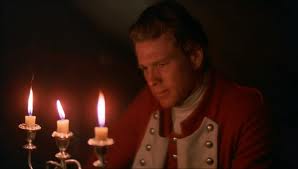
Barry Lyndon-4Barry Lyndon begins with ne’er do well, Redmond Barry (quietly adequate Ryan O’Neal) trying to improve his lot in life after the death of his father in a duel, leaving Barry and his mother to scheme amongst monied families. Falling in love, being rejected and getting revenge, before running off to Ireland.


Joining the British Army to survive the French at the Battle of Minden. Before deserting and trying his luck at the gaming tables. In search of a sponsor or a titled friend.

Barry’s a very busy boy and finds himself in the employ of a minor spymaster and gambler (Hardy Kruger). Forming an alliance at the gaming tables and shady dealing with new, well-off friends and acquaintances. Working their way across Europe to placate Barry’s desire to make money the old fashioned way. Marrying it!

Barry Lyndon-2The apple of Barry’s eye is the beautiful, willowy, wealthy and widowed, Countess of Lyndon. Outwardly delicate and sedately seductive Marisa Berensen, whose gaze, occasional glare and silence carries more weight than pages of written dialogue!

She is seemingly wedded to intricate gowns constructed of rigid whispering taffeta and flattering loose silk, and even more elegant hats. Gliding about parquet floor sally ports or the polished woods of grand halls, posture perfect and temperament mild as she and Barry are wed. With her young son, Lord Bullington (Dominic Savage as an infant and child; Leon Vitale, later in life), who sees Barry for what he is and despises him. Even more so as a baby stepbrother, Bryan Patrick is added to the equation, upon whom Barry ridiculously and lavishly dotes.

Barry Lyndon-3I won’t go into heavy detail, but Barry does what he does. Going through paramours and the Countess’ wealth with carefree and sloppy abandon, as Lord Bullington’s anger grows. Intrigues about inheritances arise, and Barry’s mother (Marie Kean) tries to take over, bringing about a duel and ending that may seem sad but is ironically well deserved.

Overall Consensus

Barry Lyndon-1With a slow-moving, yet intricate morality play of this size, acting, is of course essential to sell the story. Yet it is costuming that seems to rise above and take center stage in cementing time and place. In a film that is essentially an opulent, lush and moody oil painting brought to life.

We’ve all heard of Mr. Kubrick’s insistence in designing camera lenses for shooting in available candle- and sun- light. Also the exactly of its time Schubert-heavy piece that comprises its soundtrack. The costumers are the unsung heroines and heroes are never seen in front of the camera, but their meticulous hard work and attention to design and detail adorns the film and make things whole.

Huge kudos to 1976 Best Costume Design Oscar winners Milena Cannonero and Ulla-Britt Sonderlund, aided by Gary and Yvonne Dahms,* Gloria Barnes, and Jack Edwards, for their vision in regaling Ms. Berensen in soft tones and period pastels, while making British Redcoats even bolder and empowered on the field of battle. And to Colin and Frances Wilson, for creating minor miracles with elegant headwear.

Note: This film is available for viewing on YouTube. Edit: As of July 4, 2022, this film is on YouTube, Vudu, Google Play, and Apple TV.

*Corrected per comment below. July 4, 2022.