This weekend we’re showing MELANCHOLIA, a very strange and very beautiful film…if you’re in Detroit, you might want to check it out Sunday (2/17) at 3 p.m. at Ponyride, 1401 Vermont in Corktown 🙂
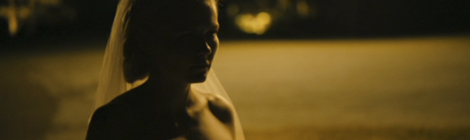
We won’t lie, we’d never seen Lars von Trier’s Melancholia on a big screen before. While the director is understandably controversial, there’s no disputing that he made a beautiful film. We really want more people to see this movie, hopefully the screen caps below will help convince you to stop by Ponyride tomorrow (Sunday, February 16)) at 3 p.m.
Oscar snubs are pretty much a given. When the Academy made the number of Best Picture nominees variable, it virtually guaranteed them in the Best Director category, and it’s no secret that I think both Ben Affleck and Kathryn Bigelow deserved nods this year. Still, If you haven’t seen Richard Linklater’s Bernie, you probably had to read the title of this post a couple times. But yes, I do believe Jack Black deserved a Best Actor nomination for his performance in the title role.
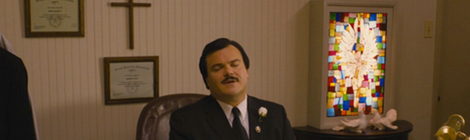
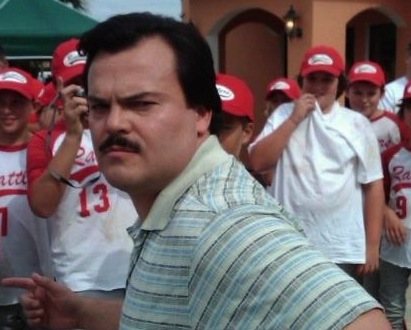
The film is a genre-defying mix of reality and fiction based on the true story of Bernie Tiede. It blends documentary style interviews, scenes with only actors, and scenes where actors play off real townsfolk playing themselves. Tiede befriended and eventually murdered an elderly woman, Marjorie Nugent (Shirley MacLaine), in Carthage, Texas in the mid-1990s. The character Bernie is unlike any other I’ve seen Black play. To be fair, I’d only seen him in The Holiday, Be Kind Rewind and Year One, in which his characters were all sort of similar, funny, a bit wild, sometimes manic, and seemingly based on himself.
Bernie Tiede is a complete departure. He’s a popular small-town funeral director who favors gospel music, community theater, and the company of women 20 years older than himself. Black becomes Bernie, but his performance isn’t just an imitation of mannerisms and speech. The actor invests the character with enough heart so that, murderer or not, he’s likable. We can relate to Bernie and his apparently innocent desire to help improve the lives of the town’s residents.
First this clip, Black as Bernie:
And an interview with the real Bernie
So why wasn’t Black nominated for an Oscar, despite receiving Golden Globe and Independent Spirit nominations? Part of it is that the Golden Globes have separate comedy/musical categories for Best Picture, Actor and Actress, while comedies are notoriously unpopular with Academy voters. And, because the film didn’t receive a wide release, I think it’s a safe assumption that many Academy members, like many of the moviegoing public, completely missed it. Also, the story unfolds on such a small canvas that it reminded me of Jane Austen’s work, and her description of it as “the little bit (two inches wide) of ivory on which I work with so fine a brush.” Yet, also like Austen’s work, it manages to comment on class conflict, justice, and human nature. How easy for a film like this to get lost in the shuffle of special effects showcases and global-history dramas. Which is really a shame.
When I say playing Bernie Tiede is a departure for Jack Black, I really mean it.
PS: I’ve said before, Bernie is a character study, and boy oh boy, is it ever full of characters. Make sure you watch the credits to see who is acting and who are actual members of the town. I’ve included some clips below in the hope that they’ll convince you to give the film a try:
Matthew McConaughey as Danny Buck Davidson, district attorney in Carthage:
A Carthage resident’s guide to Texas:
Plus, sing along with Bernie on “Love Lifted Me” — this scene is our first sight of Black in the film:
Starring Humphrey Bogart and Ida Lupino reprising their film roles in High Sierra based on the story by W. R. Burnett. This show was originally broadcast on April 17, 1944 on the Columbia Broadcasting System (CBS) and was Bogart’s second radio recording of his character, Roy Earle from the 1941 Raoul Walsh film adaptation, his breakout role. He’d voiced the character previously on January 4, 1942 co-starring with another actress.
The Screen Guild Theater was a popular radio anthology series broadcast from 1939 until 1952.
Note that this recording also includes broadcasts of Screen Guild Theater radio adaptations of Disney’s, Snow White and another gem that stars Brian Donlevy and Lucille Ball, A Night to Remember. The focus here is High Sierra, however, in tribute to Ida Lupino on what would have been her 94th birthday.
Greetings, all and sundry! When an opportunity arises to indulge in a favorite pasttime. Wax nostalgic about the ins and outs and nuts and bolts of a specific time in cinematic history. Its awards and rewards. You graciously accept and give it your best effort. To that end, I would like to thank Paula for chance to shine some light on…
1973: A Very Good Year in Film
A year that created a lot of controversy as the war in Vietnam was finally winding down and the palette of tastes continued to swell and expand, allowing some well-established talent to prove their mettle, while young upstarts were given the chance to make their mark for future generations.
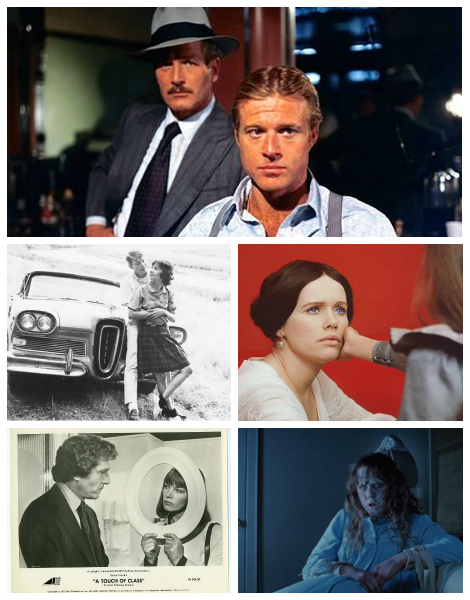
Best Picture 1974, clockwise from top: Winner THE STING; nominees CRIES AND WHISPERS, THE EXORCIST, A TOUCH OF CLASS, and AMERICAN GRAFITTI
Ingmar Bergman weighed in with a familial tome, Cries and Whispers. Which would explore the world of sisters as one is bedridden and slowly deteriorating to cancer in late 1800s Stockholm. Wondrously, sometimes rawly, told in flashbacks of earlier times and sibling rivalry, as the sisters coalesce and slowly retreat and pull apart.
While the previous year’s heavy hitter, William Friedkin, exceeded all expectations. Bought the rights to the worldwide best seller, The Exorcist, and re-wrote the limitations of American Horror. In a film that pulls the audience in and takes them on a ride not soon forgotten. And a fledgling director named George Lucas gave his personal take on rites of manhood and cruising the strip on a warm summer night before college in American Graffiti. A cut in the can, near-documentary benchmark film that would launch countless careers.
Not to be outdone, and to prove that he still had it, Melvin Frank put together a trans-continental, high-end romantic comedy, A Touch of Class. That spans Europe and mixes lush backgrounds and scenery as an affair takes root and flourishes. Placed squarely opposite what many would wrongly perceive to be a forgettable medium-length, low-budget ode to changing times and morals from John G. Avildsen, Save The Tiger. Only to have the field rounded out by George Roy Hill and his offering, The Sting. Which had the trademark look and feel of an old Warner Brothers backlot gangster film. Though highly polished and superbly executed on Universal’s backlots. Brought to life by two of the most handsome and proven actors in Hollywood.
A heady brew, indeed. Five contenders, unique in their own ways, vying for the 1974 Best Picture Academy Award. With the shot callers and odds makers outside the Academy close to tossing their arms up in the air. As quality and story cancelled each other out for the most part. Perhaps, and perhaps not, revealing the value of large ad campaigns as ballots were cast. Not exactly a coin toss, but a process of taking in the myriad details and many memorable moments as a decision is made.
I can’t disagree that The Sting deserves the top slot. Hill directs masterfully with a practiced touch around well and often meticulously detailed sets that somehow always seem smaller than they appear. Not exactly cramped, but compact. Drawing attention to the two leads as they move and share space with a stalwart cast of veterans and soon-to-be-recognized talent. In a tale that boasts no weak spots. Moves fluidly and builds to a delightful payoff. Infinitely watchable. And re-watchable, as only a few key scenes are telegraphed ahead of time. And even those have a pleasant twist.
The category of Best Actor is just as difficult. With Marlon Brando, the odds-on favorite for his role as American expatriate Paul in Last Tango in Paris. Still riding the crest of his role as Don Corleone in The Godfather and being re-introduced to a new generation of audiences. Brando plays an often unlikeable character, a bit too fascinated and fixated on sex. Under the helm of Bernardo Bertolucci. In a film more memorable for its intimate scenes than stunning dialogue.
Followed closely by Jack Nicholson. A soon-to-be household name after his roles in Easy Rider, Five Easy Pieces and Carnal Knowledge. It is in The Last Detail that Nicholson is allowed to push already legendary boundaries. Chew occasional scenery in scenes where he loses it. Keeping the faith as a believable career Navy NCO on a job few want, but needs to be done.Up-and-coming Al Pacino delivered a more than solid performance in Serpico. As New York policeman, Frank Serpico. A career-long honest cop who resisted the temptations of payoffs and worse. Becoming a pariah and shifted from precinct to precinct. Making notable cases, busts and arrests across the boroughs. While gathering information on bad cops and being denied a detective’s gold shield.
Staunch and stoic Jack Lemmon’s name on the ballot may have raised cursory eyebrows. An everyman’s actor just coming into his own. And his Harry Stoner in Save the Tiger has those quiet inner qualities writ large. As the head of a company which mass produces fashions seen on the catwalks of Paris, Milan and London. Suddenly stricken with hard times. In a film that would reveal Mr. Lemmon to be one of America’s great untapped dramatic talents. I’ve no doubt those cursory eyebrows were lifted a bit more with the addition of Robert Redford in The Sting. His often too-cautious Johnny Hooker is one of Redford’s best roles opposite Paul Newman. Though not what I would consider to be Oscar quality.
Many might have been surprised with Mr. Lemmon’s Oscar win for Best Actor, though I wasn’t. I knew his performance as mid-life crisis material Harry Stoner was special after just fifteen minutes of sitting in a near-empty matinee. And that the fix would be in as the final credits rolled. Few actors have been able to open up and reveal the heights and depths of their characters as Mr. Lemmon had. And would again in later films.
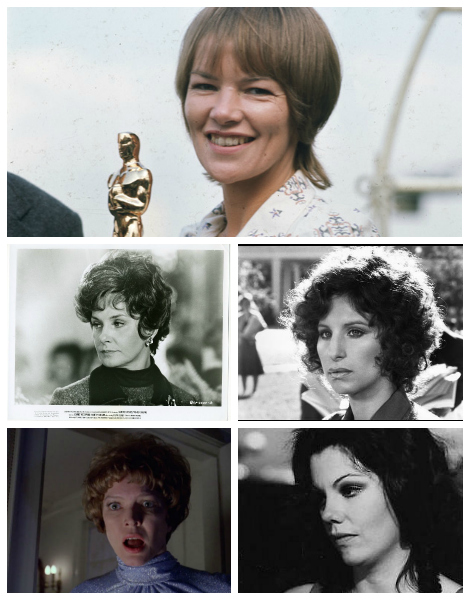
Best Actress 1974, clockwise from top: Winner Glenda Jackson; nominees Barbara Streisand, Marsha Mason, Ellen Burstyn, and Joanne Woodward
Which made the selection of Best Actress only slightly less difficult. With fresh, aspiring faces mixed amongst veterans who always delivered more than was asked or required. With Joanne Woodward exploring and making her mark in fertile fields usually left for Gena Rowlands in Summer Wishes, Winter Dreams. As Rita, a wife on the verge of a nervous breakdown due to empty nest syndrome and wishes that she had married the young man she had a crush on ages ago. One of the first and better “What if?” films of the 1970s. Followed closely by Barbra Streisand’s post-WWII radical chic Katie in The Way We Were tangled up with Navy officer Redford in an “on-again, off-again” relationship under the deft touch of Sydney Pollack.
Offset by Marsha Mason’s hard luck Maggie Paul in Mark Rydell’s Cinderella Liberty. Doing whatever is necessary to her and her ten-year-old mulatto son’s heads above water in the Navy liberty port of Seattle, Washington. While a single mom in Georgetown (Washington DC), Chris MacNeil, played by nearly unknown Ellen Burstyn, copes with her daughter being possessed by Satan in The Exorcist.
Leaving Glenda Jackson several obstacles and egos to clear in her role as George Segal’s “other woman” in A Touch of Class. A nicely detailed return to the earlier sophisticated romantic comedies of 1950s and ’60s. Where wit, adult dialogue and lush sets and backdrops have equal weight with the leads’ chemistry. An odd, almost safe choice for Best Actress at first glance and by today’s standards, though Ms. Jackson and Mr. Segal make the idea of “love at first sight” appear elegant, if not effortless. Even between a divorcée and a married man.
Which brings us to Best Supporting Actors. With Jason Miller and his role as Father Damien in The Exorcist out in front. Mostly, I believe for his ability to respond so well to shock and fear amongst then cutting edge special effects technology and a child’s bedroom kept at below freezing temperatures. Followed close by John Houseman’s Professor Kingsfield in James Bridges’ The Paper Chase. Mr. Houseman made the most of his voice that could easily bounce off the back walls of any enclosed space. Along with enunciation, a near void of contractions to project and surround himself with the aura of omniscient invincibility to a classroom full of aspiring college students.
Leaving plenty of room for Vincent Gardenia to play with his role of old and wizened coach, “Dutch” Schnell, in Bang the Drum Slowly. Though tinged with tragedy, still one of the better baseball films around. And Mr. Gardenia makes the most of his role as the team’s Father Confessor, manager, and mother hen. With veteran Jack Gilford and young upstart Randy Quaid filling whatever space is left with their quiet brilliance. In Mr. Gilford’s case, it’s playing Jack Lemmon’s wise old sage and business partner Phil Green in Save the Tiger.Who, like Mr. Lemmon’s Harry Stoner, just wants another season, but won’t condone arson and insurance money to do it. And Randy Quaid’s oversized, introspective, something of a dullard young sailor, Meadows, makes more than the most of each scene opposite Jack Nicholson. While on their way to Norfolk and its brig for petty theft from a Base Exchange.
A very contentious field. A grand master of projection with Mr. Houseman. Opposite a grounded character actor in Mr. Gardenia and two students of the “Less is more” contingent. A tough choice for Best Supporting Actor, but a proper one, as Mr. Houseman’s haughty, eloquent Professor Kingsfileld in The Paper Chase is awarded the prize.
With ladies demanding equal time. The nominees for Best Supporting Actress are more diverse and eclectic. Peter Bogdanovich’s Paper Moon is double-tapped, with Madeline Kahn’s Trixie Delight and Tatum O’Neal’s Addie Loggins, who may or may not be con man Ryan O’Neal’s Moses Pray’s daughter. Busily wrapping any and all in her way around her little finger. While Trixie offers fresh and often insightful comic relief.
While near complete unknown Linda Blair delivers above and beyond as an adolescent girl with familial problems experiencing a close encounter of the inexplicable kind in The Exorcist. While Sylvia Sidney excels as Woodward’s aged and infirm mother Mrs. Pritchett in Summer Wishes, Winter Dreams. Leaving Candy Clark’s bombshell blonde turn as a tempting Marilyn Monroe beauty behind the wheel of a classic white T-Bird in Lucas’ American Graffiti.
The award of Best Supporting Actress to Tatum O’Neal in Paper Moon came as no real surprise. Though her voice may have grated a time or two. Ms. O’Neal showed great potential and ease of execution in a familial, very family-friendly film. The sum of which reflected Mr. Bogdanovich’s “sit back and let it happen” school of direction.
Overall Consensus:
I’ve long believed that the 1970s were the last great era for films. With many directors taking a path away from the slowly stagnating Hollywood “system” and indulging in ventures that would make or break them and their reputations. And 1973 is a banner year for those pioneers. Who were able to find the talent and money and put it all on the line. As with John Alvidson and Jack Lemmon collaborating in what could and should have been a just under two hour personal ode to changing times and morals that reaped enormous rewards. Especially for screenwriter, Steve Shagan. And just being recognized Marvin Hamlisch and his minimalist score for Save the Tiger.
Add to the mix a young unknown named George Lucas given a fistful of money to start a project, choose his own cast of unknowns who would find fame in later films, shoot through the nights, and cut the film in the can. And start all over again for consecutive nights. While proven directors like William Friedkin and George Roy Hill are given wherewithal to run their films their way. Even if the former’s project, The Exorcist, rubbed many the wrong way at first viewing, and the latter’s The Sting, the second collaboration of Messieurs Newman and Redford, is a superior, cast-driven long con and period piece.
Taken altogether, 1973 was a watershed for directors taking the less-used path. And actors, cinematographers, arrangers, musicians, set designers, and wardrobe technicians applying new ideas and swinging for the fences.
Recently tagged “most underappreciated film of 2012” by the Los Angeles Times, Bernie (2012) is based on the true story of Bernie Tiede (Jack Black), who befriended and eventually murdered an elderly woman, Marjorie Nugent (Shirley MacLaine), in Carthage, Texas.
In real life, Tiede befriended Nugent in 1990, shot her in 1996, was convicted in 1998, and is serving a life sentence. The case deeply divided the townspeople of Carthage. Danny Buck Davidson, the district attorney played by Matthew McConaughey in the film, told a local paper in 1998, “This town is split up.” Nugent’s son, Dr. Ron Nugent, maintains that Tiede drove her family away and that her side of the story has never been told. On the other hand, there is a blog, Free Bernie Tiede, which allows Bernie to communicate with his supporters, and in August 2012, the Dallas Morning News reported that, after seeing the film, an Austin attorney has taken an interest in Tiede’s case.
But Bernie isn’t really about all that. It’s actually a character study, the kind Hollywood doesn’t really produce all that much any more, and, in this world of big-budget special effects showcases, something as narrow in scope and as perfectly executed as Bernie is a welcome refreshment.
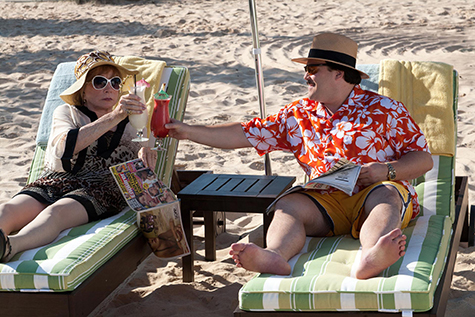
Marjorie Nugent (Shirley MacLaine) and Bernie Tiede (Jack Black) in happier times
In the film, Bernie is much beloved by all of Carthage for his affable personality and tireless involvement in many civic and church activities. A mortician by trade, it is his habit to check up on the town’s widows, and someone as unpleasant as Mrs. Nugent, recently bereaved, needs a friend. The two soon become inseparable, but Mrs. Nugent is also more and more possessive of and verbally abusive toward Bernie, who can’t deal with any kind of negativity or drama. One night he snaps and shoots her. He then hides her body and continues as if she’s still alive…just very very sick. Having been given power of attorney, Bernie also spends her money, but only to help other people.
When Marjorie’s body is found, the music on the movie’s soundtrack is the only real indication of sadness. Nobody, including her family, really missed her spiteful ways, only her money. No one in town can quite believe Bernie capable of murder, anyway; a few even hassle the district attorney to “leave poor Bernie alone.”
Reality and fiction meld in this genre-defying film. Bernie is a seamless mix of documentary-style interviews with actual Carthage townsfolk interspersed with re-enactments and scenes from Bernie’s point of view, which use actors. It’s pretty clear whose side director Richard Linklater is on, but the story and its implications are only part of this film’s pull. The casting is perfect. Black excels as Bernie, making the character relatable and the oddity of the plot believable. MacLaine makes the most of her smaller role, displaying a steely-eyed malice and hinting at the grief behind the jealousy. However, the citizens of Carthage steal the show — they are a charming, funny bunch whose loyalty to Bernie is as endearing as it is stubborn.
Aurora’s excellent update on our rapidly approaching 31 Days of Oscar blogathon…email, comment or @ me on Twitter if you want in 😀
“Stingers,” aka “post-credit scenes,” are those awesome little clips that reward the patience of that intrepid moviegoer who, resisting his or her comrades’ rush to the parking lot or the restroom, remains seated for the entire credits of a motion picture. Just when this film fan thinks it’s all over…a little gem of a scene pops up, giving much satisfaction and perhaps a slight feeling of superiority.
The term “stinger” is also applied to extra scenes or bloopers shown during the credits, which are also a ton of unexpected fun, but to me, they’re not as gratifying as true post-credit scenes.
A stinger is the sign of filmmakers who really love movies. I can picture these people wanting to share that feeling of not wanting to leave the cinema. The stinger becomes an in-joke between the makers of a film and its fans, and may also complete the story or hint at further developments taking place after the time included in the movie.
Text advertising the next installment of a movie series (“James Bond will return in…”) had been around since From Russia With Love (1963), but according to Wikipedia, “[o]ne of the earliest appearances of a true stinger” was in The Muppet Movie (1979). The earliest movie stinger I can remember is Ferris Bueller’s Day Off, in which the main character, having demolished the fourth wall throughout the film, appears and says to the audience, “It’s over. Go home!”
Comedy and action-adventure seem to provide the majority of post-credit scenes, although some horror films have them. The Avengers cycle has delivered a few of my favorites.
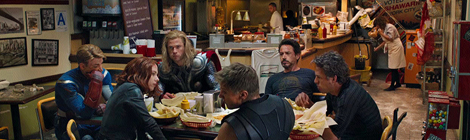
The Avengers (2012) actually had two stingers, one involving The Other and Thanos, and this one:
Recently I ran across MediaStinger, a site which exhaustively catalogs scenes that run during and after the credits in movies and video games. Consult this site before going to the theatre and you’ll never miss another stinger. Details and spoilers are thoughtfully hidden behind a link. Comments are not hidden though, so don’t scroll down too far if you want to preserve the surprise.
The most recent post-credit scene I’ve seen (I don’t think this is a spoiler anymore) is the very fleeting one in Django Unchained. What is the first stinger you remember seeing, and what are some of your favorites?
Time for an update on the 31 Days of Oscar blogathon (full rundown at the original post). We’re a little more than a couple of weeks out from the first deadline. Publish your post and email me the link by any one of the following dates: January 31, February 7, February 14, February 21 and February 28.
The nominations were announced on Jan. 10, providing as much fodder for blog posts as any other’s, maybe more. Right away, I was aware of what I consider to be one major snub: Ben Affleck for Argo, and now that I’ve seen Zero Dark Thirty, I think Kathryn Bigelow was snubbed as well. Of course, the format of the Best Picture nominations, where 5-10 movies are tapped, virtually guarantees that there will be snubs. Is the Academy crazy, or crazy like a fox? Sounds like an idea for a blog post, speaking of which here’s some topic prompts (new ones at the end of the list):
Is there a film, performance or art or technical work the non-nomination of which you feel is a crime? Tell us about it.
Sometimes the Oscar seems to hinder, not help, someone’s career, including but not limited to the “Best Supporting Actress Curse.” Discuss.
Spotlight on sound editing and sound mixing, or any other unfairly neglected award.
Your favorite/the most influential Best Costume winners/nominees/should-have-beens through the years, or just focus on one.
Short films are often given short shrift…throw some love on your favorite.
Cinematography and editing vs.directing…the auteur theory, etc. Discuss, using Oscar-winning examples.
The Oscars still create the most hoopla, but should we be paying more attention to other awards, such as the Golden Globes or (fill in the blank)?
NEW:
The Academy’s rules for selection of the Best Picture dictate that any film receiving 5 percent or more of first place votes is nominated, so that a minimum of 5 and a maximum of 10 are in the running each year. This year there are 9 nominees, but there are still only 5 Best Director nods. Discuss the implications and ramifications of this set-up.
Judi Dench famously won a Oscar for her 6 flawless minutes in Shakespeare in Love. If there was an Oscar for cameos, who would be nominated, and who would win?
It’s generally accepted that actors and directors, and possibly other filmmakers, may receive an Oscar for a previous year’s, or an entire career’s, work, sometimes referred to as a “cumulative Oscar.” Do you think this is legit or totally unfair? Discuss.
Academy…why so serious? Certain genres are overlooked every year, generally speaking comedy, adventure, and science fiction are rarely given nods. Is this due to the overall age of the Academy, or other factor(s)?
Final Oscar ballots aren’t due until the Tuesday before Oscar Sunday; this year that is Feb. 19. Any answer to this question is likely to be pure speculation but: Do the other awards influence voting?










 Paula's Cinema Club