
Reckless Review: BERNIE

Recently tagged “most underappreciated film of 2012” by the Los Angeles Times, Bernie (2012) is based on the true story of Bernie Tiede (Jack Black), who befriended and eventually murdered an elderly woman, Marjorie Nugent (Shirley MacLaine), in Carthage, Texas.

In real life, Tiede befriended Nugent in 1990, shot her in 1996, was convicted in 1998, and is serving a life sentence. The case deeply divided the townspeople of Carthage. Danny Buck Davidson, the district attorney played by Matthew McConaughey in the film, told a local paper in 1998, “This town is split up.” Nugent’s son, Dr. Ron Nugent, maintains that Tiede drove her family away and that her side of the story has never been told. On the other hand, there is a blog, Free Bernie Tiede, which allows Bernie to communicate with his supporters, and in August 2012, the Dallas Morning News reported that, after seeing the film, an Austin attorney has taken an interest in Tiede’s case.

But Bernie isn’t really about all that. It’s actually a character study, the kind Hollywood doesn’t really produce all that much any more, and, in this world of big-budget special effects showcases, something as narrow in scope and as perfectly executed as Bernie is a welcome refreshment.

bernie_marjorie-lowres
Marjorie Nugent (Shirley MacLaine) and Bernie Tiede (Jack Black) in happier times

In the film, Bernie is much beloved by all of Carthage for his affable personality and tireless involvement in many civic and church activities. A mortician by trade, it is his habit to check up on the town’s widows, and someone as unpleasant as Mrs. Nugent, recently bereaved, needs a friend. The two soon become inseparable, but Mrs. Nugent is also more and more possessive of and verbally abusive toward Bernie, who can’t deal with any kind of negativity or drama. One night he snaps and shoots her. He then hides her body and continues as if she’s still alive…just very very sick. Having been given power of attorney, Bernie also spends her money, but only to help other people.

When Marjorie’s body is found, the music on the movie’s soundtrack is the only real indication of sadness. Nobody, including her family, really missed her spiteful ways, only her money. No one in town can quite believe Bernie capable of murder, anyway; a few even hassle the district attorney to “leave poor Bernie alone.”

http://youtu.be/YJuhWKcY_6U

Reality and fiction meld in this genre-defying film. Bernie is a seamless mix of documentary-style interviews with actual Carthage townsfolk interspersed with re-enactments and scenes from Bernie’s point of view, which use actors. It’s pretty clear whose side director Richard Linklater is on, but the story and its implications are only part of this film’s pull. The casting is perfect. Black excels as Bernie, making the character relatable and the oddity of the plot believable. MacLaine makes the most of her smaller role, displaying a steely-eyed malice and hinting at the grief behind the jealousy. However, the citizens of Carthage steal the show — they are a charming, funny bunch whose loyalty to Bernie is as endearing as it is stubborn.
Reckless Review: ARGO

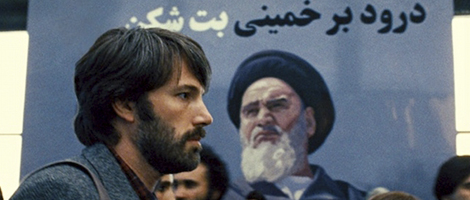
The thing about Argo is that we already know how it ends. In 1980, CIA operative Tony Mendez (played by Ben Affleck) managed to “ex-filtrate” the six Americans who escaped to the Canadian ambassador’s house when Iranian revolutionaries took over the US embassy in Tehran. But I forgot all about that, and judging from the reactions of others in the audience, so did everyone else. This film immerses you in suspense.

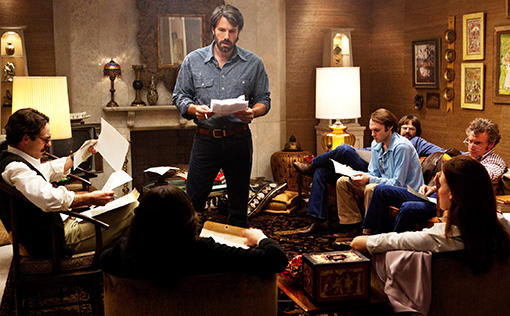
Table read…or briefing session? Mendez/Affleck coaches his “cast” in a scene reminiscent of the film’s earlier table read of the fake film they’re supposed to be making, also named ARGO. It’ll make sense when you see it.

As I noted in one of my past posts, I liked the trailer for Argo, maybe because it reminded a bit of The Town, one of my favorite heist pictures ever, also directed by Affleck. The director doesn’t disappoint, ratcheting the tension up exponentially. It could have been a bit too tense, but Affleck and screenwriter Chris Terrio break the mood with some very funny moments at Hollywood’s expense. The lighter, satirical scenes with John Goodman and Alan Arkin in the movie capital do more than just relieve almost unbearable stress. These scenes – actually the whole movie – are a meditation on the nature of espionage, movies, and storytelling. It begins with a brief history of Iran and the causes of the 1980 revolution. Instead of the usual text on a blank background, or a newsreel-style montage, Argo‘s introduction is a series of animated story boards. Then, of course, there are the fake identities and backstories the diplomats take on to pull off their own rescue. If they can act convincingly enough, they’ll live. At the risk of saying too much, this film shows that the key to being a good spy and the key to making a good movie are one and the same — having the ability to tell to a good story.

PS: I highly recommend reading this excellent Entertainment Weekly interview with Affleck and Mendez if you haven’t already. Among other things, I found out that the Argo story is just one chapter in the CIA agent’s fascinating life. Hoping Hollywood will call on him again.

Evil Dead and a greedy family haunt the Redford Theatre

Our friends at the Redford Theatre are treating Detroit horror fans to two frightening classics this weekend. On Friday October 26th only, there will be a midnight showing of Evil Dead (1981), the now-classic story of the doomed trip to an isolated cabin in the woods undertaken by a group of college students. The film has quite a few Michigan connections. Writer/director/producer Sam Raimi and star/producer Bruce Campbell both hail from the Mitten, and a rough cut of the film, then known by its working title Within the Woods, was shown to potential investors at the former Punch & Judy Theater in Grosse Pointe Farms.

Most importantly for Friday’s showing, Evil Dead was first shown at the Redford Theatre back on October 15, 1981, and went on to become one of the best-loved and most influential horror movies ever. Don’t miss this opportunity to see all the blood and gore (it’s rated NC-17 for a reason) on the big screen. The organ overture begins at 11:30pm. Tickets are $5.00.

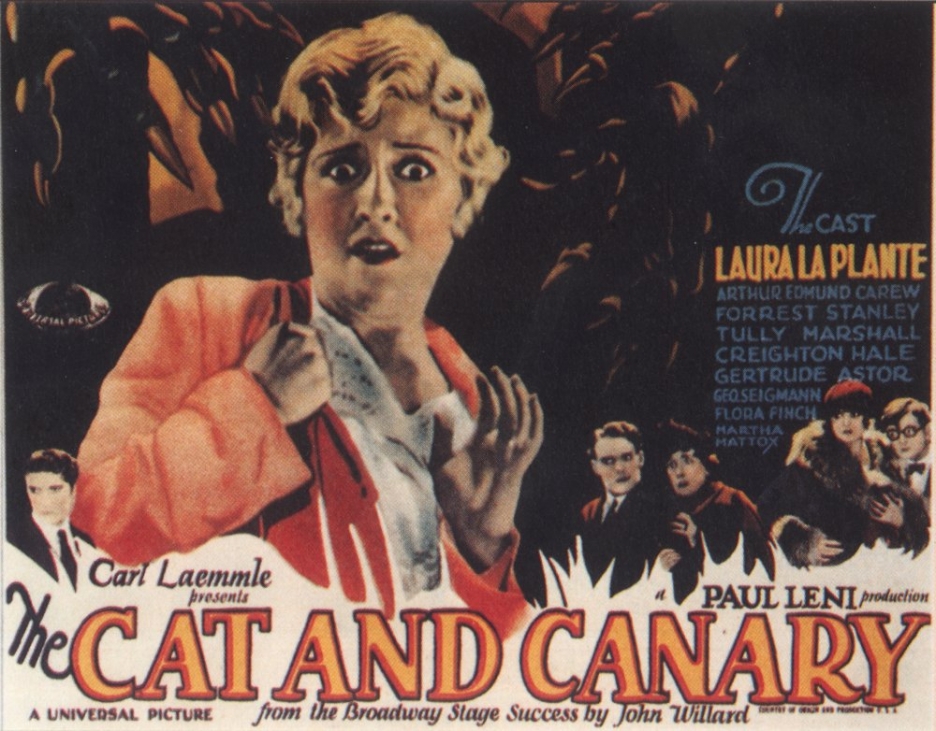
936full-the-cat-and-the-canary-posterIf goofy monochrome horror is more to your taste, never fear, the Redford has you covered too. On Saturday, they’ll be showing the rarely-seen silent, The Cat and the Canary, starring Laura La Plante. Heirs to a fortune find themselves spending the night at a menacing mansion, where mysterious and eerie things happen throughout the night. La Plante can only inherit her old relative’s money if she is declared sane in the morning.

Tony O’Brien will accompany the film on the Barton Theatre Pipe Organ, and as a bonus, the silent short The Haunted House starring Buster Keaton will precede the feature. The evening begins at 8:00 p.m. Tickets for this showing are $12.00 for adults and $8.00 for children 12 and under.

Universal horror at the Redford Theatre

On Saturday, October 20th, Detroit’s Redford Theatre is showing a Universal Studios horror double feature: The Bride of Frankenstein (1935) and Frankenstein Meets the Wolfman (1943).

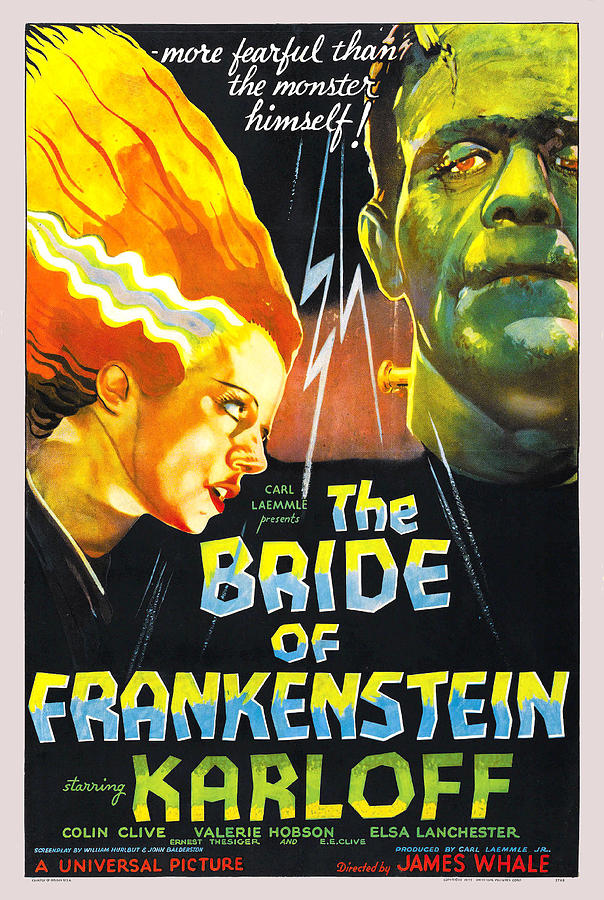
Poster of The Bride of FrankensteinIn Bride, a sequel to the wildly successful Frankenstein (1931), Boris Karloff returns as the Monster and Colin Clive reprises his role as Dr. Henry Frankenstein. This installment of one of the first horror movie franchises sees Dr. Frankenstein forced by another mad scientist to make a match for the Monster, with scary and sad results.

By 1943 Karloff had given up the mantle of the Monster, so Universal passed it to another one of their horror icons, Bela Lugosi. It seems as if the studio felt that one creature was good, but two was even better. So the film has the Monster facing off against the Wolfman, played by Lon Chaney Jr.

Seeing these two excellent examples of Universal horror classics is particularly appropriate this Halloween season as 2012 is the studio’s 100th birthday. And while you can see these movies at home (The Bride of Frankenstein is included on the newly released Universal Classic Monsters: The Essential Collection box set), seeing them on a big screen, like the Redford’s, adds much to the experience. Why not see these films as they were seen when they were first released —in a movie palace?

Reckless Review: THE AVENGERS (2012)

The Avengers is a very good film. If I had a rating system, I’d give it 4.5 out of 5 stars. Yes, it is that good. If you haven’t seen it, go now…I’ll go with you. Seriously. I don’t know if the world can stand one more person waxing eloquent about this movie, but I’m going to go for it anyway. Some thoughts…

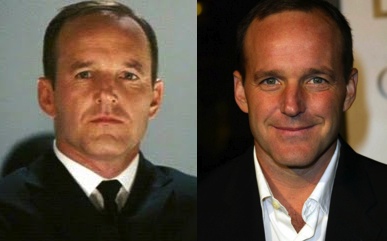
Clark Gregg is like a different person when he’s playing Agent Coulson. His whole face tightens up.

Clark Gregg as Agent Coulson; Clark Gregg as himself


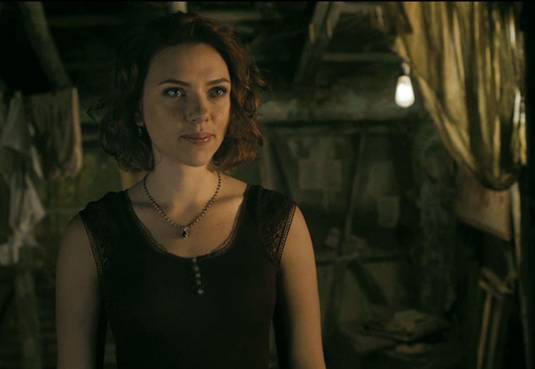
I still say that if I was an actress, I would want Scarlett Johansson’s career…from child actress to indie darling to action movie star…this year it’s a big comic book franchise and a sci-fi picture, next year she’s in some indie directed by Joseph Gordon-Levitt. A versatile talent.

I don’t have anything snarky to say about Scarlett Johansson as Black Widow


Playing the villain is always more fun, and that’s exactly what Tom Hiddleston looks like he’s having throughout the film. His Loki is also more proof that it helps to get Genuine Thespians for these comic-book action blowout extravaganzas. There’s a lot of talent here, including a bunch of Oscar nominees and winners, and they can make even the most potentially ludicrous lines sound good.

I am Loki and I am here to mess you up…with my flawless diction


I’m throwing down the gauntlet…I’d put our Detroit shawarma (that is the correct spelling) up against any in the world. That’s right, the world.

I just can’t stay away from the topic of food


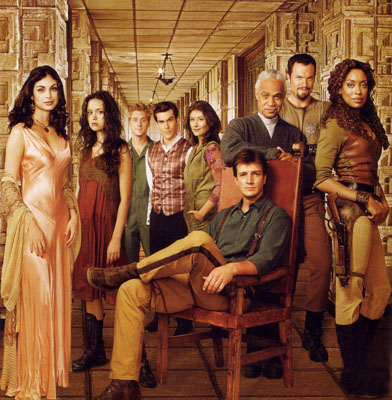
One of the themes in Joss Whedon’s work is the mismatched, bickering team that, through hardship, becomes a family, and the Avengers are a perfect example of this. Their bipolar bickering and eventual unity really reminded me of the crew from Firefly. And it is greatly to Whedon’s credit that in a 2-1/2 hour movie (as opposed to an entire season of a TV show), each major character is a three-dimensional person I cared about. The regular-person-ization starts right away with Pepper Potts (Gwyneth Paltrow) chatting with Coulson (he’s not just a suit, he has a girlfriend…she plays the cello!) and doesn’t end until after the credits (stay until they kick you out). Let’s put it this way, the unexpected (at least by me) death in Avengers affected me as much as the one in Captain America did.

One big happy? family


Captain America (Chris Evans) is my favorite Avenger. So sue me. If you’d been asleep for 70 years and woke up to find the world was completely changed, your girl was gone, and your favorite music/movies/food/cars/clothing had all been replaced by other stuff, you’d probably be pretty quiet too. Seriously…what do you think Captain America thinks of the sagging pants look?

You call that music?


I’ve only got two complaints overall about the film: With all the great lines Tony Stark (Robert Downey Jr.) got, at times the film seemed like Iron Man 3. Not that RDJ doesn’t maximize them…I like him and the character…I guess I should have gotten a clue when I saw the poster. And second, the ending reminded me quite a bit of the ending of X Men: First Class. But these are minor complaints to me. Apparently there’s going to be 30 minutes of deleted scenes on the Blu-ray. That means there’s more awesomeness! I can’t wait to see.

So…what did you think of The Avengers? Leave me a comment.


Reckless Review: The Hunger Games

Because there’s been so many reviews of The Hunger Games, I know there isn’t much I can say that hasn’t been said already, but I do have a few thoughts. NB: I haven’t read the books. POSSIBLE SPOILERS.

I really enjoyed this movie. While some of the suspense is negated by knowing that there’s 2 more books after this and the heroine will survive no matter how harrowing the circumstances, I was literally on the edge of my seat almost the entire time. I have to agree with my friends Ruth at Flix Chatter and T at Focused Filmographer that it deserves 4.5 out of 5 stars.

Jennifer Lawrence as Katniss Everdeen
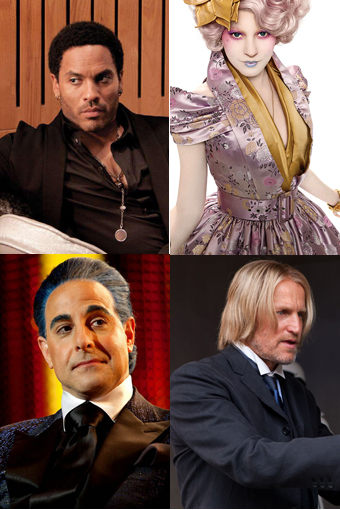
  • The actual Games themselves are horrifying and yet very familiar. The way they are presented in the film is pretty standard for reality TV. Just like American Idol, HG has a smarmy host, Caesar Flickerman (Stanley Tucci), a live audience, and ubiquitous promotion (does Panem TV show anything but HG?) The swooping shots of the riled-up crowd and the banter between the host and contestants are too much like AI and America’s Got Talent et al to be a coincidence. Once the Games begin, alliances are made and broken, like on Survivor. And like all reality shows, the Games’ storylines are set and the contest is manipulated for ratings — “They just want a good show” is the motto of Katniss’ mentor Haymitch Abernathy (Woody Harrelson). I believe we are closer than I realized to a society where a TV show like this is possible. I’ve often thought that it will be only a matter of time until somebody gets killed on a reality show, and from there, it seems like it’s not much of a leap for contestants killing each other to become a show’s main goal. I hope I’m wrong.
  • Another similarity is that of Panem and contemporary US society. Like those in the Capitol, some people in the US are doing extremely well, and proportionately more people are much worse off, like those in District 12. (Much like the denizens of the Firefly universe were caught in the 1800s, only with more technology, D12 seems to have rewound to the Great Depression and gotten stuck there.) In the US in 2012, the gap between rich and poor is widening and coal mining accidents, like the one that killed Katniss’ father, are still happening. So it seems to me that Panem’s situation isn’t really all that different from ours.
  • Squirrel tastes like chicken. In case you were wondering.
  • Sometimes supporting players really put a film over the top. There’s no way I’d have given this picture as high of a rating without the fabulous work done by Tucci, Harrelson, Elizabeth Banks and Lenny Kravitz.
  • Can anyone do an action or fight scene these days without dizzying close-ups and jittery handheld-style camerawork? That’s kind of a dumb question….the answer is obviously not! But I think it’s an appropriate choice for The Hunger Games, most of the time. It accurately conveys the disorientation of a teenager fighting for his or her life. The one exception where I thought it was completely bewildering was the fight scene atop the Cornucopia near the end. That was so fragmented that it was difficult to tell what was really going on for too long.
  • I see a similarity between Katniss Everdeen, Lisbeth Salander, and Peppy Miller, and I hope that it’s a trend brewing. Not just that I enjoyed all of these characters’ films, although that is true. All of them are independent and resourceful women, and all of them save others’ lives. What people see in films and TV and read in books has an effect on their real-life expectations, and so I believe a variety of female characters—not just the passive/reactive ones— is a good thing.


Leave me your thoughts about The Hunger Games below.

EDIT: I want to make it clear…I WATCH REALITY TV. Seriously, I do. If there’s any judgement, it’s on myself as well.

Reckless Review: Thirteen Women

Back in December, TCM had a day of Myrna Loy films and I recorded a bunch of them, including a goofy little pre-code picture called Thirteen Women (1932). I have to say, though Loy is excellent in it, this is an extremely odd picture. She plays a mysterious psychotic named Ursula who was bullied at a posh school by a bunch of mean girls and has set out to get revenge on them. This she does in a peculiar and ludicrous way. Capitalizing on the spiritualism craze of the time and the mighty power of suggestion, Ursula sends each woman a fake astrological chart, accompanied by a letter predicting death, dismemberment, or other calamity. She signs the letters with the name of the fake swami she works for. Each recipient then becomes so obsessed with her letter that the prediction comes true.

The look that kills: Myrna Loy as Ursula in Thirteen Women

I always knew Loy’s beauty was spellbinding, but in this, despite five pounds of spackle, she actually hypnotizes men. Fixed in her gaze, the “swami” passes out. Ditto the chauffeur she employs to do her evil bidding later on. She forces him to send Irene Dunne’s son poison candy, but Mom has the sense to get it tested at the police lab. The chemist says, “This candy is fine but it was tampered with. If anyone had eaten it, they’d have died.” Then it isn’t “fine”!The film is full of odd moments like that: The first classmates/victims are two sisters in a trapeze act..sort of a weird career choice for alumnae of the type of upper-crust school they were all supposed to have attended. And if you actually count, only 10 women are accounted for. I remember reading that 15 minutes were cut from the film somewhere along the way. Single moms who have the nerve to be happy, career women, and sex talk remain, so God only knows what was cut. Maybe it would make more sense with the missing piece. But I wouldn’t bet on it.

The film keeps asking us to identify with the sorority girls, portrayed by Irene Dunne, Kay Johnson, Florence Eldridge, and Peg Entwhistle, among others. But it also keeps showing us the remains of this group’s adolescent clique-y-ness and their complete gullibility, so that, though the maniacally evil Ursula has the most exaggerated eyeliner caught on celluloid until Divine made his debut, she is the most consistently watchable and interesting character. Mostly the film is a soap-y curio from a time when every house had a Ouija board. Don’t try to make too much sense of it, just suspend your disbelief and enjoy this showcase for Loy’s gorgeous looks and make-the-best-of-it dramatic talents.

January Movies (whew!)

I seem to be perpetually short on time so I thought I’d make a nice list instead of those long, drawn-out posts I like so much 😉

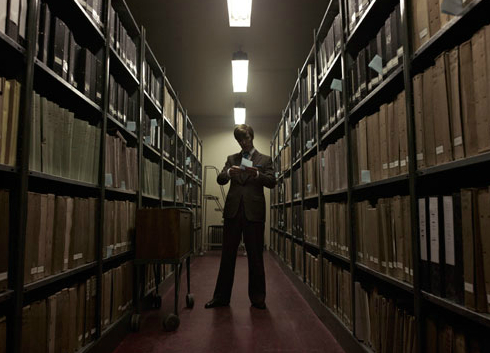
Dude, get out of there! Hurry!

I really liked Tinker Tailor Soldier Spy (4 out of 5 stars). I usually like espionage movies, and of course there is the cast (some of whom are wearing some pretty great suits). Even if just any two of these guys was in it, I’d have gone, plus I am no longer ignorant of Benedict Cumberbatch. (Don’t judge the gaps in my knowledge! OK, go ahead…but at least leave a comment.) There isn’t a lot of shoot-’em-up behavior, but it is suspenseful nonetheless, especially if you get nervous when spies are spying on each other. Shoot-’em-up is fine too, though. This Means War? I’m so there.

I really liked Shame, but in a different way (4.5 out of 5 stars). It’s nearly perfect in itself but I don’t think I could see it again. I found it as depressing as I thought it would be from reading the script, although a lot of stuff in the version I read didn’t make it into the finished film. There’s no question that Michael Fassbender and Carey Mulligan deserved Oscar nominations. Both actors suggested so much in a non-showy way, without much dialogue, and I believe those performances are actually what kept Academy voters away (in addition to the subject matter). I’d have given it 5 stars if there had been just a little bit more backstory about Brandon and Sissy. What is the significance of “New York, New York?” Why is Brandon obsessed with the Standard Hotel? You know that cool girl in your high school that wore vintage years before it was cool and always looked fabulous? That’s Sissy…but what happened to her after that? You won’t find out in this interview Fassbender did on Canadian TV show The Hour but I’m throwing it in here because it’s pretty interesting.

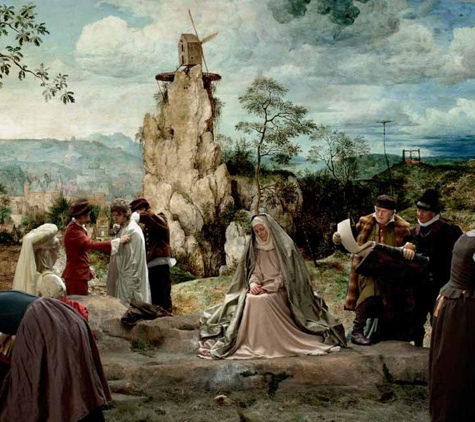
Charlotte Rampling as Mary (center)

I really liked The Mill and The Cross (4 out of 5 stars). I wish there was a movie like this for every painting. It’s difficult to describe it. Again…not a lot of dialogue. It basically shows Brueghel’s (Rutger Hauer) inspiration for each figure and situation in the work. It’s a meditation on the creative process, a record of the human condition in Flanders in the 16th century (hint: lousy), an invective on humanity’s inhumanity, and a powerful statement in favor of the separation of church and state. If you get a chance to see this on the big screen, definitely go. Much will be lost on even the biggest home TV.

I loved The Artist (5 out of 5 stars), it’s just brilliant. It’s also laden with homages and tributes to Old Hollywood and the early 20th-century silents — a feast for classic movie fans. Still working on a larger post on this theme.

This month I also decided there should be ejector seats in cinemas (5 out of 5 stars). People who are talking/yelling, chomping loudly on gum, crinkling candy wrappers, talking on a cell phone, texting, tweeting or IMing can be removed in a speedy and efficient manner. Alternatively, should ejector seats prove too costly, perhaps two auditoriums can show the movie at the same time — talkers in one, silent types in the other. I’m kidding…sort of 😉 The stillness of Tinker Tailor Soldier Spy and The Mill and The Cross was almost wrecked. That was my non-classic moviegoing month of January 2012, how was yours?


Review: A Dangerous Method

I was a bit reluctant to see A Dangerous Method. Carl Jung’s ideas about the collective unconscious, synchronicity, archetypes, and the anima/animus were revolutionary at the time and still make a lot of sense to me. If you’ve ever taken a Myers-Briggs Type Indicator, that’s based on Jung’s concept of extroverted vs. introverted personalities. But the trailer sort of made it seem like I was going to have to title this review “Carl Jung Did More Than Feud with Freud and Sleep with His Patients.” Though Jung did have differences (and a messy breakup) with his onetime mentor Sigmund Freud, and at least two extra-marital relationships, there is so much more to the life and work of one of the 20th century’s greatest minds. And thankfully, A Dangerous Method is a better film than its trailer.

It is true, Jung was unique in his time for his emphasis of feminine consciousness, and he had many female patients, students, and colleagues, many of whom worked closely with him when they became analysts and/or researchers in their own right, well before women were the norm in the field. Method is about the relationships between Jung (Michael Fassbender); a woman who was all of the above plus Jung’s mistress, Sabina Spielrein (Keira Knightley); and both of their relationships, a kind of intellectual triangle, with Sigmund Freud (Viggo Mortensen). Also in the mix are a couple of polar opposites —Emma, Jung’s rather uptight wife (Sara Gadon), who knows all, and Otto Gross, a libertine student of Freud’s (Vincent Cassel), who avoids repression of any urge.

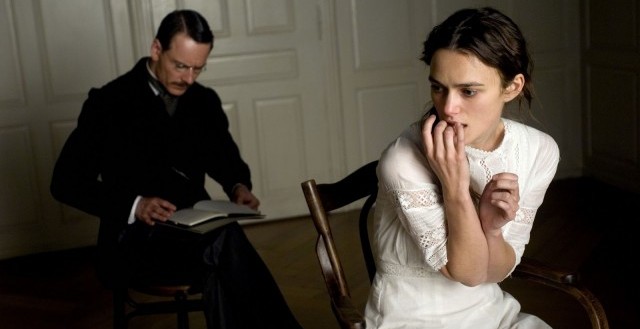
Michael Fassbender as Carl Jung, Keira Knightley as Sabina Spielrein.

Sabina Spielrein was the first patient Jung attempted to cure with Freud’s “talking cure,” the basis of modern psychoanalysis. The danger of this method is transference, in which the patient transfers their feelings, often romantic or erotic feelings, to the therapist. The film opens as she’s in the midst of a nervous breakdown, being admitted to the Burghölzli, a psychiatric hospital at the University of Zurich in Switzerland, where Jung is assistant director. She’s volatile and disturbed, but she’s smart and educated, not to mention beautiful, and she responds well. Because her stated ambition is to become a doctor, she is soon helping Jung with his research, while he’s still treating her. She is admitted to a university and they work together. Eventually, Jung and Speilrein become lovers.

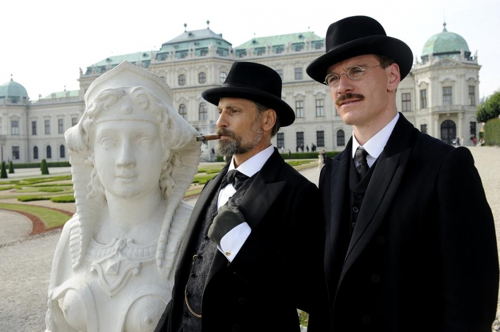
Freud and Jung before it all went downhill.

At the beginning of the film, Jung and Freud haven’t yet met. When they do, they have a 17-hour conversation and Jung is deemed heir apparent to Freud. “I’ve simply opened a door,” Freud tells Jung. “It’s for the young men like yourself to walk through it.” But as their collaboration continues, it seems like Freud would rather slam the door shut than let Jung take over. Freud thinks all neurosis has a sexual cause, and Jung believes that there are other factors, including spirituality and individual personality. Freud, almost 20 years older and set in his ways, is more and more reluctant to hear the younger man’s ideas. We see the authoritarian, almost tyrannical, side of him, and the cold and ruthless streak in Jung. Spielrein is caught in the middle — her love is with Jung but her mind takes her nearer to Freud.

The acting is uniformly great. Fassbender and Mortenson are excellent of course. Gadon is appropriately controlled. Cassel has an interesting cameo as Gross, who sets the stage for Jung and Spielrein’s relationship. Gross seems like a representation of Jung’s desires; we never see him talking to anyone else and he says so many things that Jung wants to hear.

But the real surprise to me was Keira Knightley. She shows you Sabina’s struggle, intelligence,  and persistence. Even when she’s in full breakdown mode, she manages to suggest that there’s something more there, whatever it was that allowed a mental patient to become an analyst herself. I even liked her accent. I figure that’s what a Russian immigrant in Switzerland would sound like. I thought she deserved a Best Supporting Actress nomination but with the field so crowded with excellent performances, I knew it was a long shot.

Jung’s ideas are fairly abstract but the movie does a good, if somewhat sensationalized, job of explaining both his and Freud’s ideas. Christopher Hampton wrote the screenplay, an adaptation of his own play The Talking Cure, sometimes using Jung’s and Freud’s exact words. The language is beautiful and delivered well, be it smooth, violent, or repressed. Ultimately the film is beautifully shot but never fully sheds its stage-play origins. That’s a small price to pay though, when you’re witnessing a revolution.

PS: If anybody wants to read up on Jung, I highly recommend Introducing Jung written by Maggie Hyde and illustrated by Michael McGuinness. It’s like a comic book and it really explains things in an effective and painless way.


Film Noir Friday – TOUCH of EVIL

I’ve had a horrendous case of writer’s block this week, trying to come up with something original to say about Orson Welles’ 1958 film noir masterpiece, Touch of Evil. As I noted last August, it’s practically impossible to say anything that hasn’t already been said about Welles and his work. After all, there are countless books and movie blogs rightly singing their praises, and Touch of Evil has long been regarded as a great of the film noir genre. But I’ve got to add my $.02 because Detroit Film Theatre is showing the film on Saturday, January 14 at 4:00 p.m. as part of their DFT 101 series. So I’ll just list why I’m so looking forward to this opportunity to see it as it was meant to be seen:

  • Touch of Evil is arguably the last in the film noir classic cycle. Welles’ own Citizen Kane is considered an important influence on what would eventually come to be known as film noir, and it’s clear that he had mastered the elements of film noir style, exemplified by his use of chiaroscuro lighting and subjective camerawork. Welles also wrote the film’s script, which contains most of film noir’s thematic elements. A hero (Charlton Heston as a Mexican narcotics officer named Mike Vargas) lost in a labyrinth of shadiness and duplicity, shadowed streets, corruption, and seedy characters. In Welles’ hands, it’s a feast for the eyes.
  • Welles also stars in this, his last American film, taking on the role of corrupt, alcohol-soaked cop Hank Quinlan. Quinlan’s jurisdiction is Los Robles, a seedy town on the Texas side of the U.S.-Mexico border where all sorts of crime occurs, but Quinlan seems to be the worst. We see him slowly losing even the pretension of moral authority, as he conspires against Vargas, endangers Vargas’ wife (Janet Leigh), plants evidence, drinks to excess, and generally acts as judge and jury, convicting anyone he doesn’t like, usually a Mexican.


  • It will be a joy to see the film’s opening sequence, a three-minute, 20-second long take, on the big screen. We are shown a bomb being armed and concealed in the trunk of a Cadillac, which we then follow over the border in an amazing continuous shot, that ends with the explosion of the bomb.
  • As Tana (Marlene Dietrich) might have said about the 1958 version of Touch of Evil, “Honey, you’re a mess.” Welles wasn’t allowed to control the film’s final cut. The studio’s version placed the credits over the long take, added a musical soundtrack to it, and added some scenes to the rest of the film —  apparently the film’s plot was deemed to intricate for the average moviegoer. Thankfully, DFT will be showing the 1998 restoration, which was based on a painstaking 58-page memo Welles sent to the head of Universal Studios (who ignored it), so that what we see on Saturday will be as near to what Orson Welles intended as possible. Don’t miss it!

The DFT is located on the John R side of the Detroit Institute of Arts, 5200 Woodward Avenue. To purchase tickets, call 313.833.4005 or visit the DFT Ticket Info page.