This chorus girl could grab your heart and tear it to pieces.
— Frank Capra
It’s difficult to consider Oscar snubs without thinking of Barbara Stanwyck. I remember reading a few years ago that she had never won an Academy Award. “That can’t be right,” I thought. One thing about this modern world, no one ever has to wonder about any factual information. In a couple minutes, I had confirmed without a doubt that, though Stanwyck received an honorary Oscar for “superlative creativity and unique contribution to the art of screen acting” in 1982, she had been nominated four times for the Best Actress Oscar, and indeed had never claimed the prize.
The four nominations were for her work as: the title character in Stella Dallas (1937), Sugarpuss O’Shea in Ball of Fire (1941), Phyllis Dietrichson in Double Indemnity (1944), and Leona Stevenson in Sorry, Wrong Number (1948). Of these, the Stella Dallas loss is the one that Stanwyck herself apparently regretted.
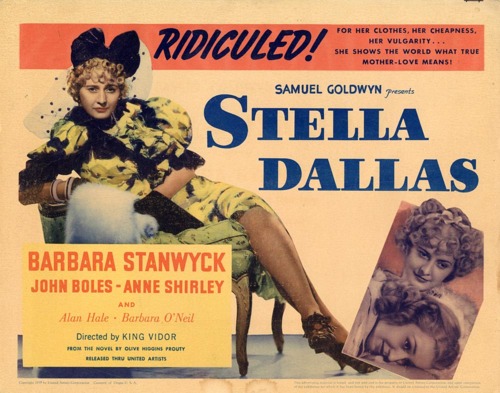 This film had the kind of source material that still draws nominations today. It was based on an acclaimed novel about a woman who marries up and can’t fit in. Eventually she gives up her daughter, whom she loves more than anyone or anything else in the world, so the latter can have a better life. The role required the actress to age 20 years. It was a plum, and Stanwyck wanted it. However, producer Samuel Goldwyn wanted a screen test. Stanwyck felt she’d proven her abilities over seven years working in Hollywood, and refused to make it.
She was not a sure thing to play Stella. The director, King Vidor, wanted her to, but Goldwyn was remaking his own 1925 version of the film, and he maintained that Stanwyck didn’t have enough sex appeal. He favored, among others, Ruth Chatterton, who turned it down.
One of many things I’ve learned from reading Victoria Wilson’s comprehensive Stanwyck bio, Steel-True, is that Joel McCrea, a frequent co-worker and friend of Stanwyck’s, was enlisted by her agent and friend, Zeppo Marx, to persuade her to make the necessary test. McCrea got nowhere. He then approached Goldwyn and pointed out that if Stanwyck was dating the handsome and very popular Robert Taylor, then she must have something going on.
I always knew Taylor was idolized in his day. Another thing I’ve learned from Steel-True is how really extremely popular he was. More than 25 years before the Beatles, Taylor was routinely getting mobbed and having his clothes torn off. He often needed a police escort to go out in public.
Goldwyn wouldn’t hear any of it. Stanwyck would have to agree to a test, which she eventually did. Per Steel-True, her test was cut into a reel with 47 others, but there was no doubt about it. Even Goldwyn had to agree, Stanwyck was Stella.
 Stanwyck is stunningly great in the film. She simply became Stella Dallas, cheap and vulgar yet lovable and generous, so that the melodramatic aspects of the character evaporate and leave a real person. She makes it believable that someone who desperately wants to move up in class somehow doesn’t know she is too much. If you don’t feel for her in the scene in the train car where Stella overhears her daughter Laurel’s “friends” ripping on her walk and clothing choices and then pretends, for Laurel’s sake, not to have heard them….check your chest, you might not have a heart in there.
The film was both a popular and a critical success. It and Stanwyck both got great reviews. Per TCM, “the movie was so popular it became a radio serial in October 1937, dramatizing the later lives of characters in the movie. The serial lasted for eight years.” [Emphasis mine.]
So what happened? First, her competition for the Academy Award for Best Actress in 1938 was formidable: Irene Dunne for The Awful Truth; Greta Garbo for Camille (co-starring Stanwyck’s beau, Robert Taylor); Janet Gaynor for A Star Is Born; and the previous year’s winner for The Great Ziegfeld, Luise Rainer for The Good Earth.
Also, Stanwyck rebelled against the system, refusing to be tied to any one studio. At the time she was cast as Stella Dallas, she had contracts with two studios, RKO and Fox, and was working on a picture at a third, Paramount. She had been suspended many times when she refused to work on a picture that was wrong for her, and had been involved in breach of contract litigation. Studios were notorious for sometimes throwing together a big star and a weak script, relying on the talent’s drawing power to make money, and Stanwyck avoided those productions for the most part. However, as Wilson writes, “Barbara’s independence from the studios came at a price.” She often took roles that were originally meant for someone else. In terms of Oscar voting, she missed out on the consistent support and yards of good press that “team players” got.
I also think the realism of Stanwyck’s performance may have been another contributing factor. She is always so natural, and almost never seems to be acting.
A Stanwyck win was widely predicted, but whatever the reasons, Rainer prevailed on Oscar night, for the second year in a row.
PS: The Variety review of Stella Dallas contended that it was incredible that Stella would wear such crazy outfits when Laurel’s apparel, designed and made by Stella herself, was so elegant. I disagree. I think Stella would have wanted her daughter to fit in as much as possible so she would have copied her friends’ clothes. Stella knows she doesn’t fit in by that point, so she would not have done the same for herself.
 This post is part of the second annual 31 Days of Oscar blogathon hosted by Paula’s Cinema Club, Outspoken and Freckled, and Once Upon a Screen. For more posts featuring Oscar snubs, visit the megapost at Outspoken and Freckled, and stay tuned for more Oscar-related posts throughout the month. Our blogathon gets its inspiration from Turner Classic Movies’ 31 Days of Oscar, “where every movie shown is an Oscar winner or nominee.”



 Paula's Cinema Club