Who's the Boss? Ida Lupino

In my research for tonight’s TCM Party, Woman in Hiding (1950), I found an abundance of interesting information about the film’s star, Ida Lupino, that is way too long for a tweet and much better suited to a blog post. This is very far from comprehensive but I hope it will pique interest in this fascinating woman who was a pioneer in so many ways. I was aware that she was one of the few female directors and was the only one working in Hollywood in the late ’40s through the mid ’50s, but I didn’t know that she also wrote film and television scripts and directed television shows throughout the ’50s and ’60s, including episodes of The Fugitive, Bewitched, and Gilligan’s Island.
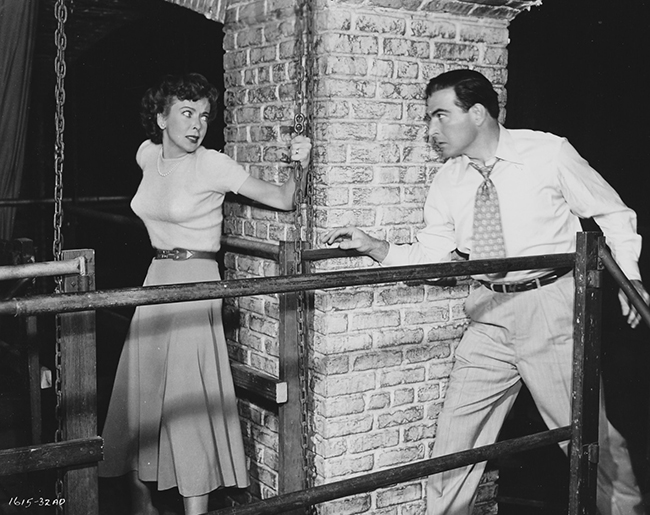
Ida Lupino is the woman hiding from Stephen MacNally

Lupino was born in Camberwell, London, England in 1918 (though the year is variously given as 1916 or 1914). Her mother was an actress; her father was a comedian from a famous theatrical family. Her uncle, Lupino Lane, was an acrobat. She wrote a play for school at the age of seven and trained for a year at the Royal Academy of Dramatic Art. She was in five films in England before moving to Hollywood in 1933, when she was hired to make two films at Columbia.

She often played tough but sympathetic women who had their share of hard luck. Her role in one of my favorite films noir Road House (1948) with Richard Widmark and Cornel Wilde seems to be a fairly typical one for her; she plays Lily, a worldly-wise singer caught between her boss Jefty and his childhood friend Pete. When Lily falls for Pete and turns down Jefty’s marriage proposal, Jefty frames Pete for embezzlement, he’s convicted, and they are trapped. It’s a really concise, enjoyable noir, with Widmark at his crazy-bad best. Lupino did her own singing, which included Johnny Mercer’s “One for My Baby (and One More for the Road).” Two other favorites of mine are High Sierra (1941) with Humphrey Bogart and Devotion (1946), about the Brontë family, in which Lupino plays Emily.

She was cast against type in Escape Me Never (1947) as an impoverished single mom being taken care of by Errol Flynn’s character. The picture flopped but Lupino and Flynn became good friends and stayed close. Her nickname for him was “The Baron” and he called her “Mad Idsy.” [tcm.com]

Lupino often referred to herself as “the poor man’s Bette Davis.” While under contract with Warner Brothers, she would pass on Davis’ seconds, often getting herself suspended. Bored during this down time, she developed a curiosity about filmmaking and began to linger on sets, learning the craft of directing.  [imdb.com]

She became a director accidentally, taking over Not Wanted (1949) for Elmer Clifton, who had a heart attack three days into filming, though she did not give herself director credit. She was already producing and had co-written the script about an unmarried pregnant girl who gives her baby up for adoption. Her films, whether she worked as director, writer, producer or all of the above, often dealt with subjects that weren’t openly discussed in US society at the time, such as pregnancy outside marriage, rape (Outrage (1950)), and bigamy (The Bigamist (1953)).  It seems to me that Lupino was the unintentional model for today’s writer/director/producer/actors who at times take jobs in front of the camera to secure funding so they can be behind it for their next projects. Sean Penn and Sarah Polley are two I thought of. The production company Lupino formed with her husband Collier Young, The Filmakers [sic], made a total of 12 films.

As a director, Lupino is known for her ability to create suspense, a talent that served her well as she moved into television work in the mid-’50s and ’60s. Her fifth film, The Hitch-hiker (1953), is about a couple of guys on their way to a fishing trip in Mexico who, as you might guess, pick up a murderous hitchhiker. Lupino builds tension by confining some of the action to the interior of the car going through the isolated Mexican desert. Even when they’re not in the car, the buddies are cornered by the psychopath and his gun. Hitch-hiker is available to watch for free on YouTube or at Internet Archive.

Just as Nora Ephron blazed a trail for Diablo Cody, so did Ida Lupino for the women who came after her.

More on Ida Lupino:

Profile on tcm.com

The Museum of Broadcast Communications Bio

Women Directors…Special Tribute to Ida Lupino at Once Upon a Screen
Future Classic Movies: CITY OF LIFE AND DEATH

By Mark

One of the major problems with war movies is they can tend to be a little revisionist – or blatently laced with nationalistic propaganda – to the point that they shouldn’t be taken too seriously by any discerning future filmgoer. Strangely enough, an exception to this rule is an epic Chinese film made in 2009 about a seminal event which took place in the lead up to the Second World War. A masterpiece in every sense of the term, Lu Chuan’s poignant City of Life and Death is a worthy entry in Paula’s Cinema Club’s Future Classic Movies blogathon.

When it comes to military atrocities of the 20th century, not too many can top the brutality of Japan’s invasion of the Chinese city of Nanking during the late 1930s. In the six weeks following Nanking’s capture in mid December 1937, the Imperial Japanese Army systematically killed somewhere between 250,000 and 300,000 people – including an estimated 57,000 prisoners of war on the banks of the Yangtze River in what has since been coined the Shaw String Massacre.

While this infamous mass murder of unarmed POWs does not occur until a third of the way through City of Life and Death, it more or less serves as a starting point for the remainder of the film’s grim narrative, which concerns itself not only with the plight of Nanking’s remaining citizens as they are forced to endure the barbarous and cruel occupation, but also the reaction of the invaders to their own behaviour while they execute their savage agenda.

As it works its way towards the Yangtze River slaughter, the movie follows the fortunes of two brave soldiers – Chinese lieutenant Lu Jianxiong (Liu Ye) and Japanese super private Kadokawa Masao (Nakaizumi Hideo), both of whom are key figures in a final, but somewhat futile, skirmish before the city’s inevitable capitulation.

The story then focuses on the dismantling of the Nanking Safety Zone – a 3.85 square kilometre refuge that had been set up by a group of foreign interests led by German (and Nazi) businessman John Rabe (John Paisley) just before the invaders arrived – after its inhabitants are betrayed by Rabe’s Chinese business assistant Tang “Mr Tang” Tianxiang (Fan Wei) as he attempts to negotiate his family’s passage to safety. (Interestingly the real life Rabe has been credited with saving 100,000 Chinese lives, putting him in the same league as fellow countryman Oskar Schindler, although the film does not really dwell on this point.)


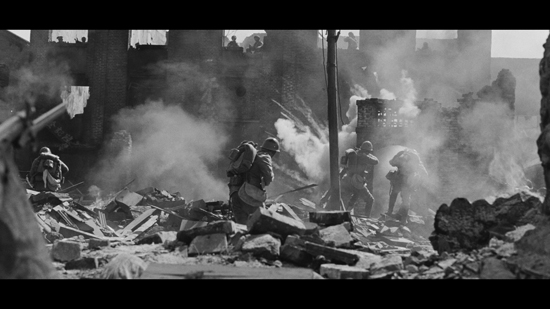
By dividing the film into these two parts, writer/director Chuan convincingly paints a comprehensive picture of war at its very worst – firstly via one of the grittiest combat scenes seen in the cinema since the fight for Ramelle in Steven Spielberg’s Saving Private Ryan, and then through the painful depiction of the Japanese occupation in which women are procured as sex slaves and repeatedly raped, prisoners are hung and/or beheaded (or, in one painful sequence, buried alive), a small child is ruthlessly thrown from an attic window, and injured soldiers are summarily executed in cold blood by makeshift firing squads.

Had City been in the hands of a lesser filmmaker, it’s possible that it might not have fully recovered after Jianxiong’s execution, such is the strength of Liu’s opening performance as the battle hardened Chinese soldier who, along with a few others, initially tries to stop most of his comrades from fleeing the city before making a desperate final stand against the Japanese invaders.

There are, however, too many other good things working for the film which keeps it in masterpiece territory for its two hour-plus running time. These include its stunning black-and-white cinematography (by Cao Yu and He Lei), its set design of mass destruction, as well as the strong performances of the supporting cast – perhaps the most noteworthy being Fan (as the hapless collaborator who ultimately redeems himself), Qin Lan (his wife “Mrs Tang”), Gao Yuanyuan (as Jian Shuyun, one of the zone’s Chinese administrators who defiantly stands up to the occupiers) and Japanese actor Kohata Ryu (playing the brutally pragmatic Second Lieutenant Osamu).

If anything, sitting through City of Life and Death is sort of akin to watching an extended version of the sacking of Vladimir by the Tartars in Andrei Tarkovsky’s 1966 classic Andrei Rublev. At the end of the day it’s not so much the human spirit that triumphs, but rather the horror.

Future Classic Movies: Round 2

To recap really quickly, the Future Classic Movies (FCM) Blogathon involves predicting films that will still be drawing audiences on TV, or a chip in our brains, or whatever form of communication exists, 30 or 40 years from now. All of the films were made during or after 2000; these will be as old then as the ones we watch on TCM now.

My FCM Round 2 pick is Moneyball (2011). It begins with a playoff disaster. In the 2001 post-season, the Oakland A’s squander their two-game lead over the New York Yankees, who win three games in a row. Their general manager, Billy Beane (Brad Pitt), sits in the home stadium, flicking a transistor radio on and off, almost afraid to hear what’s going on. A couple weeks later, losing his best players on the free agent market, Beane is begging the A’s owner for more money. No way, he’s told. Make do with the lowest payroll in the league. His scouts are all older guys whose info on the players is half speculation and half gossip. When Beane takes a meeting with Mark Shapiro of the Cleveland Indians, he notices that all the older guys always look to Peter Brand (Jonah Hill), a “player analyst” in the front office.

After the meeting, Beane grills Brand (in a parking garage à la “Deep Throat” in All The President’s Men). The latter admits that he has a radical, economics-and-statistics-based system for baseball: buying wins. That is, buying runs. Brand says, “Baseball thinking is medieval. They are asking all the wrong questions.” Beane is impressed. He hires Brand away from Cleveland and together they start to remake the A’s for the 2002 season. But there’s plenty of resistance, naysaying, and defiance from the scouts and the manager, Art Howe (Philip Seymour Hoffman), who is on a 1-year contract and knows a poor season could end his career. He’s downright insulting about this new way of putting a team together. The big scary doubts of the fans on talk radio are interleaved with flashbacks from Beane’s crash-and-burn career and scenes from his current complicated personal life (ex-wife with smug husband, sweet daughter he doesn’t see enough).

Pitt and Hill were both nominated for Oscars and I was surprised by this when I finally saw the movie. The acting in this film is pretty much the definition of natural, which the Academy doesn’t always reward. I definitely agree with whoever said that unless Brad Pitt is in a movie right at the moment, everyone forgets that he is in fact a great actor. He is excellent here. Hill adds little touches — fidgeting, nervous looks — that make his Brand real (though the character is a composite). One of my favorite moments is when Brand is on his way out of Howe’s office and says, “You want this door closed?” Chris Pratt as catcher (turned first baseman) Scott Hatteberg gives an authentic performance as a guy scared out of his mind.

The film’s cinematography is beautifully done by Wally Pfister, probably better known for his work with Christopher Nolan.

I’m not the biggest baseball fan in the world (though I do like going to Comerica Park) but if you like baseball, there’s enough behind-the-scenes intrigue about how deals are done to keep you interested. (“He’s talking to Dave Dombrowski! Wow, Steve Schott!”) Moneyball is really three movies, and Bennett Miller’s command of music, sound and closeups prove that there is crying in baseball, at least for me: the rise and fall and rise of a washed-up baseball player (Beane); a behind-the-scenes history of a baseball revolution; and the eternal struggle of originality and creativity against “we’ve always done it this way.”

Because if The Artist is about dealing with change, so is Moneyball. Or more accurately, it’s about the perseverance, determination and courage to not just adapt, but to change the rules, the situation, the world. That is of course what Beane did — he may have doubts about the new system, but he never really wavers. The film is a dramatization but his concepts were adopted by the Boston Red Sox and, two years later, they broke their 86-year World Series drought. And some underfunded political campaigns have been taking a look at Bill James’ “sabermetrics”, which paved the way for Beane’s system, and applying the former to their election races. And that is some consolation to anyone trying to find their way in a constantly changing world. And that is why, in 30 years, people will still be watching Moneyball, along with these other FCMs:
Big Fish, Happy Accidents, The Namesake, The Science of Sleep, and Walk the LineThe Motion Pictures

The 40-Year-Old VirginImpassioned Cinema

Requiem for a DreamThe Warning Sign

Eternal Sunshine of the Spotless MindPG Cooper’s Movie Reviews

Almost FamousJourneys in Classic Film

City of Life and Death – Mark

Pride and Prejudice and Tinker Tailor Soldier SpyReveal Something More

NorthforkLeft to my own devices

TCM Week – June 4-10

Not that anyone noticed that I stopped doing my weekly TCM picks, but there’s a very simple reason. My subscription to Now Playing, the TCM monthly magazine, ran out and I forgot to renew. Evidently I’m quite reliant on it because I missed two months of it and it’s too difficult to do picks without it. Everything is back to normal this month. Just so you know 🙂

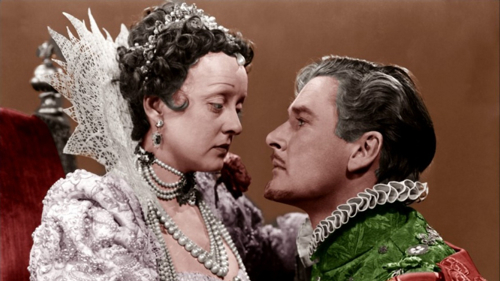
Apparently Bette Davis (as Queen Elizabeth I) slapped Errol Flynn (as the Earl of Essex) so hard during the filming of Elizabeth and Essex that he saw stars.

Monday, June 4
8:00 p.m. The Private Lives of Elizabeth and Essex (1939)
***TCM PARTY***
Possibly in honor of Elizabeth II’s real-life Diamond Jubilee, TCM has two Elizabeth I-related films tonight, the #TCMParty Private Lives at 8:00 and The Virgin Queen (1955) following at 10:00, both with Bette Davis as Britain’s best-loved monarch. (I just conducted a scientific poll via Google search and she is the one royal about whom people have the least bad things to say.) Watching her run a country while trying to keep the Earl of Essex (Errol Flynn) and Walter Raleigh (Richard Todd) in line is quite a treat. Apparently Davis and Flynn were no more well-matched than their characters and feuded during filming to the point of physically injuring each other. Despite this, or because of it, this is a great period drama, with beautiful costumes, sets and lighting. Watch for Herbert Marshall and Joan Collins in Virgin Queen. Watch and tweet along with #TCMParty.

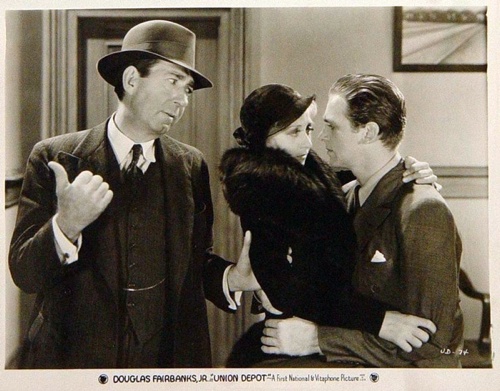
There’s a couple other people in the picture but whatever.

Tuesday, June 5
12:45 a.m. (Weds) Union Depot (1932)
A rather racy-sounding pre-code picture chosen for the presence of Joan Blondell and the fact that it takes place in real time, 20+ years before High Noon.

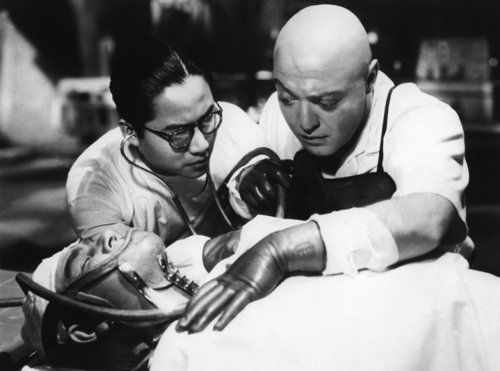
Looks like Orson Welles borrowed heavily from Peter Lorre’s look in Mad Love for the older Charles Foster Kane.

Wednesday, June 6
TCM has scheduled a bunch of 1930s horror films for daytime, several of which —Island of Lost Souls, Mark of the Vampire, The Hunchback of Notre Dame (1939) — have the gorgeous Expressionistic cinematography I love so. I’ve chosen two I’ve not yet seen. Doctor X (1932) at 7:45 a.m. was directed by the versatile Michael Curtiz (Casablanca) and is sung about in “Science Fiction/Double Feature,” the first number in The Rocky Horror Picture Show. Mad Love (1935) at 3:30 p.m. shares a cinematographer, Gregg Toland, and some details with Citizen Kane. This film is one of several based on the novel Les Mains d’Orlac and it will be interesting to compare to The Hands of Orlac (1924), which starred Conrad Veidt as the recipient of the titular evil hands.

Thursday, June 7
8:00 p.m. Jailhouse Rock (1957)
***TCM PARTY***
This is one of the best Elvis Presley movies, along with Loving You and Viva Las Vegas. Unfortunately, it’s also his only his third movie, and he made quite a few more. However, nobody delivers a classic line such as “That ain’t cheap tactics, honey. That’s just the beast in me” better than Elvis. With special #TCMParty guest host @CitizenScreen.Watch and tweet along

Friday, June 8
TCM has scheduled an unofficial block to honor Alexis Smith on her birthday. Born in 1921, this Canadian actress, though not as well-known today as some of her contemporaries, had a career in movies, stage and TV for more than 50 years.
7:45 a.m. Dive Bomber (1941)
Smith had uncredited roles in 12 films before landing this, her first credited role, opposite Errol Flynn and Fred MacMurray as the girl who comes between them in a WWII drama made just before the U.S. entered the war. (Her last film role was in Age of Innocence (1993)).

9:30 a.m. The Constant Nymph (1943)
I won’t even front like I like this movie. I find it very odd and at times ridiculous. Joan Fontaine is supposed to be a teenager who separates her composer cousin (Charles Boyer) from his wife (Smith). (Seriously, am I the only one who thinks this is weird?) By the end of the film, I felt they deserved each other. But I’m going to watch it again just for Smith, as I’ve read this was her breakthrough role which led to her parts in Night and Day (1946) and The Two Mrs. Carrolls (1947).

There’s a great summary of today’s TCM Gothic offerings here, courtesy of Classic Movies Examiner Jennifer Garlen.

Saturday, June 9
5:30 p.m. The Train (1965)
***TCM PARTY***
In the waning days of World War II, a French railway inspector who is also a member of the Resistance (Burt Lancaster…just go with it) is ordered by the Nazi-in-charge (Paul Scofield) to get a train through to Germany no matter what. Which wouldn’t be a big deal, except that nearly every important piece of art left in France is on that train. Directed by John Frankenheimer, this excellent film is an unpredictable chess match that’s as near to an anti-war statement as you’ll get in a WWII picture. Look for us on Twitter with #TCMParty.

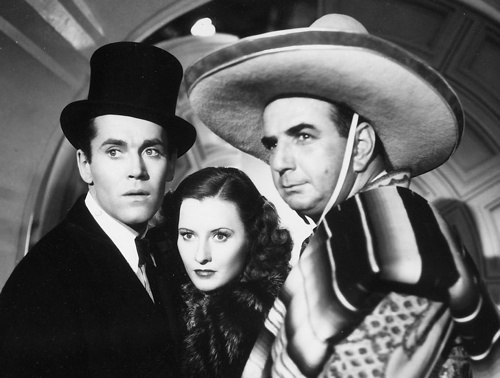
Henry Fonda, Barbara Stanwyck, and someone in a sombrero

midnight The Mad Miss Manton (1938)
The Lady Eve co-stars Barbara Stanwyck and Henry Fonda made this lesser-known comedy three years before Eve. Let’s see…great chemistry in a comedy/mystery with Hattie McDaniel…i’m so there.

Sunday, June 10
JUDY GARLAND’S 90th BIRTHDAY
You can’t really go wrong with anything today.