This Week on TCM — Oct. 31-Nov. 6

This Week on TCM spotlights a highly subjective selection of the week’s essential or undiscovered films on the Turner Classic Movies channel to help plan viewing or DVR scheduling. All times are EST.

Monday, October 31 — Halloween Classic Horror
TCM is featuring horror films all day, here are just a few…

10:15 a.m. Dracula, Prince of Darkness
In Hammer’s sequel to Dracula (aka Horror of Dracula), a series of incidents leads four travelers to the Count’s castle, where they unwittingly resurrect him. Followed by another Dracula picture at noon, both feature Christopher Lee as Dracula.

3:15 p.m. Frankenstein Created Woman
One of Hammer’s takes on the Frankenstein story. Peter Cushing as Frankenstein transplants a convicted murderer’s soul into the body of a disfigured woman. He cures the woman’s deformity and she begins to act on the soul’s agenda. One of the films Martin Scorsese picked for a National Film Theatre season of his favorites.

8:00 p.m. Village of the Damned (1960)
***TCMParty***
Everyone in a British village blacks out momentarily but all seems normal when they wake up. A couple of months later it becomes apparent that all the women of childbearing age are pregnant. When the children are born, they are all towheaded, grow like weeds, and have a telepathic bond with each other. It becomes apparent they also have no emotions or scruples. A truly disturbing movie. Watch and tweet with hashtag #TCMParty.

12:15 a.m. (Tues.) The Innocents (1961)
A Victorian-era governess (Deborah Kerr) thinks her charges may be possessed by demons or ghosts. Commenter Roger Ryan wrote last week on my Top 5 Classic Horror post that this film has been “slavishly imitated recently by films like The Others….it never fails to unsettle me. Kubrick borrowed some ideas from this Jack Clayton film when he made The Shining.”

Tuesday, November 1
There’s a whole bunch of films noir scheduled for today. Of course I highly recommend Out of the Past (9:00 a.m.) and The Big Sleep (6:00 p.m.). And Fritz Lang’s Scarlet Street (2:15 p.m.) is an interesting example of the genre. But I’ve never seen “tautly directed B-movie gem” Tension (4:00 p.m.), in which “(a) man who had planned to murder his wife’s lover becomes the prime suspect when somebody beats him to it.”

Wednesday, November 2
8:30 a.m. The Flame and the Arrow
Jacques Tourneur (Out of the Past, Cat People) directed this account of Roman rebels, led by Burt Lancaster, fighting barbarian invaders.

5:30 p.m. Seven Days in May
This political thriller from Manchurian Candidate director John Frankenheimer stars Lancaster as a military officer who discovers his superiors are planning a coup d’etat against the President of the United States.

Thursday, November 3
10:45 a.m. Storm Center (1956)
I’m looking forward to seeing Miss Bette Davis as a librarian fighting censorship and McCarthyism in a small Kansas town in this still-relevant film, made when memories of the House on Un-American Activities Committee were still fresh. Rarely shown.

Friday, November 4
6:00 p.m. A Big Hand for the Little Lady
A pioneer woman (Joanne Woodward) learns how to play poker in a hurry when her husband (Henry Fonda) has a heart attack and can’t stay in a high-stakes game in which he’s managed to lose all their money.

8:00 p.m. The Invisible Man (1933)
***TCMParty***
Claude Rains portrays a scientist whose experiments with invisibility are successful. But the stuff he takes to become invisible drives him to insanity and murder. Directed by James Whale, who also helmed the 1931 versions of Waterloo Bridge and Frankenstein. Watch and tweet with hashtag #TCMParty.

9:30 p.m. Gold Diggers of 1935
Part of TCM’s block of films starring Gloria Stuart, this one is considered by many to be the finest of Busby Berkeley’s film and was reportedly Berkeley’s own favorite. His staging of “Lullaby of Broadway” is a stunning example of his choreographical storytelling technique.

Saturday, November 5
1:45 p.m. The Hound of the Baskervilles (1959)
Another Hammer Films classic, with Peter Cushing (as Sherlock Holmes) and Christopher Lee (as Sir Henry Baskerville).

Sunday, November 6
8:00 a.m. The Divorce of Lady X
Merle Oberon, usually known for her dramatic roles in movies like The Scarlet Pimpernel and Wuthering Heights, shows her comedic abilities as a woman who dupes a lawyer (Laurence Olivier) into thinking she’s the soon-to-be ex of his client.

2:00 a.m. (Mon.) The Two of Us
During World War II, an older Catholic French couple agree to take in a mischievous Jewish boy. The anti-Semitic husband develops a strong and complicated affection for the child. Based on director Claude Berri’s own childhood.

What will you be watching this week on TCM and why? Did I miss any of your favorite movies? Let me know in the comments.
Metro Detroit Classic Movie Fan — Maurice Greenia, Jr.

Maurice Greenia, Jr., is a Detroit poet, painter and puppeteer. He is also in several musical groups: SpacebandThe Don’t Look Now Jug Band, and its smaller side project, The Fireflies. He works at the McNichols Campus library at the University of Detroit Mercy. His work is online herehere and here. He also writes a cinema blog.

You’ve been watching movies at the Detroit Film Theatre (DFT) since the first season. Do you remember the first movie you saw there? What are some of the more memorable movies you’ve seen there over the years? 
I have copies of all of the Detroit Film Theatre schedules. I loved the afternoon film programs that they ran (even before the DFT started). I think maybe the first thing I saw there was a double feature of the Marx Brothers in Duck Soup and Laurel and Hardy in Sons of the Desert. Also, early on, there was a showing of Orson Welles’ Touch of Evil on a foggy night.

Back when Luis Buñuel was still alive, I was at a showing of his film The Milky Way. The projectionist was attacked and the film was torn off the projector twice! That was a pretty memorable early experience.

I loved a lot of their series/theme programming as well. The Silent Clowns retrospective, sometime around 1979, was really great. I got to see a lot of Buster Keaton, Charlie Chaplin and Harold Lloyd films for the first time. It’s always sweet when they have live music for the silent films. I enjoyed retrospectives of directors such as Werner Herzog, Alfred Hitchcock, and Akira Kurosawa. And it wasn’t all just quality or art films — the 3D movie series was a lot of fun too.

How and how much, if at all, has film influenced your art?
I think that cinema has had a big impact on my “poetic sensibility.” It changes the way I view life and the world around me, and in turn, influences my writing, puppetry and visual art.

Also, I used to make short films myself, which heightened my sense of editing, of trying to get the “little bits” into the right sequences.

Why do we like classic movies? Some of these films are 50 or more years old, and our times seem completely different. What makes them relevant and watchable still?
Human nature hasn’t really changed as much as some may think. We still laugh, cry and puzzle over the same things we always have. The ways in which people faced life and reality in days past, can inform the ways in which we face it now. If something was well-made, magical, or thought-provoking 40 or 50 years ago, it may still be now. This is especially true for those of us who love the old movies and watch a lot of them.

What is the first classic movie that really affected you?
It’s probably the 1939 MGM version of The Wizard of Oz. You see a lot of films when you’re a kid, but that one stands out. The first few times I saw it, it was on an old black and white TV. so I was probably six or seven. It took a while before I saw it on color TV and on the big screen. We’d just watch it every year when it was on TV.

What are five of your favorite classic films?
It’s hard to pick just five, but here’s one take on that. Three out of five choices are silent films, and three out of five are on the downbeat side.

Citizen Kane (1941) is from Orson Welles, with great help from co-writer Herman Mankiewicz, musician Bernard Herrmann, cinematographer Gregg Toland, and a lot of good actors and actresses. It’s sort of a cliche to include it, but every time I see it, I’m still a bit amazed. You can see how Welles’ years in radio added to the richness of Kane’s sound design. I picked it for obvious reasons. It’s a wonder.

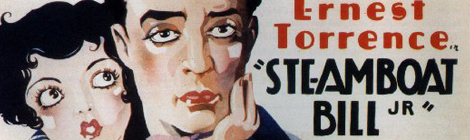
Steamboat Bill, Jr. (1928) is from Buster Keaton. Charles Reisner is credited is director but Keaton definitely at least co-directed. It’s funny as can be, with wild, daredevil elements. It’s a hilarious and magical film. I love film comedy, especially the silents, and I’m crazy about Buster Keaton.

G.W. Pabst’s film Pandora’s Box (1929) is showcase for the great American actress Louise Brooks. It’s beautiful and chilling, and Brooks gives a legendary performance. I love her and have enjoyed numerous other films by Pabst.

Alexander Mackendrick’s Sweet Smell of Success (1957) is a great film noir. Burt Lancaster and Tony Curtis are memorably nasty characters. The film also made good use of New York location photography. I love film noir in general and enjoy this film in particular, possibly because it dwells on the ugly, noir side of show business.

Erich Von Stroheim’s Greed (1924) is, even in its truncated, butchered form, still pretty amazing. This can stand-in for all superior “lost films.” It’s brutal and shocking, even today. Yet the direction and performances make it glow. It really shows how something damaged, bleak, and sordid can still be great.

Tell me some more about Greed. What was lost and what do you think the overall experience of the film would have been? How would a 9-hour movie be seen today? Do you think it could it be re-made as a mini-series?
I have the book that has stills from all the cut scenes, The Complete Greed by Herman Weinberg. You can piece together what it might have been. He also did a similar book of another cut up Von Stroheim film, The Complete Wedding March.

There’s a romantic scene wherein a couple sits together on top of a sewer. There’s a banquet which details disgusting food and eating habits. In the wedding scene, you can see a funeral going on outside the window, with a figure on crutches following the procession. The Death Valley scenes are legendary. I believe that at least one person died and others were taken ill. They had to keep wrapping the cameras in wet cloths to keep the film from burning up.

I don’t think that it would work today as a mini-series, not in the United States anyway.  The vision is too extreme and unrelenting. Maybe someone could do another version of the source material, the novel McTeague by Frank Norris. It wouldn’t be anything like Von Stroheim’s vision though.

If his original 8- or 9-hour movie existed, I’m sure it could play at places like the Detroit Film Theatre or New York’s Film Forum or the Museum of Modern Art. I’ve seen movies that long before. It just wouldn’t be for a “popular audience.”

Von Stroheim’s version of The Merry Widow once played at the Redford Theatre. His film Foolish Wives is coming to the Detroit Film Theatre on October 22 at 4pm.

I’d like to see the Rick Schmidlin reconstruction of Greed. In the end though, I think I’d prefer seeing the chopped up version and just look through the book afterward.

There are always some actors/actresses or directors who are worth watching no matter what. Who are 2 or 3 of your favorite classic actors/actresses, directors, writers?
I love the films of The Archers, a.k.a. the team of Michael Powell and Emeric Pressburger. I especially like The Red Shoes,The Tales of Hoffman and I Know Where I’m Going. Some of the films Powell did without Pressburger are also well worth seeing, especially The Thief of Baghdad (1940), which he co-directed, and Peeping Tom. Their work has always had an effect on me.

I like the musical genre, and there are a lot of great dancers on screen, from Gene Kelly to a whole group of African-American dancers, from Bill “Bojangles” Robinson” to the Nicholas Brothers. I have to mention Fred Astaire, who’s a personal favorite. Whether dancing solo, with Ginger Rogers, or with other partners, he’s always great to see.

i’m also a big fan of Alfred Hitchcock. I’ve seen most of his films and he did a lot of good work. From Notorious to The 39 Steps to North By Northwest to Vertigo and Rear Window, his work is often fascinating as well as a lot of fun.

I’m also a big fan of documentaries, foreign films (a.k.a. world cinema), and experimental or avant-garde works.

Classic fans, what is the first classic that you really remember had an affect on you? Have you ever seen any of Maurice’s favorites? What did you think? Let me know in the comments!